Bamboo Hoop Earrings Gold: Technical Guide & Sizing
Explore the technical details of bamboo hoop earrings gold styles. Learn about hollow vs. solid construction, gold alloys, gauge sizes, and hinge mechanics.

The Anatomy of Bamboo Hoops: Construction and Texture
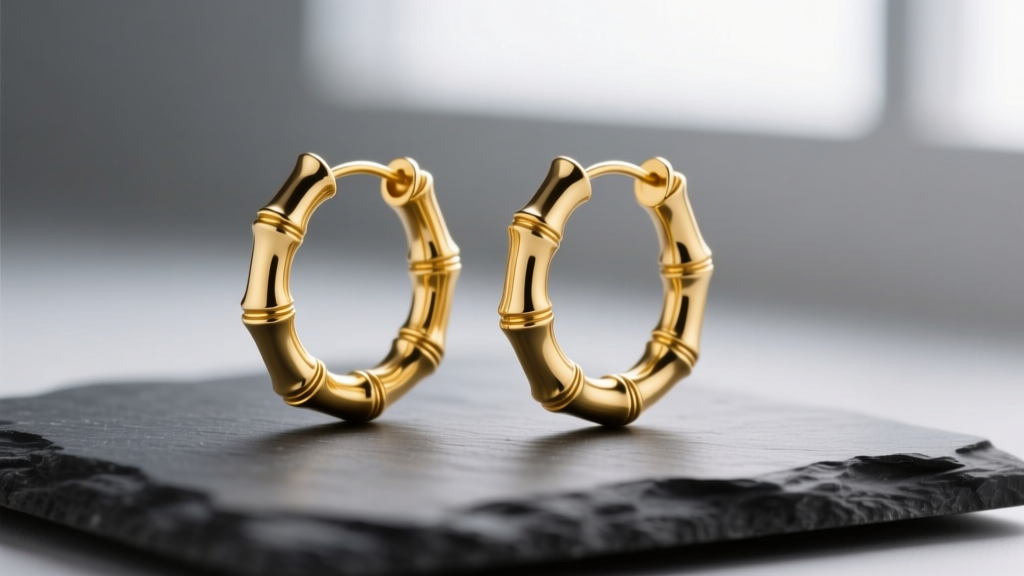
When navigating the market for premium bamboo hoop earrings gold variations, it is crucial to look past the aesthetic and examine the underlying structural engineering. Bamboo hoops—characterized by their ribbed, segmented texture that mimics the nodes of a bamboo stalk—are a staple in both vintage and contemporary jewelry. However, the technical execution of this texture dictates the earring's longevity, weight, and overall value. Unlike smooth tube hoops, bamboo hoops require precise metallurgical planning to ensure the raised ridges do not wear down or become structural weak points over time.
The fundamental decision in manufacturing these pieces is the choice between solid and hollow tube construction. For smaller huggie styles (under 15mm in diameter), solid gold tubing is common and provides a satisfying, premium heft. However, for standard 25mm to 40mm hoops, solid gold becomes prohibitively heavy and expensive. According to manufacturing data from Rio Grande jewelry supply, most high-quality large-diameter bamboo hoops utilize hollow-formed tubing. This process involves rolling a flat sheet of gold alloy into a tube and soldering the seam, or utilizing electroforming to build the metal around a wax mandrel. The bamboo texture is then applied to the exterior of this hollow tube.
Creating the Ribbing: CNC Milling vs. Mandrel Stamping
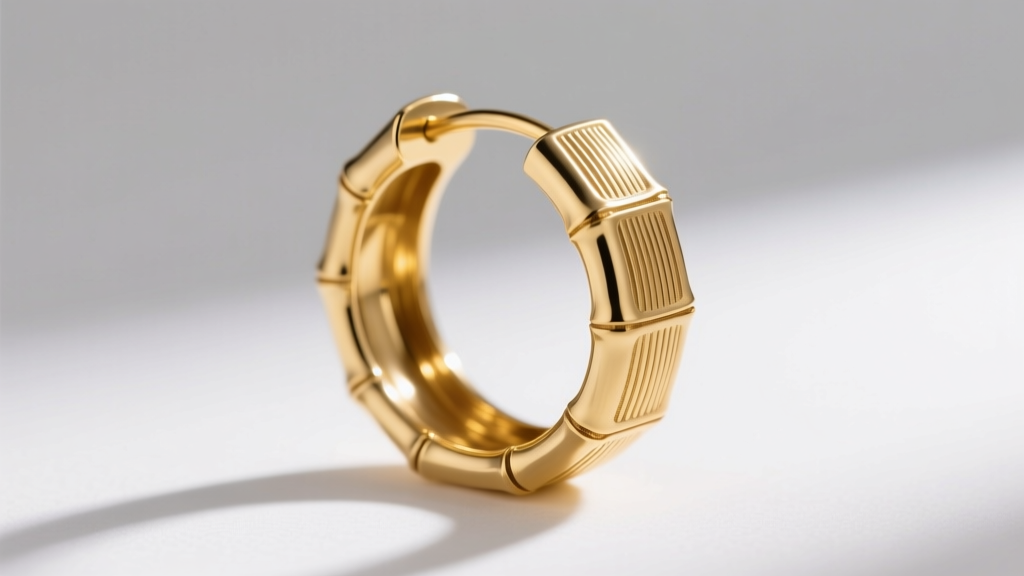
As of 2026, the sharpest and most durable bamboo textures are achieved through CNC (Computer Numerical Control) micro-milling. A CNC lathe cuts the 'nodes' and valleys into the gold tube with microscopic precision, ensuring uniform wall thickness at the deepest points of the grooves. Cheaper, mass-market alternatives use mandrel stamping, where a textured metal rod is forced into a soft gold tube to push the ridges outward. While stamping is faster, it thins the gold at the high points of the bamboo ridges, making them highly susceptible to cracking or wearing flat with daily friction.
Metallurgy: Gold Alloys and Texture Retention
Selecting the right bamboo hoop earrings gold pieces requires a deep understanding of gold alloys. Pure 24k gold is far too soft to hold any textured detail. Therefore, jewelers alloy gold with metals like copper, silver, and zinc to increase its tensile strength and hardness. The hardness of the alloy, measured on the Vickers Hardness (HV) scale, directly impacts how well the bamboo ridges will survive years of wear, handling, and accidental impacts.
While 18k gold (75% pure gold) is highly prized for its rich, warm color, it is inherently softer than 14k gold (58.3% pure gold). For a heavily textured design like the bamboo hoop, 14k yellow or 14k rose gold is often the technically superior choice. The higher copper and zinc content in 14k alloys increases the Vickers hardness, allowing the sharp edges of the bamboo nodes to resist polishing down over time. The Gemological Institute of America (GIA) notes that alloy composition not only dictates color but fundamentally alters the wear-resistance of the finished jewelry piece.
| Gold Alloy | Purity | Approx. Vickers Hardness (HV) | Texture Retention Rating |
|---|---|---|---|
| 14k Yellow Gold | 58.3% | 120 - 140 HV | Excellent (Ideal for daily wear) |
| 18k Yellow Gold | 75.0% | 100 - 120 HV | Good (Ridges may soften over time) |
| 14k Rose Gold | 58.3% | 130 - 150 HV | Superior (High copper adds rigidity) |
| 18k White Gold | 75.0% | 125 - 145 HV | Excellent (Nickel/Palladium alloys are hard) |
Sizing, Gauge, and the Hinge Weak Point
The most common point of catastrophic failure in bamboo hoops is not the textured tube itself, but the transition point where the ear wire meets the hoop. Because bamboo hoops utilize thicker tubing (typically ranging from 2.5mm to 5.0mm in diameter) to accommodate the deep ribbing, there is a severe dimensional mismatch when attaching a standard ear wire.
Post Gauge and Hinge Durability
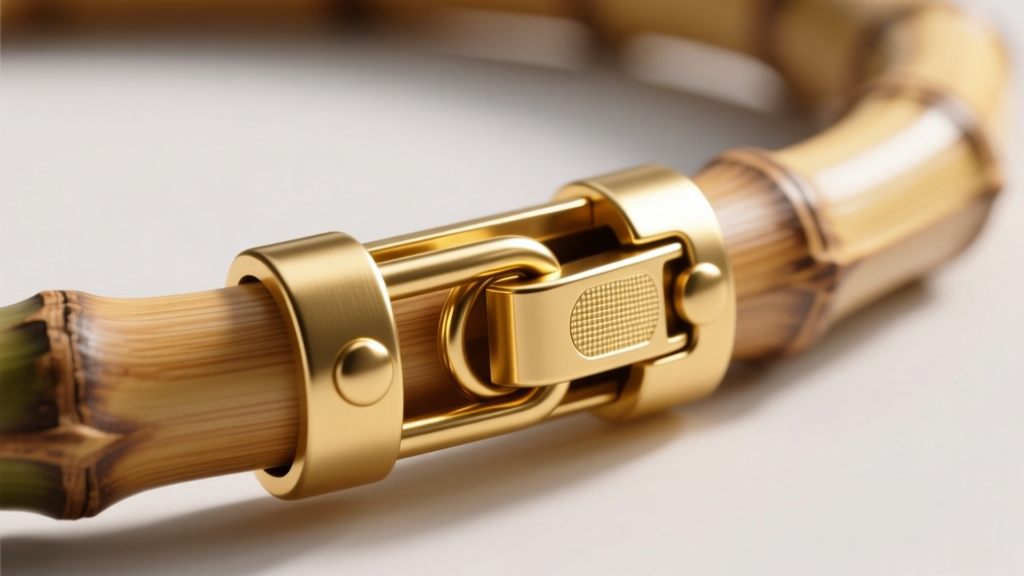
Many entry-level gold-plated or vermeil bamboo hoops attempt to bridge this gap by soldering a thin 22-gauge (0.64mm) wire directly onto a 4.0mm hollow tube. This creates a massive structural weak point; the thin wire will easily bend or snap under the leverage of the heavy tube. When evaluating high-end options, look for integrated hinge mechanisms or a minimum 18-gauge (1.02mm) to 16-gauge (1.29mm) wire post. For hinged clicker closures, the hinge pin itself must be machined from a durable alloy, often stainless steel or a high-strength white gold, to prevent the pin from shearing. Saddleback closures, which feature a wider, contoured wire that snaps into a grooved cradle, offer superior weight distribution for heavier bamboo styles.
Weight Distribution and Earlobe Biomechanics
When shopping for bamboo hoop earrings gold designs, buyers often overlook the center of gravity. A well-engineered hoop should hang perfectly perpendicular to the floor when worn. However, to save on metal costs, some manufacturers only apply the bamboo ribbing to the front-facing half of the hoop, leaving the back half as a smooth, thin, hollow tube. This 'illusion' construction shifts the center of mass forward, causing the earring to droop and pull uncomfortably on the earlobe piercing.
For optimal biomechanics and comfort, especially in hoops exceeding 30mm in diameter, insist on 360-degree continuous ribbing. While this increases the manufacturing cost and overall weight, it ensures the hoop rotates naturally with your movement without placing asymmetric stress on the fistula (the piercing channel). Furthermore, the internal diameter must be proportionate to the tube thickness; a 20mm hoop with a thick 5mm bamboo tube will leave very little clearance for the earlobe, leading to friction and irritation.
Maintenance: Clearing the Ridges
The intricate nodes and valleys of bamboo hoops are notorious traps for sebum, dead skin cells, cosmetics, and environmental dust. If left uncleaned, this buildup can dull the gold's luster and, in the case of lower-karat alloys, accelerate localized tarnishing in the deep grooves where moisture becomes trapped.
- Weekly Cleaning: Use a solution of warm water and a few drops of mild, phosphate-free dish soap. Soak the earrings for 10 minutes to loosen oils.
- Mechanical Agitation: Use a soft-bristled baby toothbrush to gently sweep along the grain of the bamboo ridges. Never use stiff-bristled brushes, as they can leave micro-scratches on the high points of the gold.
- Ultrasonic Caution: While solid 14k or 18k gold can safely withstand ultrasonic cleaning, gold vermeil or gold-plated bamboo hoops should never be placed in an ultrasonic machine. The high-frequency vibrations can cause micro-fractures in the plating, especially over the sharp edges of the bamboo nodes, leading to rapid flaking and peeling.
- Drying: Always dry the hoops thoroughly with a microfiber cloth or a blast of compressed air to ensure no moisture remains trapped in the deep crevices before storage.
Expert Verdict: What to Look for in 2026
Ultimately, the best bamboo hoop earrings gold designs balance striking visual texture with uncompromising structural integrity. As a buyer or collector, prioritize CNC-milled textures over stamped ones, opt for 14k alloys for superior ridge retention, and meticulously inspect the hinge and post gauge to ensure the hardware can support the weight of the textured tube. By understanding the metallurgy and manufacturing techniques behind these iconic pieces, you can invest in bamboo hoops that will retain their sharp, architectural beauty for decades. For further reading on precious metal standards and hallmarking, refer to the guidelines established by Jewelers of America.


