Beaded Dangle Earrings: A Technical Guide to Weight & Wire
Explore the engineering of beaded dangle earrings. Learn about wire gauges, bead hardness, weight limits, and clasp mechanics for durable jewelry.


The Physics and Engineering of Beaded Dangle Earrings
While often appreciated purely for their aesthetic sway and kinetic movement, beaded dangle earrings are, from a bench jeweler’s perspective, complex structural assemblies. They are subject to continuous tensile stress, gravitational torque, and friction. As we navigate the jewelry landscape in 2026, the demand for intricate, multi-bead dangle designs has surged, yet many commercial manufacturers fail to account for the material science required to make these pieces durable and comfortable for daily wear.
Designing or selecting high-quality beaded dangle earrings requires a deep understanding of wire metallurgy, gemstone hardness, and earlobe biomechanics. A beautifully strung earring will quickly become a broken or lost earring if the underlying engineering is flawed. This guide deconstructs the technical specifications that separate heirloom-quality dangles from fast-fashion disposables.
Wire Gauge and Metallurgy: The Structural Skeleton
The wire used in beaded dangle earrings serves two distinct purposes: structural framing (the ear wire and primary drop) and binding (wrapping and weaving). The American Wire Gauge (AWG) system dictates the thickness, which directly correlates to the earring's tensile strength.
Gauge Specifications and Applications
- 20-Gauge (0.81mm): The industry standard for the primary ear wire and structural drop frames. It provides enough rigidity to support moderate bead weight without bending under the torque of daily movement.
- 22-Gauge (0.64mm): Ideal for passing through smaller bead drill holes (typically 0.7mm to 0.8mm) and for creating secondary structural links in lighter dangle designs.
- 24-Gauge (0.51mm) to 28-Gauge (0.32mm): Reserved exclusively for binding, coiling, and wire-wrapping beads to the main frame. These gauges lack the structural integrity to bear weight independently.
Wire Temper and Work Hardening
According to technical guidelines from Rio Grande, wire temper is just as critical as gauge. Dead-soft wire is highly malleable and essential for intricate wire-wrapping around beads, but it will deform under weight. Half-hard wire has been drawn to increase its yield strength, making it mandatory for the ear wire and the main vertical drop of a dangle earring. When a jeweler bends half-hard wire, it undergoes 'work hardening,' becoming brittle. Proper annealing or precise bending limits are required to prevent the wire from snapping at the stress points near the clasp.
Modern Alloy Selections
For the ear wire—the component penetrating the tissue—biocompatibility is paramount. ASTM F136 Grade 23 Titanium remains the gold standard for hypoallergenic applications. However, for the visible wire wrapping, Argentium 935 silver has largely overtaken traditional sterling silver in high-end 2026 collections due to its germanium content, which forms a transparent, self-healing oxide layer that drastically slows tarnishing.
Bead Selection: Mohs Hardness and Drilling Tolerances
The beads in a dangle earring are not merely decorative; they act as pendulum weights that generate kinetic force. Selecting the right bead requires analyzing both its Mohs hardness and its drill hole tolerance.
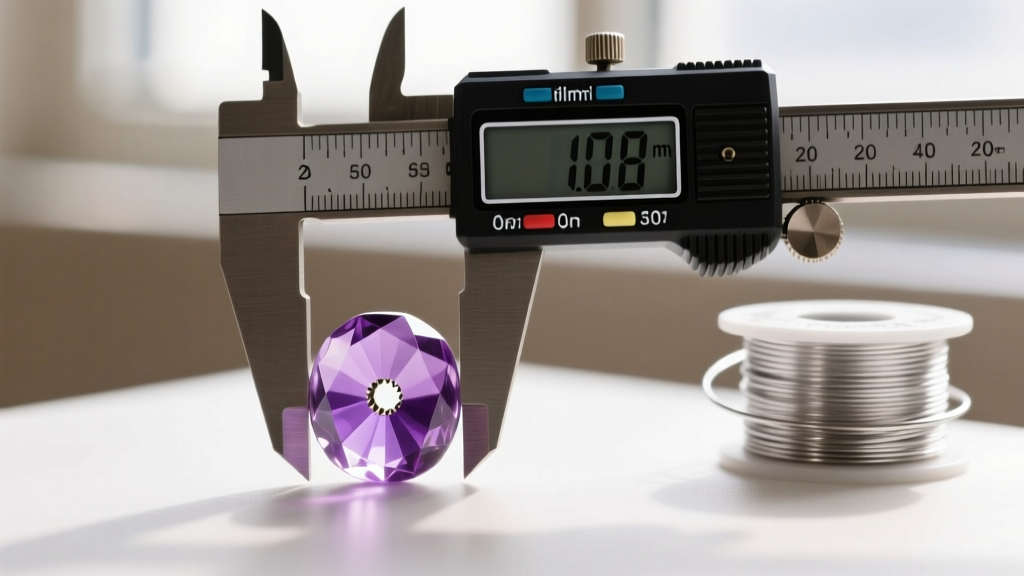
The Gemological Institute of America (GIA) emphasizes that the Mohs scale is relative, not linear. A quartz bead (Mohs 7) is significantly harder and more resistant to micro-abrasions from wire friction than a turquoise bead (Mohs 5-6). When beads rub against each other or against the wire during the swinging motion of a dangle earring, softer stones will degrade, enlarging their drill holes and eventually causing the bead to slip off the wire or crack under stress.
Technical Comparison of Common Bead Materials
| Bead Material | Mohs Hardness | Avg. Density (g/cm³) | Min. Recommended Wire Gauge | Failure Mode |
|---|---|---|---|---|
| Fused Glass | 5.5 - 6.5 | 2.50 | 22G | Shattering from bead-on-bead impact |
| Turquoise (Stabilized) | 5.0 - 6.0 | 2.70 | 22G with wire guard | Drill hole enlargement and cracking |
| Amethyst (Quartz) | 7.0 | 2.65 | 20G or 22G | Wire abrasion (wire wears before bead) |
| Freshwater Pearl | 2.5 - 4.5 | 2.75 | 24G (silk knotting required) | Nacre peeling from wire friction |
Standard gemstone beads are drilled with a 0.8mm to 1.0mm hole. If a designer uses a 22-gauge wire (0.64mm) through a 1.0mm hole, the resulting 0.36mm gap allows the bead to 'wobble.' Over months of wear, this micro-movement acts like a file, slowly grinding away the interior of softer beads or work-hardening the wire until it snaps. Precision sizing—matching the wire gauge as closely as possible to the drill hole, or using micro-beads as spacers—is a hallmark of expert craftsmanship.
Weight Distribution and Earlobe Biomechanics
The human earlobe is composed of adipose tissue and skin, lacking the cartilage structure found in the upper ear. The standard lobe piercing is performed at 18-gauge or 20-gauge. When a heavy beaded dangle earring is suspended from this delicate fistula, it creates a continuous downward and forward torque.
Calculating Tissue Stress
According to biomechanical guidelines referenced by the Association of Professional Piercers (APP), prolonged wear of heavy jewelry can lead to tissue migration, stretching, and eventual tearing of the fistula. For daily wear, a beaded dangle earring should not exceed 7 to 10 grams per ear. Large, dense gemstones like hematite or thick glass beads can easily push a single earring past 15 grams.
When designing or purchasing heavier beaded dangles, the weight must be mitigated through structural support:
- Wider Wire Profiles: Upgrading the ear wire to 18-gauge or 16-gauge distributes the downward force across a wider surface area of the fistula, reducing the 'cheese-cutter' effect.
- Friction Backings: Utilizing silicone o-rings or specialized earring support patches (like Bling Guards) behind the lobe transfers the load from the piercing hole to the broader surface of the earlobe tissue.
- Center of Gravity: Designing the dangle so the heaviest beads sit closer to the ear wire, rather than at the extreme bottom of the drop, reduces the pendulum effect and the resulting leverage applied to the piercing.
Clasp Mechanisms and Real-World Failure Modes
The clasp is the single most common point of failure in beaded dangle earrings. The kinetic energy generated by walking, turning the head, or hugging places repetitive stress on the closure mechanism.
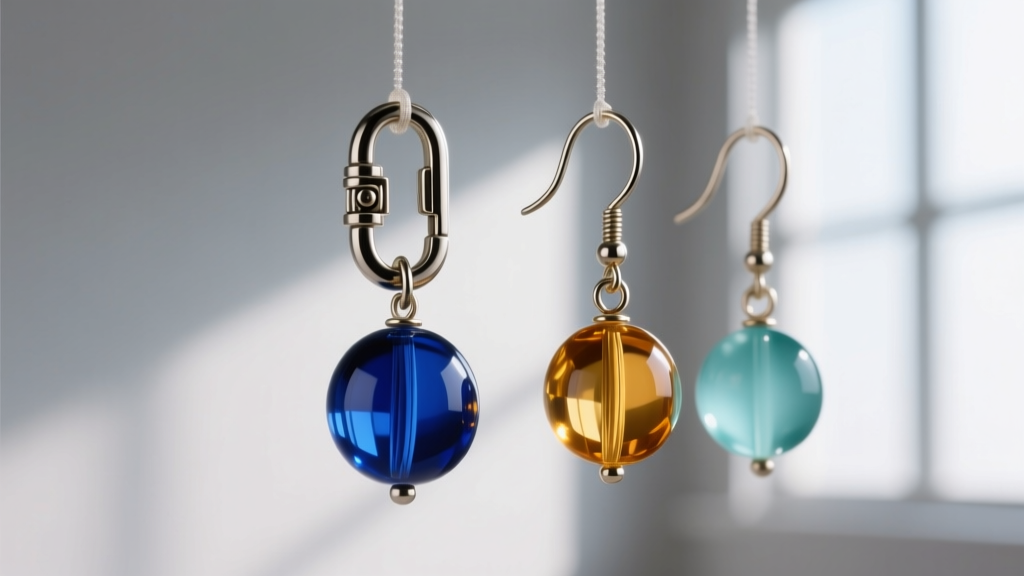
Evaluating Ear Wire Styles
- French Hook (Shepherd's Hook): The most common and cost-effective wire. It relies entirely on gravity and the friction of the earlobe to stay in place. Failure Mode: Easily dislodged by hair, scarves, or masks. Adding a silicone stopper is mandatory for security, but it does not prevent the wire from bending forward under heavy bead loads.
- Leverback: Features a hinged, spring-loaded latch that closes securely behind the ear. Advantage: Near 100% retention rate. Drawback: The mechanism adds 1.5 to 2.5 grams of weight to the earring before any beads are even added, which must be factored into the total weight budget.
- Kidney Wire: A continuous loop of wire where the straight end hooks into a small catch on the curved front. Advantage: Highly secure and lightweight. Drawback: Requires two hands to fasten, and the thin catch mechanism can deform if the heavy dangle pulls it outward.
Maintenance: Preventing Metal Fatigue and Bead Degradation
Even perfectly engineered beaded dangle earrings require specific maintenance protocols. The intersection of dissimilar materials (metal wire and mineral beads) creates unique cleaning challenges.
Bench Tip: Never place beaded dangle earrings with porous stones (turquoise, lapis lazuli, malachite, or pearls) into an ultrasonic cleaner. The high-frequency vibrations will not only strip the polish from softer stones but can also cause micro-fractures along the drill hole, leading to catastrophic bead failure.
For metal maintenance, wire-wrapped beads should be polished using a treated jeweler's cloth rather than liquid dips, which can become trapped in the tight spaces between the wire and the bead, causing localized corrosion. Furthermore, the structural loops of the dangle should be inspected every six months for metal fatigue. If a wire loop has been repeatedly opened and closed, or if the earring has been dropped, the metal's crystalline structure may be compromised, requiring the component to be replaced before it snaps and loses the bead assembly.
Final Engineering Checklist for the Consumer
When evaluating a pair of beaded dangle earrings for purchase or long-term wear, run through this technical checklist:
- Gauge Check: Is the main drop wire at least 20-gauge or 22-gauge? (Avoid 24-gauge structural wires).
- Weight Test: Does the earring feel excessively heavy? If it pulls the lobe downward immediately, it exceeds the 10-gram daily comfort threshold.
- Fit Tolerance: Is there excessive 'play' or rattling between the wire and the bead drill hole?
- Clasp Security: If using French hooks, are silicone stoppers included? If using leverbacks, does the spring mechanism snap shut crisply without lateral wobble?
By prioritizing structural integrity, appropriate material hardness, and biomechanical limits, you ensure that your beaded dangle earrings remain both a beautiful and enduring part of your jewelry wardrobe.


