Styling Rectangle Earrings Gold: A Beginner's Guide
Discover how to choose, style, and care for rectangle earrings gold. Learn about karat durability, weight limits, and face shape mapping.


The Architectural Appeal of Geometric Gold
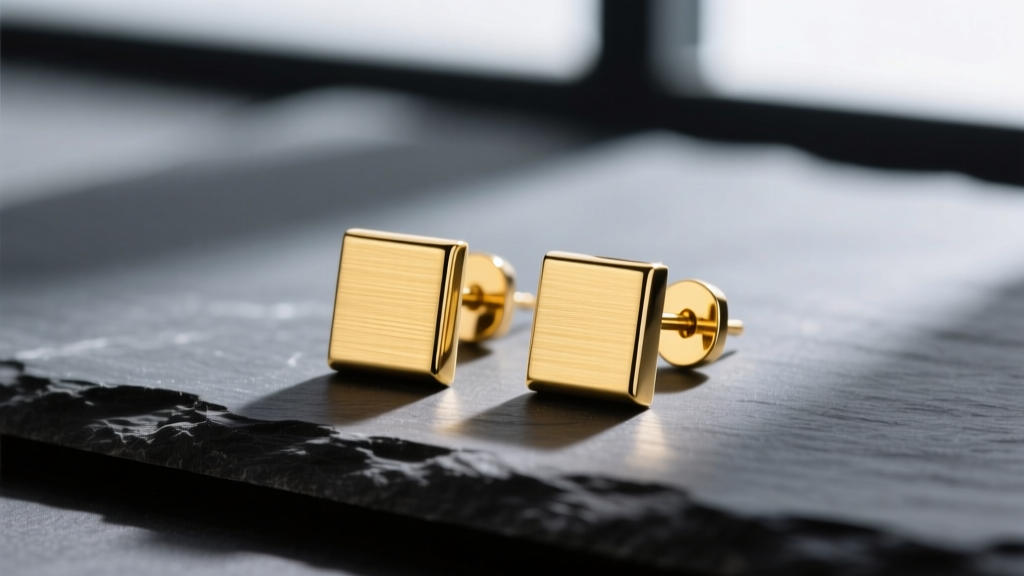
Geometric jewelry has transcended fleeting trends to become a permanent fixture in modern minimalist wardrobes. Among these structural shapes, rectangle earrings gold variants stand out for their clean lines, mid-century modern influence, and effortless versatility. For beginners, navigating the intersection of metallurgy, structural integrity, and facial proportions can be daunting. A poorly chosen geometric piece can warp, weigh down the lobe, or clash with your natural features. This guide breaks down the exact specifications, material grades, and styling frameworks you need to know before investing in your first pair of architectural gold earrings.
Decoding Karats: Why 24k Fails in Geometric Designs
When shopping for gold jewelry, higher karats are often mistakenly equated with higher quality. However, geometric shapes with sharp corners and straight edges require structural rigidity. Pure 24k gold is exceptionally soft and malleable; a 24k rectangle earring will easily dent, bend, or lose its crisp corners if dropped or squeezed in a jewelry box. To achieve the necessary durability, gold must be alloyed with metals like copper, silver, and zinc. According to the Gemological Institute of America (GIA), alloying not only increases tensile strength but also dictates the final color and tarnish resistance of the piece.
| Karat | Gold Purity | Durability for Sharp Edges | Best Use Case |
|---|---|---|---|
| 10k Gold | 41.7% | Excellent (Very Hard) | Large, thin architectural hoops |
| 14k Gold | 58.3% | Very Good (Industry Standard) | Everyday rectangle studs and drops |
| 18k Gold | 75.0% | Good (Requires Thicker Design) | High-end, chunky geometric blocks |
| 24k Gold | 99.9% | Poor (Too Soft) | Avoid for sharp geometric shapes |
For beginners, 14k solid gold is the optimal sweet spot. It provides the rich, warm hue associated with fine jewelry while possessing the structural integrity required to maintain sharp 90-degree angles over years of daily wear.
Proportion Mapping: Matching Rectangles to Face Shapes
Because rectangles introduce strong horizontal and vertical lines, they actively alter the perceived geometry of your face. Use this framework to select the right proportions:
- Round Faces: Opt for elongated, vertical rectangular drops (e.g., 30mm long by 8mm wide). The sharp vertical lines create an illusion of length, counterbalancing the soft curves of a round jawline and cheekbones.
- Square Faces: Avoid narrow, harsh vertical lines that echo a strong jaw. Instead, choose wider, shorter rectangular blocks (e.g., 15mm by 15mm) or rectangles with slightly softened, beveled corners to add contrast without aggression.
- Oval Faces: The universal canvas. Oval faces can pull off both extreme elongated drops and wide, chunky geometric studs. Experiment with asymmetrical lengths for a modern editorial look.
- Oblong/Long Faces: Avoid long vertical drops, which will exaggerate face length. Stick to horizontal rectangular bars or compact square-rectangle studs that sit snugly on the lobe to add visual width.
The Physics of Dangle: Weight, Gauge, and Lobe Fatigue
Gold is a remarkably dense metal (19.3 g/cm³). A solid 14k gold rectangle that is 2mm thick and 35mm long can easily weigh 5 to 7 grams per earring. When suspended from a delicate piercing, this density becomes a structural liability.

Understanding Wire Gauge and the 'Cheese-Cutter' Effect
Standard lobe piercings are typically done at 20-gauge (0.81mm) or 18-gauge (1.02mm). If you hang a heavy, solid gold rectangle from a thin 20-gauge post, the localized pressure will cause the earring to slowly migrate downward through the tissue—a painful phenomenon known in the body modification community as the 'cheese-cutter' effect. The Association of Professional Piercers (APP) consistently warns against excessive jewelry weight in standard gauge piercings to prevent irreversible lobe stretching and tearing.
Weight-Buying Guidelines for Beginners
- Under 3 grams: Safe for standard 20g or 18g posts. Ideal for small, solid rectangle studs.
- 3 to 6 grams: Requires a thicker 16-gauge (1.29mm) post or a reinforced 14-gauge (1.63mm) wire to distribute weight safely across the fistula.
- Over 6 grams: Avoid solid gold at this size. Instead, look for electroformed or hollow-core gold rectangle earrings. These manufacturing techniques create a thick outer shell of 14k gold over a removable resin or wax core, reducing the weight by up to 70% while maintaining the exact same exterior dimensions and visual impact.
Market Pricing: What You Should Actually Pay
The jewelry market is saturated with misleading terminology. Understanding the difference between plating, vermeil, and solid gold is critical to ensuring you pay a fair price for rectangle earrings gold designs.
| Material Category | Composition Details | Expected Price Range (Per Pair) | Longevity |
|---|---|---|---|
| Gold Plated (Brass Base) | Flash layer of gold over brass/copper | $25 - $50 | Low (Tarnishes in months) |
| Gold Vermeil | Thick 14k/18k gold over Sterling Silver | $60 - $120 | Medium (1-3 years with care) |
| Solid 14k Gold (Small) | Cast or stamped 14k alloy, under 2g | $140 - $280 | Lifetime (Heirloom quality) |
| Solid 14k/18k (Large/Hollow) | Hollow-core or heavy cast, 3g+ | $350 - $850+ | Lifetime (Requires gentle handling) |
Pro Tip: If a brand advertises 'gold rectangle earrings' for $45 but claims they are solid, it is a red flag. Check the product specifications for the exact metal stamp (e.g., '14k' or '585').
Everyday Maintenance for Sharp Edges
Geometric jewelry requires specific care to maintain its pristine angles. The sharp corners of rectangle earrings are natural catch-points for knit sweaters, hairbrushes, and silk pillowcases. Always put your earrings on after dressing and styling your hair. To clean 14k or 18k solid gold rectangles, avoid harsh chemical dips which can dull high-polish finishes. Instead, use a few drops of mild dish soap in warm water and gently scrub the flat planes and corners with an extra-soft baby toothbrush. Dry immediately with a lint-free microfiber cloth to prevent water spots from obscuring the geometric reflections. Store them in a dedicated compartmentalized box; tossing sharp-edged rectangles into a communal jewelry pouch guarantees they will scratch your softer gemstone pieces and dent their own corners.


