Beginner Guide to Buying and Styling White Hoop Earrings
Explore our beginner guide to white hoop earrings. Learn about materials, gauge sizes, face shapes, and care tips for the perfect fit.


Why White Hoop Earrings Are a Wardrobe Essential
When building a foundational jewelry collection, white hoop earrings occupy a unique and highly versatile space. Unlike yellow gold, which leans warm, or rose gold, which carries distinct pink undertones, white metals and opaque white materials offer a crisp, reflective neutrality. They bounce light directly onto the face, brightening the complexion without clashing with cool or warm color palettes in your wardrobe. For beginners, navigating the sheer volume of options—from delicate 10mm huggies to dramatic 60mm statement pieces—can be overwhelming. This guide breaks down the exact material grades, gauge specifications, and structural hardware you need to know to make an informed, long-lasting purchase.
Decoding the Materials: What 'White' Actually Means
Not all white jewelry is created equal. The term 'white' in jewelry usually refers to the color of the metal alloy or a specific surface treatment. Understanding the metallurgy behind your earrings will dictate their durability, price point, and maintenance requirements.
14k vs. 18k White Gold and Rhodium Plating
White gold does not exist in nature; it is an alloy of pure yellow gold mixed with white metals like nickel, palladium, or silver. Because the underlying alloy still retains a faint yellowish or grayish tint, it is electroplated with a microscopic layer of rhodium (a platinum group metal) to achieve that brilliant, mirror-like white finish. According to the Gemological Institute of America (GIA), 14k white gold (58.5% pure gold) is significantly harder and more scratch-resistant than 18k white gold (75% pure gold). For hoop earrings, which are prone to bumping against hair, phones, and clothing, 14k is the superior choice for longevity. Expect to pay between $150 and $450 for quality 14k white gold hoops.
Platinum (950 Grade)
Platinum is naturally white and does not require rhodium plating. Jewelry marked '950 Pt' contains 95% pure platinum. It is denser and heavier than gold, making it exceptionally secure for holding gemstones, though this weight can cause earlobe fatigue if the hoops are oversized. Platinum develops a soft 'patina' over time—a satin-like finish caused by microscopic scratches displacing the metal rather than removing it. It is highly recommended for those with nickel allergies. Pricing is steep, generally starting at $500 and exceeding $1,500 for medium-to-large diameters.
Alternative Whites: Ceramic and Enamel
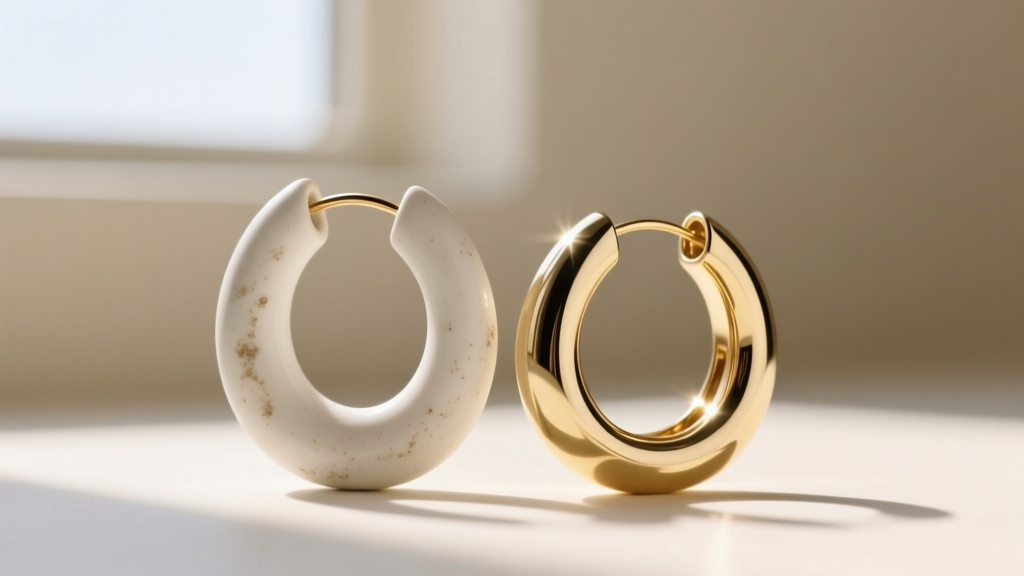
For a bold, opaque, and purely white aesthetic, high-tech ceramic and vitreous enamel are excellent choices. Ceramic is highly scratch-resistant and hypoallergenic but can shatter if dropped on a hard tile floor. Enamel, which is essentially fused glass over a metal base, offers vibrant color but is susceptible to chipping upon impact. These materials typically range from $40 to $200, making them accessible entry points for trend-driven styling.
Sizing, Proportions, and Face Shapes
The diameter of your white hoop earrings drastically alters their visual weight and how they interact with your facial structure. Here is a practical framework for selecting the right size based on millimeter (mm) diameter and face shape.
| Category | Diameter (mm) | Best Face Shapes | Styling Context & Notes |
|---|---|---|---|
| Huggies | 10mm - 15mm | Heart, Oval | Sits flush against the lobe. Ideal for office environments, active lifestyles, and sleeping. Often features a hinged clicker closure. |
| Small Hoops | 16mm - 25mm | Round, Square | The most versatile everyday size. Adds structure to round faces without overwhelming the jawline. Perfect for casual and business-casual wear. |
| Medium Hoops | 26mm - 40mm | Oblong, Diamond | Creates horizontal width, which helps balance longer or narrower face shapes. A classic 'statement' size that remains manageable for daily wear. |
| Large / Statement | 41mm - 60mm+ | Oval, Heart | High visual impact. Best reserved for evenings or minimalist outfits. Heavy weights can stretch the earlobe over time; opt for hollow tube designs to reduce mass. |
Lobe vs. Cartilage: Navigating Gauges and Hardware
One of the most common mistakes beginners make is ignoring wire thickness, known as 'gauge.' The gauge system is inverse: the higher the number, the thinner the wire. Wearing the wrong gauge can lead to irritation, migration, or the earring simply not fitting through the piercing.
Standard Gauge Specifications
- 20 Gauge (0.81mm): The standard for basic, delicate lobe piercings and lightweight fashion jewelry.
- 18 Gauge (1.02mm): A slightly thicker, more secure option for standard lobe piercings. Highly recommended for medium-sized hoops to prevent bending.
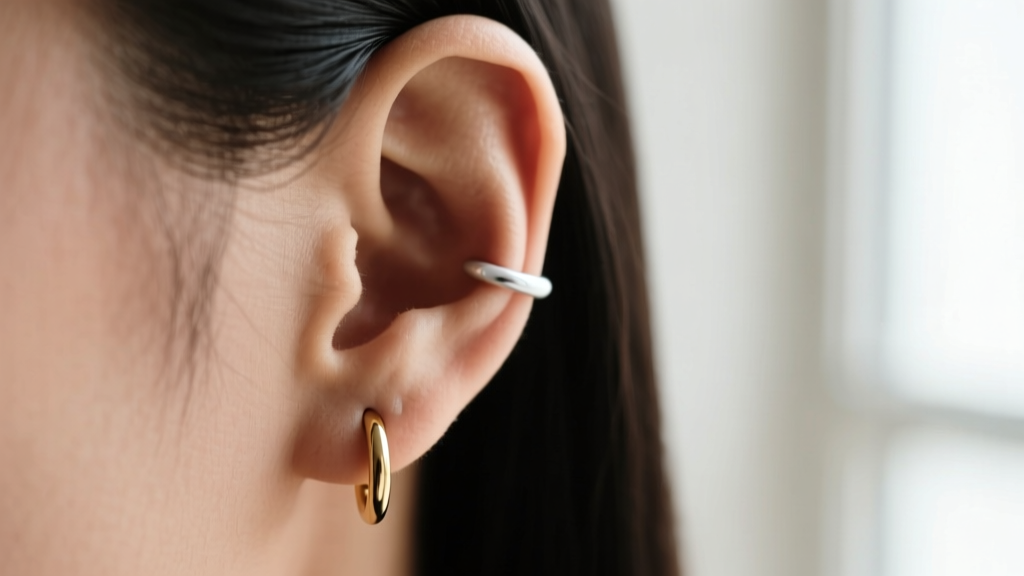
- 16 Gauge (1.29mm): The standard for cartilage piercings (helix, tragus, conch). If you are threading a hoop through a cartilage piercing, it must be 16g or thicker to avoid the 'cheese-cutter effect,' where thin wire migrates through the tissue.
- 14 Gauge (1.63mm): Used for thicker cartilage or daith piercings. Provides maximum structural integrity for larger diameter hoops.
For authoritative guidelines on body jewelry materials and safe gauge sizes for healing and healed piercings, always consult the Association of Professional Piercers (APP).
Hardware and Closure Types
The closure mechanism dictates both security and ease of use. Continuous (Endless) Hoops feature a subtle hinge and a tension-fit segment. They are incredibly secure and offer a seamless look, but they require practice to open and close without warping the circular shape. Clickers use a hinged snap closure; they are beginner-friendly and easy to insert, but the visible hinge line can disrupt the aesthetic, and hair can occasionally catch in the seam. Captive Bead Rings (CBRs) use the tension of the ring to hold a small bead in place. They are highly secure for active wearers but notoriously difficult to insert without specialized ring-opening pliers.
Care, Maintenance, and Troubleshooting
White jewelry requires specific maintenance routines to retain its brilliance. Because white gold relies on surface plating, and alternative materials have unique physical properties, a one-size-fits-all cleaning approach will lead to damage.
Rhodium Replating and Metal Care
If your white gold hoops begin to look slightly yellow or dull at the bottom edge, the rhodium plating has worn away due to friction and skin acidity. This is not a defect, but a normal wear pattern. You will need to take them to a jeweler for a 'rhodium dip.' This process involves electroplating a fresh layer of rhodium onto the metal. Expect to pay between $35 and $75 per pair, and plan to do this every 1 to 3 years depending on how often you wear them.
What to Avoid
- Ultrasonic Cleaners: While excellent for plain white gold and platinum, ultrasonic vibrations will shatter ceramic hoops and cause vitreous enamel to crack or flake off the metal base.
- Chlorine and Saltwater: Swimming pools and hot tubs contain harsh chemicals that can permanently discolor white gold alloys and degrade the structural integrity of lower-karat solders used in hoop closures.
- Sleeping in Large Hoops: Never sleep in hoops larger than 15mm. The pressure of your head against the pillow can bend the wire, warp the circular shape, or cause the earring to snag and tear the earlobe.
Pro-Tip for Continuous Hoops: If your endless hoop becomes slightly oval-shaped from tugging, do not try to bend it back into a circle with your bare hands. Roll it gently along a flat, hard surface while applying light downward pressure with your palm to restore the perfect geometric curve without stressing the metal's memory.
By understanding the material science, precise measurements, and hardware mechanics behind white hoop earrings, you can build a collection that is not only visually striking but engineered to last a lifetime. Whether you opt for the indestructible nature of 950 platinum or the crisp, modern edge of white ceramic, choosing the right specifications ensures your jewelry works seamlessly with your lifestyle.


