Material Guide for Dangly Earrings on Men: Weight & Durability
Discover the best metals for dangly earrings on men. Compare titanium, steel, and gold for weight, lobe stress, and durability in our expert guide.

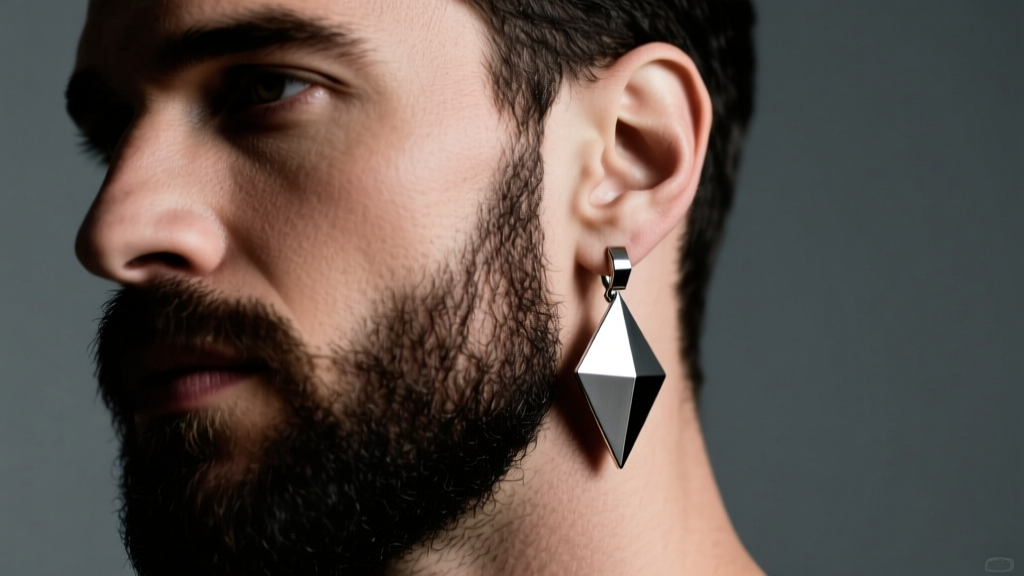
The landscape of men's jewelry has fundamentally shifted. What was once relegated to subcultures or historical tropes is now a cornerstone of contemporary menswear. Specifically, dangly earrings on men have become a staple of high fashion and streetwear alike, championed by style icons ranging from A$AP Rocky to Timothée Chalamet. However, transitioning from a simple 14-karat gold stud to a dynamic, moving dangle introduces complex physical variables that most buyers overlook. When you introduce movement, gravity, and momentum into the equation, the material composition of your jewelry is no longer just an aesthetic choice—it is a structural necessity.
The Physics of the Pendulum Effect on Male Lobes
To understand why material selection is critical, we must first examine the biomechanics of the earlobe. A standard lobe piercing is typically performed at 18-gauge (1.0mm) or 16-gauge (1.2mm). When a stud rests in this fistula, the weight is distributed evenly. A dangle earring, however, acts as a pendulum. Every time you turn your head, walk, or pull a hoodie over your head, the earring swings, creating localized shear stress at the bottom of the piercing channel.
This phenomenon, often referred to by professional piercers as the 'cheese-cutter effect,' can slowly migrate the piercing downward, permanently thinning the lobe tissue. While male earlobes are often slightly thicker than female earlobes on average, the dermal tissue is equally susceptible to this mechanical fatigue. Therefore, the density of the metal and the diameter of the wire are inextricably linked. A heavy metal requires a thicker wire to distribute the load, but a thicker wire requires a larger gauge piercing. This is where advanced metallurgy steps in to solve the weight-to-strength ratio.
Material Breakdown: Density, Tensile Strength, and Corrosion
Choosing the right alloy for dangly earrings on men requires balancing three factors: volumetric density (weight), yield strength (resistance to bending), and biocompatibility. Let us break down the most common metals used in premium men's dangles.
Implant-Grade Titanium (ASTM F136)
Titanium is the undisputed champion for large, architectural dangle earrings. Specifically, you must look for ASTM F136 compliant implant-grade titanium, not the vaguely marketed 'titanium steel' (which is usually just 316L stainless steel). Titanium boasts a remarkably low density of 4.5 g/cm³, making it nearly 45% lighter than stainless steel. Brands like Vitaly have leveraged CNC-machined titanium to create massive, brutalist dangle designs that weigh less than three grams. Furthermore, titanium is entirely nickel-free and highly resistant to chloride corrosion, meaning it will not degrade when exposed to heavy sweat during workouts.
Surgical Stainless Steel (316L)
316L stainless steel is the budget workhorse of the jewelry industry. With a density of 8.0 g/cm³, it is significantly heavier than titanium. While it offers excellent tensile strength and will not easily snap under pressure, its weight makes it a poor choice for dangles exceeding 1.5 inches in length. The primary failure point for steel dangles is not structural, but biological: 316L contains trace amounts of nickel. When the metal swings and creates micro-friction in the fistula, nickel ions can leach into the tissue, triggering contact dermatitis in sensitized individuals. According to the Association of Professional Piercers (APP), 316L is acceptable for healed piercings, but its weight and nickel content make it suboptimal for heavy, moving jewelry.
Solid 14k vs. 18k Gold
Gold remains the ultimate status symbol, but its purity dictates its structural integrity. Pure 24k gold is far too malleable for dangle wires; it will bend and warp under the stress of daily wear. When evaluating gold dangles, 14k gold (58.5% pure gold) is vastly superior to 18k gold (75% pure gold) for the structural components. The higher alloy content (usually copper, silver, and zinc) in 14k gold increases its Vickers hardness, allowing the french wire or locking mechanism to maintain its shape after repeated snagging. As noted by the Gemological Institute of America (GIA), the alloy mix not only determines color but fundamentally alters the metal's durability. For the decorative charms hanging below the ear, 18k is perfectly fine, but the wire traversing the ear must be 14k or alloyed for strength.
Tungsten Carbide & High-Tech Ceramics
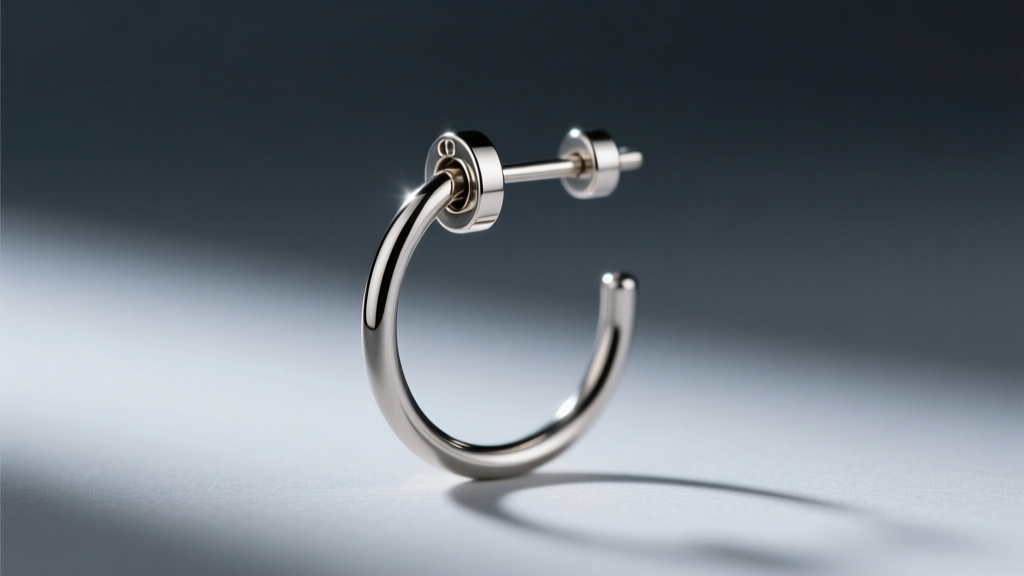
Tungsten carbide has gained massive popularity in men's wedding bands due to its extreme scratch resistance, but it is a dangerous choice for dangly earrings. Tungsten is incredibly dense (approx. 15.6 g/cm³) and highly brittle. If a heavy tungsten dangle catches on a shirt collar and snaps back, the kinetic energy can cause the metal to shatter rather than bend, posing a severe laceration risk to the ear and neck. High-tech ceramics (like zirconia) offer a lighter, scratch-proof alternative, but they share the same catastrophic brittleness. These materials should be strictly avoided for any earring that extends below the jawline.
Comparative Data: Material Properties for Dangles
To visualize how these materials perform under the pendulum effect, review the structural data below. This framework should dictate your purchasing decisions based on the physical size of the earring you desire.
| Material | Density (g/cm³) | Recommended Wire Gauge | Yield Strength | Best Use Case |
|---|---|---|---|---|
| ASTM F136 Titanium | 4.5 | 16g (1.2mm) or 14g (1.6mm) | High | Oversized, architectural, and long chain dangles. |
| 316L Stainless Steel | 8.0 | 18g (1.0mm) max length 1 inch | Very High | Short, chunky drops and budget-friendly hoops. |
| 14k Yellow/White Gold | 12.9 | 16g (1.2mm) | Medium-High | Medium-length luxury chains and gemstone drops. |
| 18k Yellow Gold | 15.6 | 18g (1.0mm) - Requires care | Medium | Small decorative charms on a stronger 14k wire. |
Hardware & Clasp Mechanics for Heavy Dangles
The material of the earring is only half the battle; the clasp mechanism is where most men's dangle earrings fail. The traditional 'fishhook' or standard french wire relies entirely on gravity to stay in the ear. For men, who frequently change clothes, wear headphones, or engage in physical activity, an open french wire is a guaranteed path to losing an expensive piece of jewelry.
When investing in premium dangly earrings on men, prioritize specialized locking hardware. Brands like Maria Tash have pioneered the use of threaded, screw-in backs and hidden click-lock mechanisms that secure the wire flush against the back of the lobe. If you are buying a heavier 14k gold or titanium dangle, ensure the wire features a secondary silicone or metal O-ring guard, or opt for a leverback closure that physically snaps shut. A 16-gauge titanium leverback provides the ultimate security-to-weight ratio, ensuring the earring remains anchored even during high-impact movement.
Real-World Failure Modes and How to Avoid Them
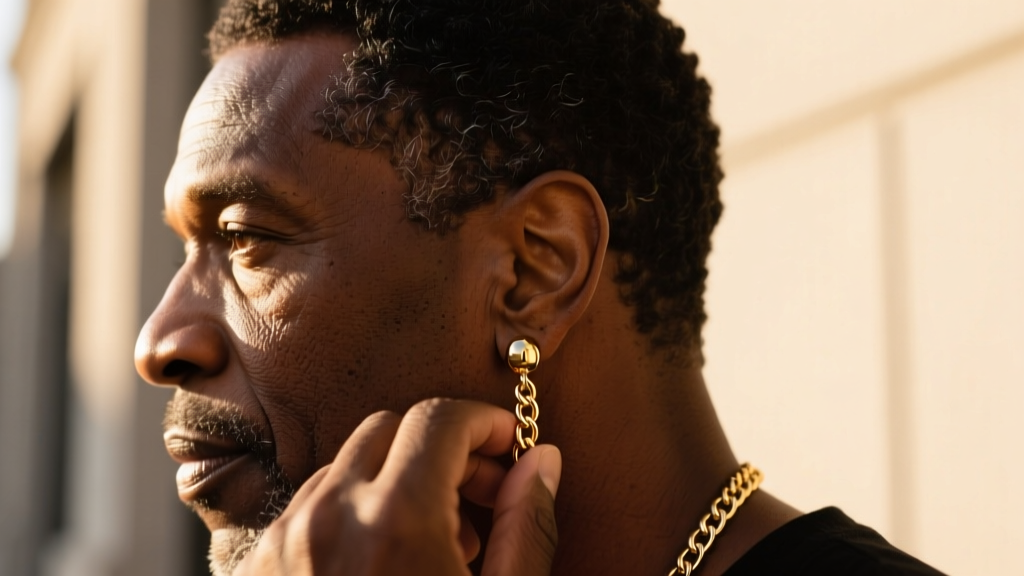
Even with the correct material and gauge, environmental factors can compromise your jewelry. Understanding these failure modes will extend the lifespan of your pieces.
- Galvanic Corrosion: If your dangle earring features mixed metals (e.g., a sterling silver charm hanging from a surgical steel wire), exposure to sweat acts as an electrolyte, causing rapid galvanic corrosion. Always ensure the entire piece, including jump rings and clasps, is forged from a single, uniform metal.
- Work Hardening and Fatigue: Repeatedly bending a gold or silver wire to open and close it causes 'work hardening,' making the metal brittle over time. Eventually, the wire will snap at the bend point. Always use proper jewelry pliers to adjust wires, or better yet, have a jeweler adjust the fit.
- Sleep Compression: Sleeping in dangle earrings, regardless of the material, applies sustained lateral pressure to the fistula. This can cause the piercing to heal at an awkward angle or lead to hypertrophic scarring. The rule is absolute: take dangles out before bed.
Final Verdict: Matching Material to Lifestyle
The surge in popularity of dangly earrings on men is a testament to the breaking down of outdated fashion boundaries. However, embracing this trend requires a pragmatic approach to metallurgy. If your lifestyle is active, or you prefer bold, oversized silhouettes that extend past the jawline, ASTM F136 implant-grade titanium is your only logical choice. It eliminates lobe fatigue, prevents allergic reactions, and survives the rigors of daily wear. For those seeking traditional luxury and willing to commit to a smaller, more refined silhouette, a 14k gold chain with a secure locking leverback offers timeless elegance without sacrificing structural integrity. By respecting the physics of the pendulum effect and choosing your alloys wisely, you ensure that your jewelry remains a permanent fixture of your style, rather than a costly, fleeting experiment.


