Best Metals for Earrings on Guys: Material Guide
Discover the best metals for earrings on guys. Compare titanium, steel, tungsten, and gold for durability, skin safety, and style in our expert guide.


Why Material Dictates the Experience in Men's Ear Jewelry
As we navigate the style landscape of 2026, the conversation around earrings on guys has matured far beyond simple aesthetics. While the silhouette of a hoop, stud, or huggie matters, the metallurgy of the piece dictates its longevity, comfort, and biological compatibility. Men's skin chemistry, lifestyle factors, and grooming habits present unique challenges for ear jewelry. Higher sebum production, frequent exposure to sweat during athletic training, and the use of harsh chemical hair products can accelerate metal degradation and trigger contact dermatitis if the wrong alloy is chosen.
Choosing the right metal is not merely a stylistic preference; it is a functional necessity. A poorly selected alloy can lead to galvanic corrosion, localized infections, or permanent discoloration of the earlobe. This guide breaks down the exact material properties, industry grades, and structural realities of the top metals used in men's earrings, providing a definitive framework for making an informed purchase.
The Metallurgy Matrix: Core Metals Compared
Before diving into the molecular specifics, it is crucial to understand how the most common metals stack up against one another in real-world scenarios. The following matrix evaluates materials based on biocompatibility, scratch resistance, and average market pricing for high-quality, body-safe pieces.
| Metal / Alloy | Biocompatibility | Mohs Hardness | Weight Profile | Avg. Price Range (USD) |
|---|---|---|---|---|
| Implant-Grade Titanium (ASTM F136) | Exceptional (Nickel-Free) | 5.0 - 6.0 | Ultra-Light | $35 - $90 |
| Surgical Steel (316L) | Moderate (Contains Nickel) | 5.5 | Medium | $15 - $45 |
| Tungsten Carbide | High (Inert) | 9.0 - 9.5 | Heavy | $25 - $70 |
| Solid Gold (14k / 18k) | High (Alloy Dependent) | 2.5 - 3.0 | Heavy | $150 - $600+ |
Deep Dive: Implant-Grade Titanium vs. Commercial Steel
The Gold Standard: ASTM F136 Titanium
When evaluating the safest and most durable option for earrings on guys, especially for fresh piercings or highly sensitive lobes, Implant-Grade Titanium (specifically alloyed to ASTM F136 standards) is the undisputed champion. Unlike commercial 'titanium' jewelry which may be mixed with unknown alloys, ASTM F136 guarantees a strictly controlled composition of titanium, aluminum, and vanadium, with virtually zero nickel content. According to the Association of Professional Piercers, this specific grade is the benchmark for initial piercings because it is entirely biocompatible and will not react to the body's natural healing fluids.
Furthermore, titanium's ability to be anodized allows for a spectrum of vibrant, permanent colors without the use of toxic dyes or plating that can chip off. For men working in manual labor or frequent gym-goers, titanium's high strength-to-weight ratio means the earring will not weigh down the lobe or cause tearing during accidental snags.
The Budget Contender: 316L Surgical Stainless Steel
Surgical steel is ubiquitous in the men's jewelry market, but not all steel is created equal. The 'L' in 316L stands for 'Low Carbon,' which increases its resistance to corrosion from sweat and water. However, 316L still contains between 8% and 10.5% nickel. While the nickel is largely trapped within the alloy's crystalline structure, prolonged exposure to acidic sweat can cause microscopic leaching, triggering allergic contact dermatitis in sensitized individuals. If you opt for steel, ensure it is strictly for fully healed piercings, and avoid it entirely if you have a known nickel allergy.
The Weight and Scratch Factor: Tungsten and Solid Gold
Tungsten Carbide: The Indestructible Armor
Tungsten carbide has surged in popularity for men's rings and is now making a strong push into earrings, particularly for rugged, industrial aesthetics like matte black studs or gunmetal hoops. Ranking at a 9.0 on the Mohs hardness scale, tungsten is virtually scratch-proof. It will not dull, tarnish, or lose its polished finish, even after years of friction against motorcycle helmets or protective work gear.
However, this extreme hardness introduces a critical failure mode: brittleness. While tungsten will not scratch, it can shatter if subjected to blunt force impact. Additionally, its high density makes it significantly heavier than steel or titanium. For earlobes that are already stretched or thinning, the continuous gravitational pull of a heavy tungsten huggie or hoop can accelerate lobe drooping over time.
Solid Gold: Navigating Karats and Alloys
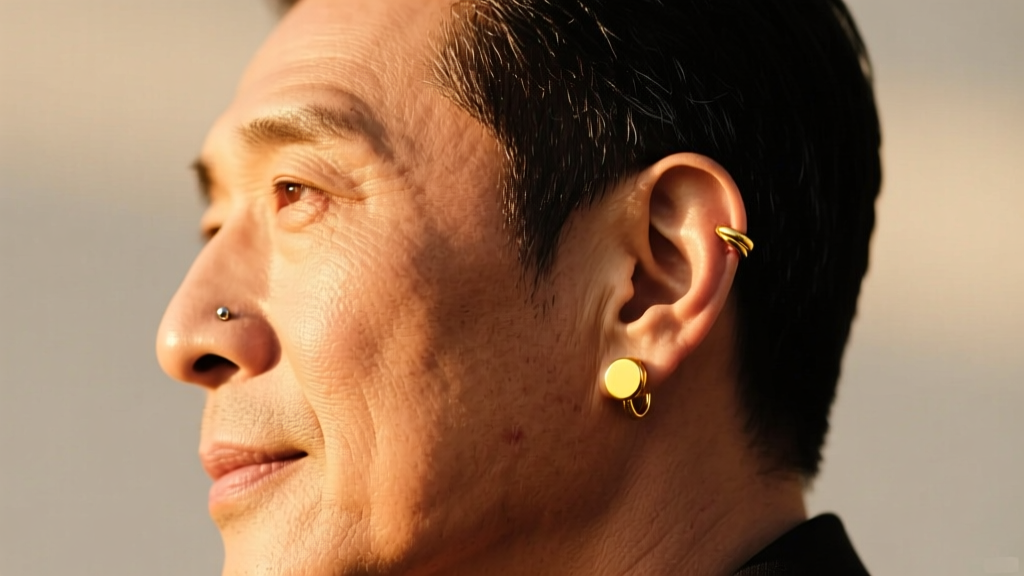
Gold remains the ultimate marker of luxury, but purity dictates its structural integrity. 24k gold is far too soft for daily wear earrings; it will easily bend, scratch, and lose its shape. The Gemological Institute of America (GIA) notes that 14k and 18k gold offer the ideal balance of rich color and structural durability. For men's earrings, 14k gold is often preferred for its slightly higher tensile strength and lower price point.
Expert Warning on White Gold: If you prefer the look of silver but want the prestige of gold, be aware that white gold is naturally yellowish and requires a rhodium plating to achieve a bright white finish. This plating wears off over time, requiring costly re-dipping. For a maintenance-free white metal, stick to platinum or highly polished titanium.
Threading and Gauge: The Hidden Hardware Mechanics
The metal of the post or hoop is only half the battle; the engineering of the hardware determines how safely the earring interacts with your piercing channel. When shopping for earrings on guys, pay strict attention to gauge sizes and threading types.
- Gauge Specifics: The standard for men's lobe piercings is typically 16-gauge (1.2mm) or 14-gauge (1.6mm). Cartilage piercings, such as the helix or tragus, are almost universally pierced at 16-gauge. Wearing a 20-gauge (0.8mm) earring in a 14-gauge hole can lead to the 'cheese-cutter effect,' where the thin wire slowly migrates through the tissue, eventually tearing the lobe.
- Internal vs. External Threading: Never buy externally threaded earrings (where the screw pattern is on the post itself). Passing sharp, threaded metal through the delicate fistula of a piercing causes micro-tears and scar tissue buildup. Always insist on internally threaded jewelry, where the post is smooth and the screw mechanism is hidden inside the decorative end or the backing.
- Threadless (Press-Fit): Gaining massive traction in 2026, threadless jewelry uses a slight bend in the pin to create tension against the inside of the hollow post. This offers the smoothest insertion and the most secure hold, virtually eliminating the risk of losing an expensive gold or diamond end.

Long-Term Maintenance and Oxidation Realities
Even the most inert metals require basic maintenance to prevent the buildup of sebum, dead skin cells, and environmental pollutants. The 'smell' often associated with men's earrings is not the metal itself, but rather oxidized sebum and bacteria trapped in the microscopic pores of the jewelry or the piercing channel.
Actionable Care Protocol
- Weekly Cleansing: Remove earrings once a week. Soak them in a solution of warm water and mild, fragrance-free castile soap for 10 minutes. Use a soft-bristled baby toothbrush to gently scrub the posts and threading.
- Ultrasonic Cleaners: For intricate tungsten or solid gold designs with crevices, an ultrasonic jewelry cleaner is a worthwhile $40 investment. It uses high-frequency sound waves to dislodge microscopic debris without scratching the metal.
- Chemical Avoidance: Never expose solid gold or anodized titanium to chlorine (in pools) or harsh bleaching agents. Chlorine can cause irreversible stress-corrosion cracking in gold alloys, weakening the structural integrity of the earring post.
Final Verdict: Matching Metal to Lifestyle
There is no single 'best' metal for earrings on guys; there is only the right metal for your specific lifestyle. If you are an athlete, a swimmer, or have highly reactive skin, ASTM F136 Implant-Grade Titanium is non-negotiable. It is lightweight, entirely hypoallergenic, and immune to sweat-induced corrosion. If you work in a rugged environment and want a piece of jewelry that will never scratch or show wear, a heavy-duty Tungsten Carbide stud is your best asset, provided your lobe can support the weight. Finally, for those seeking a timeless, premium aesthetic for professional or formal settings, 14k Solid Gold with internally threaded hardware offers unmatched prestige and long-term value. By prioritizing metallurgical facts over marketing hype, you ensure your ear jewelry remains as resilient and sharp as the rest of your wardrobe.


