Big Thick Hoop Earrings: A Technical Guide to Weight and Gauge
Discover the engineering behind big thick hoop earrings. Learn about gauge thickness, weight distribution, and clasp mechanics to prevent lobe tearing.


The Physics of Proportion: Diameter vs. Gauge Thickness
When evaluating big thick hoop earrings, most consumers focus purely on aesthetics, ignoring the fundamental physics at play. A hoop earring is essentially a cantilevered weight suspended from a delicate column of connective tissue. As the diameter of the hoop increases, so does its leverage. This creates a pendulum effect: every time you turn your head, the hoop swings, multiplying its static weight by a dynamic factor of 2x to 3x on the piercing fistula.
To achieve the coveted 'chunky' aesthetic without causing structural failure of the earlobe, the wire gauge (thickness) must be engineered in direct proportion to the diameter. Standard fashion earrings typically use 20-gauge (0.81mm) or 18-gauge (1.02mm) wire. However, big thick hoops generally start at 12-gauge (2.05mm) and scale up to 6-gauge (4.11mm) or even 4-gauge (5.18mm). While a thicker gauge provides necessary rigidity to prevent the hoop from warping into an oval shape under its own weight, it simultaneously introduces the risk of the 'cheese-cutter effect'—where a heavy, thick wire slowly slices through the earlobe tissue due to constant downward pressure.
Material Science: Density and Lobe Strain
The material composition of your hoops dictates their mass, which directly correlates to lobe strain. A 50mm diameter hoop crafted in 8-gauge (3.26mm) wire will weigh drastically different amounts depending on the alloy used. Understanding metallurgical density is critical for selecting wearable statement pieces.
| Material | Alloy Standard | Density (g/cm³) | Relative Weight (50mm/8G Hoop) | Biocompatibility |
|---|---|---|---|---|
| 14k Yellow Gold | 58.5% Au alloy | 13.9 | ~14.5 grams | High (if nickel-free) |
| 316L Surgical Steel | ASTM F138 | 8.0 | ~8.2 grams | Moderate (contains nickel) |
| Titanium | ASTM F136 (Ti-6Al-4V) | 4.5 | ~4.8 grams | Exceptional (hypoallergenic) |
| Brass | Cu-Zn alloy | 8.4 | ~8.6 grams | Poor (requires plating) |
As the data illustrates, solid gold is exceptionally dense. A 14.5-gram earring exceeds the comfortable long-term wear threshold for most standard piercings, which typically max out at 7-10 grams before gradual stretching occurs. For those seeking massive dimensions in gold, hollow-tube construction (often called 'sleepers' or 'tubing hoops') is mandatory to reduce mass. Conversely, ASTM F136 Titanium offers the structural rigidity of a thick gauge at less than half the weight of steel, making it the superior choice for oversized, solid-wire designs. For deeper insights into metal allergies and biocompatibility, the Gemological Institute of America (GIA) provides excellent metallurgical breakdowns.
Clasp Mechanics for Heavy-Duty Hoops
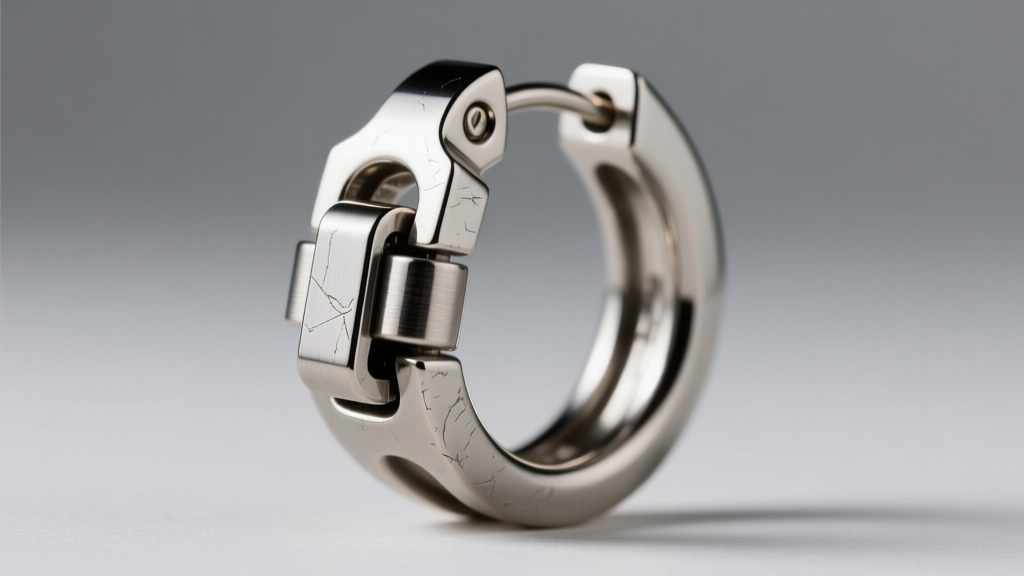
The clasp is the primary failure point for big thick hoop earrings. The shear strength of the closure mechanism must withstand the dynamic load of the heavy wire. Standard thin-wire latch-backs will bend and deform under the weight of anything thicker than 14-gauge.
Hinged Saddles vs. Latch-Backs vs. Continuous
- Hinged Saddle (Omega) Clasps: The gold standard for heavy hoops. These feature a thick, hinged post that locks into a secure saddle groove. They distribute weight across a wider surface area of the clasp body rather than concentrating it on a single thin pin.
- Clicker (Segment) Rings: Often used in thicker gauges (8G to 2G). The hinged segment snaps into place with a distinct 'click'. While highly secure, the hinge pin itself is a microscopic point of failure if subjected to lateral torque.
- Continuous (Endless) Hoops: These rely on the tension of the wire itself, with a thin pin sliding into a hollow tube. Expert Warning: Never use continuous hoops for big thick designs above 16-gauge. The tension required to keep the pin seated in thick wire is immense, and the pin will inevitably snap or slip out, resulting in lost jewelry.
Preventing Lobe Trauma: Wear Protocols
Wearing heavy, thick-gauge hoops requires proactive lobe management. The Association of Professional Piercers (APP) emphasizes that jewelry weight and gauge must be carefully balanced to prevent fistula damage. Implement the following protocols to protect your earlobes:
- Use Invisible Support Patches: Adhesive silicone lobe supports (like LobeWonder or similar medical-grade silicone patches) adhere to the back of the earlobe. They feature a reinforced slit that distributes the downward shear force of the earring across a 15mm surface area, completely neutralizing the cheese-cutter effect.
- Silicone O-Ring Buffering: For hoops with a post-and-clutch or saddle back, sliding a small, medical-grade silicone O-ring between the clasp and the back of the earlobe provides a shock-absorbing buffer that reduces friction and localized pressure necrosis.
- The 8-Hour Rule: Heavy solid-wire hoops should not be worn for more than 8-10 consecutive hours. Prolonged compression restricts blood flow to the fistula, leading to micro-tears and delayed healing.
- Sleeping Prohibitions: Never sleep in big thick hoops. The lateral pressure of a pillow against a 50mm hoop creates extreme torsional stress on the piercing channel, which can cause immediate blowouts or angular migration.
Expert Sizing Matrix: Diameter to Minimum Gauge
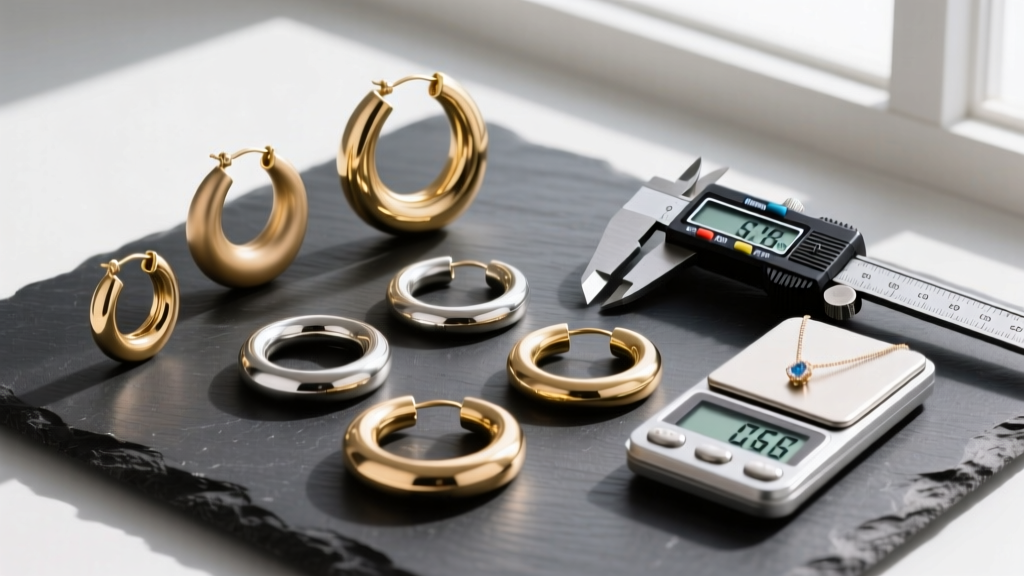
When commissioning or purchasing big thick hoop earrings, use this engineering matrix to ensure the wire thickness is sufficient to maintain a perfect circle under load. If the gauge is too thin for the diameter, the hoop will warp into an egg shape when the clasp is engaged.
| Inner Diameter | Minimum Gauge (Steel/Titanium) | Minimum Gauge (Solid Gold) | Structural Notes |
|---|---|---|---|
| 30mm - 40mm | 12G (2.0mm) | 10G (2.5mm) | Maintains shape well; standard lobe weight. |
| 45mm - 55mm | 10G (2.5mm) | 8G (3.2mm) | Requires hinged saddle clasp; monitor lobe fatigue. |
| 60mm - 75mm | 8G (3.2mm) | 6G (4.0mm) or Tubing | High dynamic swing; use silicone support patches. |
| 80mm+ | 6G (4.0mm) | Hollow Tubing Only | Extreme leverage; not recommended for fresh piercings. |
True luxury in statement jewelry is not just visual weight, but engineering elegance. A perfectly balanced thick hoop should feel substantial in the hand, yet remarkably unobtrusive when worn.
Final Engineering Considerations
Selecting the perfect pair of big thick hoop earrings requires looking beyond the display case and examining the structural integrity of the piece. By prioritizing biocompatible materials like ASTM F136 titanium for solid-wire designs, insisting on hinged saddle clasps for diameters over 40mm, and utilizing silicone support patches for heavy gold alloys, you can enjoy the bold aesthetic of oversized hoops without sacrificing the long-term health of your piercings. Always verify the exact millimeter gauge and gram weight before purchasing, ensuring your jewelry is engineered for both impact and endurance.


