Black Cross Earrings: Expert Guide to Metals, Gauges & Fit
Discover the metallurgy, gauge sizing, and structural fit of black cross earrings. Expert guide on PVD, black rhodium, and oxidized silver.


The appeal of black cross earrings spans multiple aesthetics, from minimalist gothic to high-fashion avant-garde. However, achieving a true, lasting black finish in fine jewelry requires navigating complex metallurgical challenges. Unlike yellow gold or polished silver, black is rarely a base metal; it is almost always a surface treatment, an alloy mixture, or a chemical reaction. As of 2026, advancements in vapor deposition and enamel firing have dramatically shifted how these pieces are manufactured, yet many consumers remain unaware of the structural vulnerabilities inherent in dark-finished jewelry.
This expert deep dive dissects the material science, gauge requirements, and biomechanical fit of black cross earrings, providing a technical framework for evaluating quality, longevity, and wearability.
The Metallurgy of Black: Coatings vs. Solid Alloys
When evaluating black cross earrings, the first critical step is identifying how the black color is achieved. The method dictates the earring's lifespan, hypoallergenic properties, and resistance to friction.
PVD (Physical Vapor Deposition)
Physical Vapor Deposition is currently the gold standard for durable black jewelry. In a vacuum chamber, titanium or zirconium is vaporized and bonded to a base metal (usually 316L surgical steel or titanium) at a molecular level. According to the Ganoksin Jewelry Making Network, PVD coatings can achieve a Vickers hardness (HV) of over 2,000, making it exponentially more scratch-resistant than traditional electroplating. For black cross earrings that are handled frequently or worn in cartilage piercings where friction is high, PVD-coated titanium is the most resilient choice.
Black Rhodium Plating
Black rhodium is an electroplated finish typically applied over 925 sterling silver or 14k/18k gold. It relies on a mixture of rhodium and other metals like ruthenium to create a dark, gunmetal-black hue. While it offers a brilliant, mirror-like dark finish that PVD sometimes lacks, it is fundamentally a surface plating. On a black cross earring, the high points of the cross and the earring post will experience friction, causing the black rhodium to wear away and reveal the bright silver or gold underneath within 6 to 18 months of daily wear.
Oxidized Sterling Silver
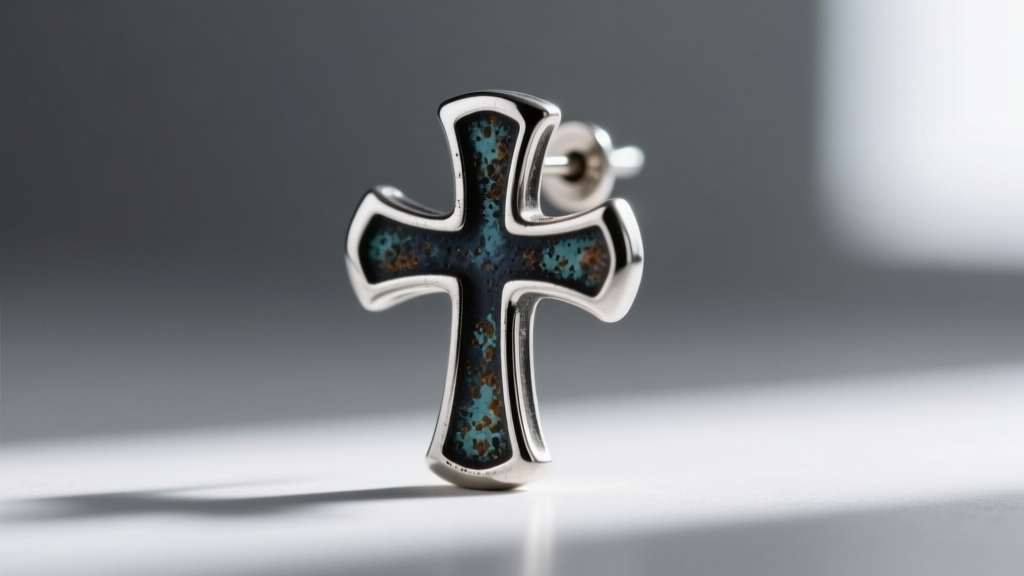
Oxidation is a chemical process, not a coating. Jewelers expose sterling silver to sulfur compounds (like liver of sulfur) to create a layer of silver sulfide on the surface. This creates a matte, antiqued black finish that settles deeply into the crevices of a cross design. The primary technical limitation of oxidized silver is that it is a sacrificial layer; the high-polish edges of the cross will naturally rub against hair and clothing, slowly returning to bright silver over time. This is considered a feature by some, but a defect by those expecting a permanent black finish.
Gauge Sizing and Torque Resistance for Cross Motifs
The geometry of a cross earring introduces unique biomechanical stress. Unlike a simple spherical stud, a cross has an extended vertical and horizontal axis. This creates a "lever arm" effect. If the earring post is too thin, the torque applied by a tight earring clutch or an accidental snag will permanently bend the post or, worse, tear through the earlobe.
The Association of Professional Piercers (APP) emphasizes the importance of appropriate gauge thickness for structural integrity and tissue health. Below is a technical breakdown of gauge sizing specifically for cross-shaped motifs.
| Gauge Size | Thickness (mm) | Torque Resistance | Best Application for Cross Motifs |
|---|---|---|---|
| 22G | 0.64mm | Very Low | Not recommended. High risk of post-bending and cheese-cutter effect in lobes. |
| 20G | 0.81mm | Low-Medium | Small, lightweight crosses (under 8mm height) for standard lobe piercings. |
| 18G | 1.02mm | Medium-High | Ideal for medium lobe crosses (10mm-15mm). Provides adequate lever resistance. |
| 16G | 1.29mm | High | Required for cartilage (helix/conch) or heavy, oversized gothic cross designs. |
| 14G | 1.60mm | Very High | Heavy statement pieces, stretched lobes, or industrial cross barbells. |
Common Failure Modes in Dark Aesthetic Jewelry
Understanding how black cross earrings fail allows buyers and collectors to make informed purchasing decisions. Here are the most frequent structural and cosmetic failure modes:
- Post-Plating Stripping: When black rhodium or PVD is applied to the entire earring, including the post, the friction of pushing a metal or silicone clutch back and forth will strip the black coating off the post within weeks. High-end manufacturers often leave the post uncoated (bright gold or silver) or use a friction-fit silicone O-ring to preserve the post's finish.
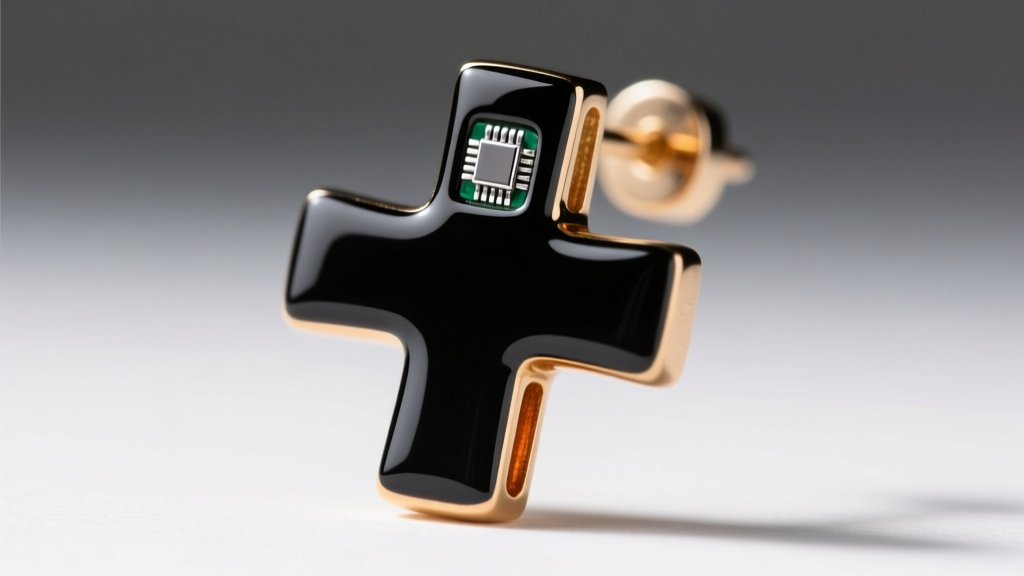
- Enamel Spalling: Some black cross earrings utilize black enamel. If the manufacturer uses "cold enamel" (a two-part epoxy resin) rather than vitreous (kiln-fired) enamel, the material is susceptible to thermal shock and UV yellowing. A drop onto a hard surface will cause cold enamel to chip or spall away from the metal armature.
- Galvanic Corrosion: If a black cross earring is cast in silver but the post is soldered using a lower-karat, copper-heavy solder, exposure to sweat and moisture can create a galvanic cell. This leads to localized green/black corrosion at the solder joint, weakening the structural connection between the cross and the post.
Biomechanical Fit: Lobe vs. Cartilage Placement
The placement of a black cross earring dictates not just the gauge, but the backing mechanism and overall weight limits.
Standard Earlobe Placement
The earlobe is composed of dense fibrofatty tissue and can support significant weight—up to 6 or 8 grams for short periods. However, a top-heavy black cross earring worn in a slightly stretched lobe piercing will cause the earring to droop forward. To counteract this, experts recommend using a flat-back labret stud or a specialized support disc (like a silicone earring lifter) behind the lobe to distribute the weight across a wider surface area, keeping the cross perfectly vertical.
Cartilage Placement (Helix, Conch, Flat)
Cartilage lacks the elasticity and blood flow of the earlobe. It is highly prone to irritation bumps and migration if subjected to uneven pressure. For a black cross earring worn in the cartilage, a traditional butterfly clutch is strictly contraindicated; the prongs can press into the concha or helix fold, causing pressure necrosis or severe irritation. Instead, internally threaded 16G or 14G flat-back labrets are mandatory. The cross motif should be bezel-set or laser-welded directly to the flat disc, ensuring the total weight remains under 3 grams to prevent tissue rejection.
"When fitting geometric shapes like crosses in cartilage, the center of gravity is your biggest enemy. A 12mm cross on a standard 6mm post will act as a lever, constantly pulling on the fistula. You must calculate the weight-to-post-length ratio to ensure the jewelry sits flush and stable." — Senior Piercer & Jewelry Fabricator
Pricing Tiers & Material Benchmarking
When shopping for black cross earrings, price is a direct indicator of the manufacturing technique and base metal quality. Use this benchmark to evaluate market offerings:
- Tier 1: Fast Fashion ($10 - $30) Base metals (brass, zinc alloy) coated in black epoxy paint or thin electroplating. High risk of contact dermatitis and rapid finish degradation. Posts are often 22G and prone to snapping.
- Tier 2: Mid-Range Artisan ($45 - $120) 925 Sterling Silver with oxidized or black rhodium finishes. Good detail and weight, but requires periodic re-plating or re-oxidation by a jeweler to maintain the dark aesthetic.
- Tier 3: Fine & Implant Grade ($150 - $400+) Solid 14k/18k gold with precision-set black diamonds, or Implant-Grade Titanium with high-end PVD coating. These pieces offer lifetime structural integrity, hypoallergenic safety, and permanent color fastness.
Ultimately, selecting the perfect black cross earring requires looking past the initial aesthetic and scrutinizing the engineering beneath the surface. By prioritizing proper gauge thickness, understanding the realities of black metallurgy, and matching the earring's biomechanics to your specific piercing anatomy, you can secure a piece that is as structurally enduring as it is visually striking.


