Blue Lace Agate Earrings: 2026 Trend & Style Guide
Discover how to style blue lace agate earrings in 2026. Explore trend forecasts, face-shape pairings, metal choices, and care tips for this serene stone.

The 2026 Resurgence: Serenity Core and Quiet Luxury
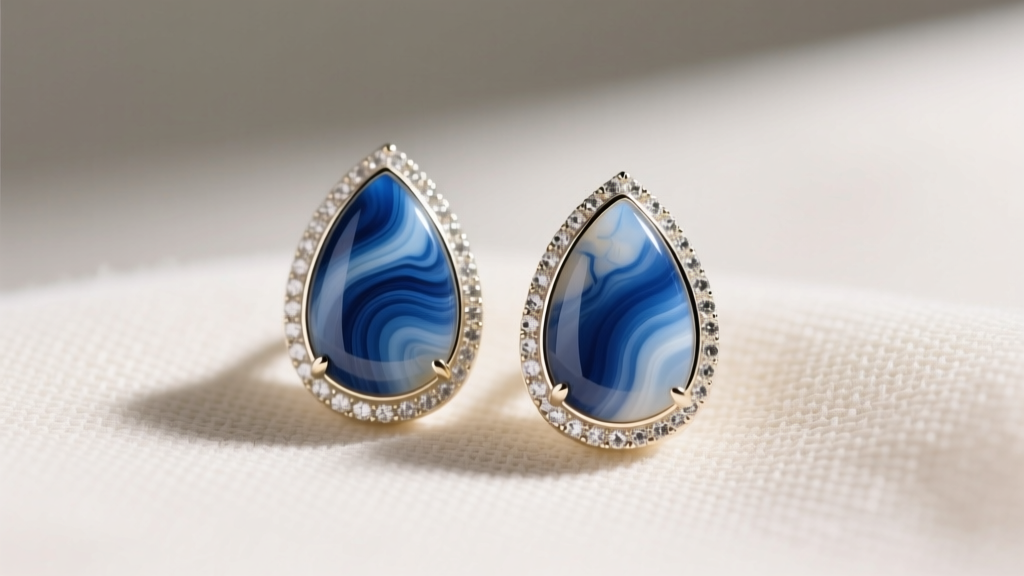
As we navigate the jewelry landscape of 2026, the industry is pivoting sharply away from the hyper-saturated, dopamine-dressing trends of the early 2020s. In their place, "Serenity Core" and "Quiet Luxury" have taken the helm, placing a premium on calming hues, organic textures, and understated elegance. At the epicenter of this shift are blue lace agate earrings, a staple that bridges the gap between accessible fashion jewelry and high-end artisanal design.
Blue lace agate is a variety of banded chalcedony, a microcrystalline quartz composed of silicon dioxide. According to the Mindat mineralogical database, its signature pale, icy blue color—often interlaced with striking white, gray, or soft lavender banding—is caused by trace inclusions of minerals like hornblende or dumortierite. With a Mohs hardness of 6.5 to 7 and a specific gravity of roughly 2.60, it is durable enough for everyday ear wear, provided the setting is engineered correctly.
Cut, Setting, and Silhouette Trends
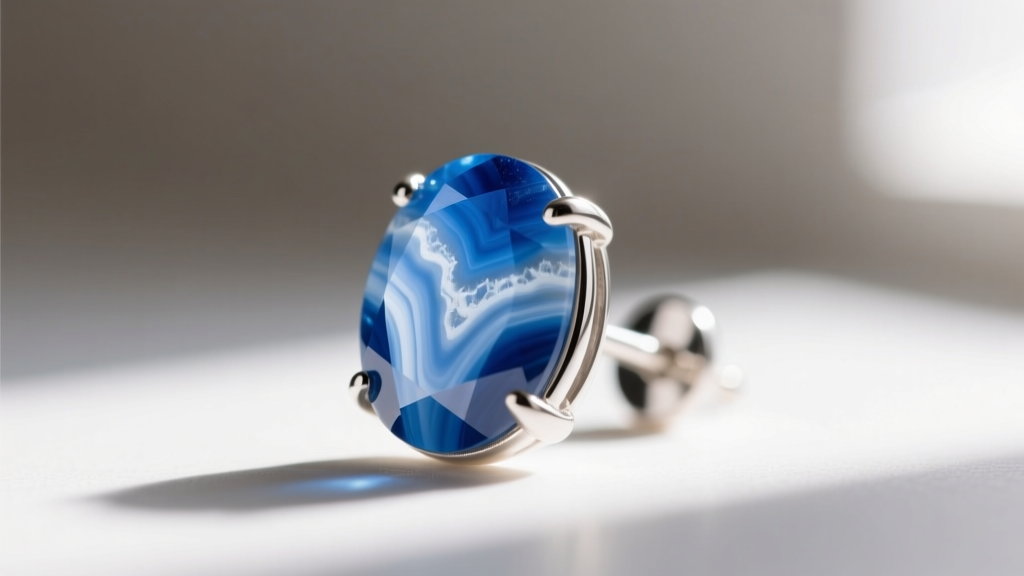
The way designers are cutting and setting blue lace agate has evolved significantly. While the traditional smooth cabochon remains popular for its ability to showcase the stone's concentric banding, 2026 has introduced a wave of rose-cut and fantasy-cut agates. By adding shallow facets to the dome of the cabochon, lapidaries are increasing the stone's light return, giving the typically opaque material a translucent, glassy luster at the edges.
The Dominance of the Bezel Setting
Because chalcedony possesses a conchoidal fracture and can chip along its banding lines if struck, prong settings are increasingly being abandoned for bezel and semi-bezel designs. A fully wrapped 14k gold or sterling silver bezel not only protects the girdle of the stone but also provides a sleek, architectural frame that aligns perfectly with modern minimalist aesthetics. For dangle and drop earrings, articulated bezel-set links are replacing rigid wire-wrapping, allowing the stone to move fluidly with the wearer.
Face Shape & Style Matrix
Selecting the right silhouette for your face shape is critical when styling statement stones. Blue lace agate's soft, powdery blue tone draws the eye, making the physical outline of the earring just as important as the gem itself. Below is our 2026 styling matrix for pairing face shapes with specific earring types.
| Face Shape | Recommended Style | Why It Works | Styles to Avoid |
|---|---|---|---|
| Round | Linear Drops & Rectangular Studs | Elongates the face and adds structural angles to soft curves. | Large circular hoops or wide button studs. |
| Square | Oval Cabochons & Curved Huggies | Softens the jawline and introduces organic, flowing lines. | Boxy, geometric, or sharp-edged dangles. |
| Heart | Teardrop Dangles & Chandelier | Adds visual weight to the lower half of the face, balancing a wider forehead. | Top-heavy triangles or wide ear cuffs. |
| Oval | Geometric Studs & Medium Hoops | Universally flattering; maintains the natural symmetry of the face. | Overly long drops that drag the features down. |
Metal Pairings: Enhancing Icy and Lavender Undertones
The metal you choose dramatically alters the visual temperature of blue lace agate. In 2026, jewelers are moving beyond standard yellow gold to explore nuanced metal alloys that interact with the stone's unique inclusions.
- White Gold & Platinum: The undisputed champions of the "icy" aesthetic. The cool, reflective nature of rhodium-plated 14k or 18k white gold amplifies the pale blue and gray bands, making the earrings look crisp and modern.
- Sterling Silver (Oxidized): For a vintage, artisanal look, oxidized sterling silver provides a dark, moody contrast that makes the white lace-like patterns pop. This is highly favored in bohemian and gothic-romantic subcultures.
- Rose Gold: A rising trend for 2026. The warm, coppery tones of 14k rose gold create a beautiful complementary contrast with the blue stone, while simultaneously pulling out the subtle lavender and mauve undertones hidden in Namibian and South African agate deposits.
Sizing, Gauges, and the "Cheese-Cutter" Effect
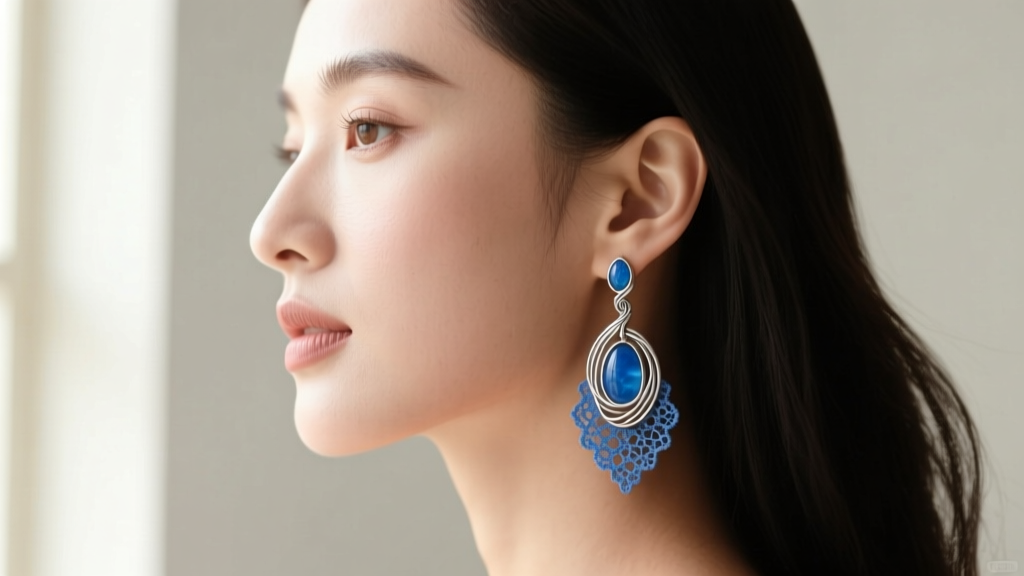
One of the most overlooked aspects of buying gemstone earrings is the relationship between stone density, earring weight, and wire gauge. Blue lace agate has a specific gravity of 2.60, meaning it is noticeably heavier than acrylic, resin, or even some porous organic gems like coral.
A standard 15mm cabochon drop earring can easily weigh between 3.5 and 5 grams. If this is suspended on a flimsy 22-gauge (0.6mm) ear wire, the weight will pull the earring forward, causing the thin wire to slice through the bottom of the earlobe piercing—a painful phenomenon known in the body modification community as the "cheese-cutter effect."
Gauge Recommendations for 2026
- 20-Gauge (0.81mm): Acceptable only for lightweight, small studs (under 2 grams) or sleepers.
- 18-Gauge (1.0mm): The minimum standard for medium-sized drops and dangles. Provides enough structural integrity to hold the stone upright without bending.
- 16-Gauge (1.2mm): Essential for heavy statement pieces, elongated linear drops, or any blue lace agate flat-backs intended for cartilage piercings (like the helix or conch), where thicker jewelry is required to prevent migration and irritation.
Authenticity, Dye Detection, and Pricing Tiers
Because natural, high-contrast blue lace agate is relatively rare, the market is flooded with dyed gray or white chalcedony. The Gemological Institute of America (GIA) notes that chalcedony is highly porous and readily accepts chemical dyes. To spot dyed stones, use a 10x jeweler's loupe to examine the fractures and banding lines; if you see concentrated pools of dark blue pigment accumulating in the cracks, the stone has likely been treated.
Here is what you can expect to pay for authentic, well-crafted blue lace agate earrings in the current market:
- Entry-Level ($25 - $60): Commercial-grade stones with muddy or low-contrast banding, typically set in 925 sterling silver with simple prong or glued settings. Often dyed.
- Mid-Tier ($80 - $250): High-quality, natural (untreated) stones with crisp, distinct white and blue banding. Set in 14k gold-filled, vermeil, or solid 10k/14k gold with secure bezel settings. Expect precise lapidary work.
- Artisan & Fine ($300 - $800+): Custom-cut, fantasy-faceted, or matched pairs of premium Namibian blue lace agate. Set in solid 18k gold or platinum, often accented with diamond or white sapphire melee. These are investment pieces from independent jewelers.
Care and Maintenance for Banded Chalcedony
Despite its respectable 6.5 to 7 Mohs hardness, blue lace agate requires specific care to maintain its luster and structural integrity. The primary enemy of banded chalcedony is the ultrasonic cleaner. The high-frequency vibrations can cause the stone to fracture along its natural banding planes or microscopic stress fractures.
Instead, clean your earrings using a solution of lukewarm water and a few drops of mild, phosphate-free dish soap. Use a soft-bristled baby toothbrush to gently sweep away skin oils and lotion buildup from the back of the cabochon and the setting's gallery. Rinse thoroughly and dry with a lint-free microfiber cloth. When storing, keep your blue lace agate earrings in a soft pouch away from harder gems like diamonds, sapphires, or topaz, which can easily scratch the agate's polished surface.


