The Ultimate Budget Guide to Earrings for Double Pierced Lobes
Discover the best budget earrings for double pierced lobes. Learn how to mix metals, match gauges, and find hypoallergenic value sets under $50.

The Economics of Curating a Double Lobe Stack
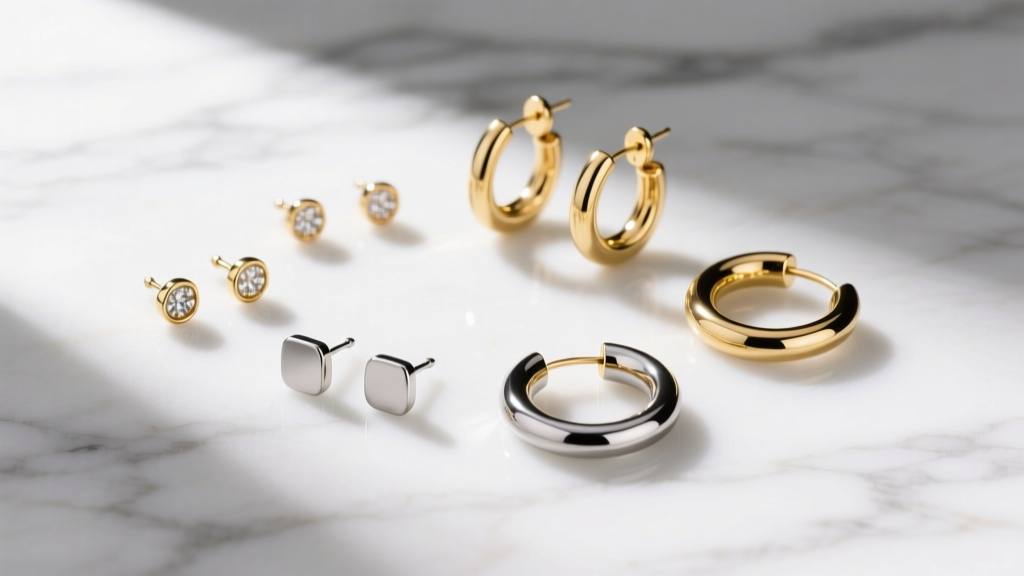
Curating a double lobe stack is an exercise in spatial geometry as much as it is a matter of personal style. When shopping for earrings for double pierced lobes on a budget, the primary challenge is not just finding affordable pieces, but finding pieces that physically coexist without overlapping, snagging, or causing friction-induced irritation. The standard distance between a first and second lobe piercing typically ranges from 6mm to 8mm. This tight real estate means that a 7mm stud in your first hole will physically collide with a 12mm hoop in your second hole, leading to metal-on-metal friction that degrades cheaper plating and irritates the fistula.
To build a high-impact, low-cost stack, you must approach your jewelry box like an economist: allocate your budget toward structural integrity and hypoallergenic basemetals, while saving on decorative complexity. In this guide, we break down the exact material grades, gauge specifications, and pairing formulas you need to curate a premium-looking double lobe stack without exceeding a $60 total budget.
Material Grades vs. Price: What You Are Actually Paying For
The most common mistake budget shoppers make is prioritizing the color of the metal over its elemental composition. Cheap fashion jewelry often uses brass or nickel-silver bases coated in microscopic layers of gold or rhodium. According to the Association of Professional Piercers, nickel exposure is the leading cause of contact dermatitis in healed piercings, and budget earrings are notorious for hiding nickel in their alloys or solder points.
When evaluating earrings for double pierced lobes, you must look for specific metallurgical designations. Here is how the most common budget materials stack up in terms of value, longevity, and biological safety.
| Material Grade | Average Price Range | Nickel Content | Longevity & Value Assessment |
|---|---|---|---|
| 316L Surgical Steel | $10 - $20 | 8% - 10% | Poor for sensitive skin. High risk of allergic reaction. Good only for short-term wear in fully healed, non-reactive lobes. |
| ASTM F-136 Titanium | $25 - $45 | 0% (Nickel-Free) | Exceptional value. Implant-grade, lightweight, and will never tarnish or cause allergic reactions. The gold standard for budget buyers. |
| 14k Gold Vermeil | $30 - $55 | 0% (Sterling Base) | Moderate value. Requires a 2.5-micron gold layer over sterling silver. Will eventually wear off with friction and moisture exposure. |
| Brass / Nickel Silver | $5 - $15 | High / Variable | Zero value for pierced ears. High failure rate, rapid oxidation, and severe allergy risk. Avoid entirely. |
For the ultimate budget-friendly and biocompatible stack, ASTM F-136 implant-grade titanium is unmatched. Many independent jewelers now offer PVD (Physical Vapor Deposition) coated titanium, which gives you the rich 14k or 18k gold aesthetic with the indestructible, hypoallergenic core of titanium, usually priced between $25 and $35 per piece.
Gauge Sizing and Post Thickness: Avoiding the Cheapest Trap
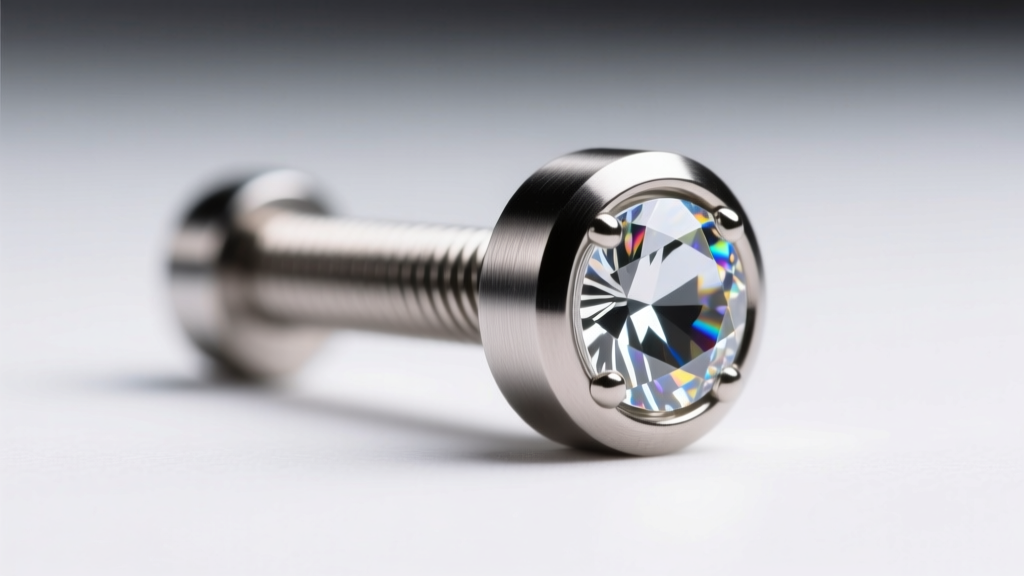
Budget earrings frequently cut costs by reducing the volume of metal used in the post or wire. Standard lobe piercings are typically pierced at 18-gauge (1.02mm) or 20-gauge (0.81mm). However, mass-produced budget earrings often utilize 22-gauge (0.64mm) or even 24-gauge wires.
While a thinner wire might save the manufacturer fractions of a cent, it introduces a severe mechanical failure mode known in the piercing community as the 'cheese-cutter effect.' A 22-gauge wire lacks the structural rigidity to support the weight of a decorative end or a small hoop. Over time, the thin wire bends, creating micro-abrasions inside the fistula (the piercing channel). Furthermore, thin wires easily warp when you sleep on them, making insertion difficult and painful the next morning.
The Value Rule: Never purchase earrings for double pierced lobes that are thinner than 20-gauge (0.81mm). If a product listing does not explicitly state the gauge size, assume it is 22-gauge and avoid it. Spending an extra $8 for a solid 18-gauge or 20-gauge post is an investment in the long-term health of your piercing channel.
Strategic Pairing: Maximizing Visual Impact on a Budget
Because the second lobe piercing is smaller and sits closer to the edge of the ear, it requires specific proportions. You do not need to buy expensive, diamond-encrusted pieces for both holes to achieve a luxurious look. By utilizing strategic contrast, you can elevate budget-friendly pieces.
Formula 1: The Minimalist Contrast (Total Budget: ~$40)
- First Lobe (Focal Point): 4mm or 5mm bezel-set CZ flat-back labret in PVD gold titanium ($22). The bezel setting prevents prongs from snagging on hair.
- Second Lobe (Accent): 8mm or 10mm seamless plain titanium hoop ($18). The lack of a clasp or hinge keeps the cost down while providing a sleek, continuous line.
Formula 2: The Textured Edge (Total Budget: ~$35)
- First Lobe: 3mm matte-finish titanium ball stud ($15). The matte texture catches the light differently than polished metal, looking intentionally high-end.
- Second Lobe: 10mm twisted wire huggie or rope-texture hoop ($20). The intricate wire wrapping mimics the look of expensive artisan craftsmanship.
Formula 3: The Asymmetric Drop (Total Budget: ~$45)
- First Lobe: Small 6mm geometric drop earring with a secure fishhook and silicone stopper ($25).
- Second Lobe: 4mm flat disc stud ($20). The disc acts as an industrial, modern anchor that allows the first lobe drop to take center stage without visual clutter.
Real-World Value Sets: Where to Spend and Where to Save
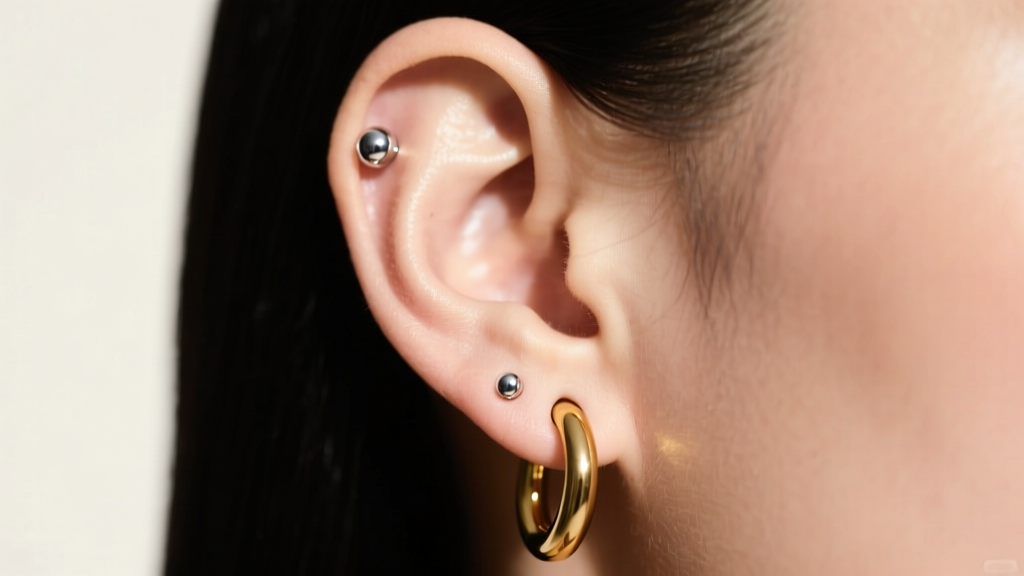
When allocating your budget across a double lobe stack, the golden rule of jewelry curation applies: Spend on the anchor, save on the satellite.
Your first lobe piercing is the anchor. It is the most visible, occupies the largest surface area, and dictates the overall tone of your ear stack. This is where you should allocate 60% to 70% of your budget. Invest in a high-quality CZ, a genuine freshwater pearl, or a precisely machined titanium end with a secure threading mechanism (such as internal or threadless press-fit).
Your second lobe piercing is the satellite. Its job is to frame and support the anchor. This is where you save. A simple, polished 10mm seamless hoop or a plain 3mm dome stud costs significantly less to manufacture because it requires no stone setting, no complex hinges, and no intricate casting. By pairing a $35 statement stud in the first hole with a $12 basic seamless hoop in the second, you achieve a balanced, expensive-looking stack for under $50.
Maintenance and Failure Modes of Budget Jewelry
Budget jewelry requires more rigorous maintenance to prevent premature degradation. If you opt for 14k gold vermeil over solid gold or PVD titanium, you must understand the mechanics of plating wear. The Gemological Institute of America (GIA) notes that gold plating thickness dictates its lifespan; vermeil must be at least 2.5 microns thick to be legally classified as such, but even this will wear away if subjected to constant friction.
Common Budget Failure Modes & Solutions:
- Vermeil Friction Burn: Sleeping in vermeil huggies causes the gold layer to rub off against your pillow, exposing the sterling silver base which then oxidizes and turns black. Solution: Remove vermeil hoops before bed, or switch to PVD-coated titanium for 24/7 wear.
- Butterfly Back Moisture Traps: Budget studs almost always use push-on butterfly backs. These trap dead skin, sebum, and shower moisture against the earlobe, leading to foul odors and localized infections. Solution: Discard the butterfly backs and purchase aftermarket silicone O-rings or flat-back labret posts.
- Hinge Tension Loss: Cheap huggie hoops with hinged closures and click-shut mechanisms often lose their tension after 20 to 30 open-close cycles, causing the hoop to pop open and fall out. Solution: Avoid hinged budget hoops entirely. Opt for continuous seamless hoops or segment rings, which rely on the natural tension of the metal circle rather than a fragile mechanical hinge.
By understanding the spatial constraints of your piercings, demanding proper gauge thickness, and strategically allocating your funds between focal points and accents, you can build a stunning, biocompatible double lobe stack that defies its price tag. True value in jewelry is not about the lowest possible price; it is about maximizing wearability, safety, and aesthetic impact for every dollar spent.


