Star Hoop Earring Value Guide: Best Budget Picks 2026
Discover the true value of a star hoop earring across price tiers. We break down materials, gauge sizes, and fair pricing for 2026.

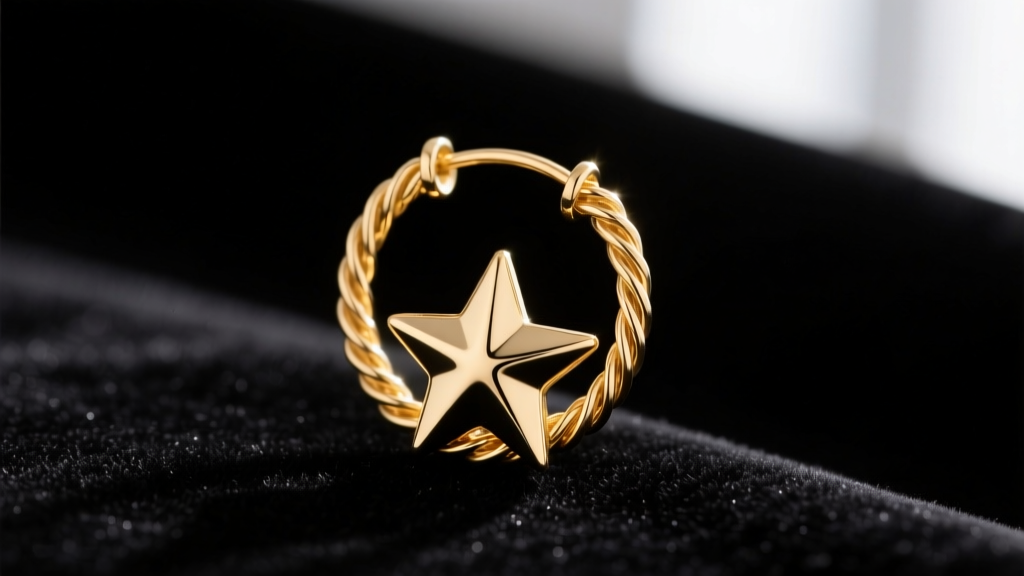
The celestial jewelry trend shows no signs of waning in 2026, cementing the star hoop earring as a permanent staple in both everyday minimalist capsules and maximalist evening stacks. However, as demand has surged, the market has become saturated with wildly varying price points—from $12 fast-fashion finds to $600 fine jewelry boutique pieces. For the savvy consumer, this creates a confusing landscape where a higher price tag does not always guarantee superior structural integrity or material longevity.
As a jewelry style analyst, I frequently see consumers overpay for poorly constructed vermeil or underpay for pieces that will inevitably fail at the clasp within a month. Assessing the true budget and value of a star hoop earring requires looking past the brand name and directly into the metallurgy, wire gauge, and manufacturing techniques. This comprehensive guide will break down exactly what you should be paying, what materials actually hold up to daily wear, and the hidden structural failure modes you must inspect before checking out.
The Anatomy of a Star Hoop Earring: Where the Money Goes
Unlike a simple, continuous wire hoop, a star hoop earring introduces a complex center of gravity. The addition of a star charm—whether it is a flat-cut silhouette, a puffed 3D casting, or a diamond-pave motif—creates a pendulum effect. This dynamic places immense stress on two specific areas: the hoop wire itself and the clasp mechanism.
Wire Gauge and the Pendulum Effect
The thickness of the hoop wire, measured in gauges, dictates how well the earring will hold its shape under the weight of the star charm. Many budget brands cut costs by using 20-gauge (0.81mm) or 22-gauge (0.64mm) wire. While this is fine for lightweight, charm-less huggies, it is a structural liability for star hoops.
- 20-Gauge to 22-Gauge (0.64mm - 0.81mm): Too thin. The weight of a standard 8mm to 12mm star charm will cause the wire to warp, bend, and eventually snap at the stress point near the clasp.
- 18-Gauge (1.02mm): The industry standard for quality demi-fine jewelry. It provides enough rigidity to support a medium-weight star charm without bending during daily wear.
- 16-Gauge (1.29mm) to 14-Gauge (1.63mm): Reserved for high-end, solid gold pieces featuring heavier, 3D-cast puffed stars or diamond-encrusted charms. This thickness ensures zero warping over decades of use.
When assessing value, always check the product specifications for the wire gauge. If a brand charges over $80 for an 18-gauge or thinner gold-plated hoop, you are paying for marketing, not materials.
Material Tier Breakdown: PVD, Vermeil, Gold-Filled, and Solid Gold
The most significant factor in your budget assessment is the base metal and the method of gold application. In 2026, plating technologies have advanced, but the fundamental rules of wear-and-tear remain unchanged.
PVD Plated Stainless Steel (The Budget King)
Physical Vapor Deposition (PVD) uses titanium nitride to bond a gold-colored finish to a 316L stainless steel base. This is the most durable plating method available for under $30. PVD is highly resistant to sweat, water, and friction. However, it is not 'real' gold, meaning it lacks the warm, buttery luster of genuine karat gold and cannot be polished or replated by a traditional jeweler once it eventually wears through.
Gold Vermeil (The Demi-Fine Standard)
According to the Federal Trade Commission Jewelry Guides, gold vermeil must consist of a sterling silver base plated with at least 2.5 microns of 10k, 14k, or 18k gold. While 2.5 microns is the legal minimum, the friction of a hoop earring sliding through the ear piercing will wear this down rapidly. For a star hoop earring that you intend to wear daily, seek out brands that explicitly state they use 3 to 4 microns of plating. Expect to pay between $45 and $90 for high-quality vermeil.
14k Gold-Filled (The Value Champion)
Gold-filled jewelry is created by mechanically bonding a thick layer of solid gold to a brass core using heat and pressure. By law, the gold must constitute at least 1/20th (5%) of the total weight of the item. Because the gold layer is up to 100 times thicker than standard flash plating, a 14k gold-filled star hoop earring can easily last 5 to 10 years of daily wear without exposing the brass core. This is the ultimate 'sweet spot' for budget-conscious buyers who demand real gold in the piercing.
Solid 14k or 18k Gold (The Heirloom Investment)
Solid gold requires no plating and will never tarnish or wear away. The Gemological Institute of America (GIA) notes that 14k gold (58.5% pure gold) offers the ideal balance of rich color and structural durability for hoop earrings, which are prone to being tugged and snagged. Solid gold star hoops will range from $150 for minimalist, lightweight 15mm huggies up to $800+ for intricate, diamond-set designs.
Pricing & Value Matrix: What Should You Actually Pay?
Use this matrix to benchmark the price of a standard 15mm to 25mm star hoop earring with a single charm. If a piece falls significantly outside these ranges, you must question the material authenticity or the brand's markup.
| Material Tier | Base Metal | Gold Layer / Thickness | Fair Price Range (15-25mm) | Expected Daily Lifespan |
|---|---|---|---|---|
| PVD Plated | 316L Stainless Steel | Titanium Nitride (PVD) | $15 - $35 | 1 - 3 Years |
| Standard Plated | Brass or Copper | 0.1 - 0.5 Microns | $10 - $25 | 1 - 3 Months |
| Gold Vermeil | Sterling Silver (925) | 2.5 - 4.0 Microns | $45 - $95 | 1 - 3 Years |
| Gold-Filled | Jeweler's Brass | 1/20 14k GF (Mechanical) | $40 - $85 | 5 - 10+ Years |
| Solid 14k Gold | N/A (Solid Alloy) | 58.5% Pure Gold | $150 - $450 | Lifetime / Heirloom |
Structural Integrity & Failure Modes to Watch For
Even if you purchase a solid 14k gold star hoop earring, poor bench craftsmanship can render it useless within weeks. When assessing value, you must inspect the structural weak points inherent to this specific design.
'The most common repair I see with charm hoops is the detachment of the charm itself. If a manufacturer uses low-temperature 'easy' solder to attach the star charm's jump ring to the hoop, a simple drop onto a bathroom counter can shatter the solder joint. Laser welding or high-temperature hard solder is required for lasting durability.' — Master Bench Jeweler, 2026
The Clasp Friction Point
Hoop earrings rely on a post-and-latch or clicker mechanism. The post constantly rubs against the inside of the ear piercing and the receiving tube of the clasp. In gold-plated or thin vermeil pieces, this friction acts like sandpaper, stripping the gold away at the clasp joint within months, exposing the base metal and causing skin irritation or green discoloration. Gold-filled and solid gold are the only materials that can withstand this localized friction long-term.
Jump Ring Integrity
How is the star charm attached to the hoop? If it hangs from a small circular jump ring, look closely at the seam. If the jump ring is not soldered completely shut, the star charm will eventually slide through the microscopic gap and be lost. High-value brands will either use laser-welded shut jump rings or cast the star charm directly onto a custom link that wraps around the hoop wire.

How to Inspect a Star Hoop Earring Before Buying
Whether you are shopping online or examining a piece in a brick-and-mortar boutique, run through this rapid assessment checklist to ensure you are getting genuine value for your budget:
- Check the Weight Balance: Hold the hoop by the top clasp. Does the star charm immediately pull the hoop forward and droop? If so, the hoop wire is too thin or the charm is too heavy, guaranteeing a warped shape over time.
- Verify the Hallmark: Look for stamped markings on the thickest part of the wire or the inside of the clasp. '14k GF' indicates gold-filled. '925' indicates sterling silver (the base for vermeil). '14k' or '585' indicates solid gold. A lack of stamps usually implies cheap brass with flash plating.
- Test the Clasp Tension: Open and close the latch-back mechanism. It should snap shut with a definitive, crisp 'click' and exhibit no lateral wobble. A loose clasp will inevitably lead to a lost earring.
- Examine the Star Edges: Run your finger over the points of the star charm. High-quality castings will have slightly softened, polished edges. Cheap, mass-stamped metal stars will have razor-sharp burrs that can catch on hair and clothing.
Final Verdict: Maximizing Your Budget
The true value of a star hoop earring is not dictated by the prestige of the brand, but by the harmony of its metallurgy and structural engineering. If your budget is strictly under $35, bypass vermeil entirely and opt for PVD-coated 316L stainless steel to ensure the piece survives daily wear and moisture exposure. If you can stretch your budget to the $45 to $85 range, 14k gold-filled hoops offer the undisputed best return on investment, providing the authentic look and feel of solid gold with a decade-long lifespan. Reserve solid 14k gold purchases for heirloom-quality, 16-gauge designs that you intend to wear in the shower, at the gym, and to sleep. By prioritizing gauge thickness, secure jump rings, and transparent material sourcing, you can build a celestial jewelry collection that shines brilliantly without draining your wallet.


