Buying Guide: Choosing the Best Crystal Teardrop Earrings
Discover what to look for when buying crystal teardrop earrings. Learn about facet cuts, metal settings, and weight distribution for perfect dangles.

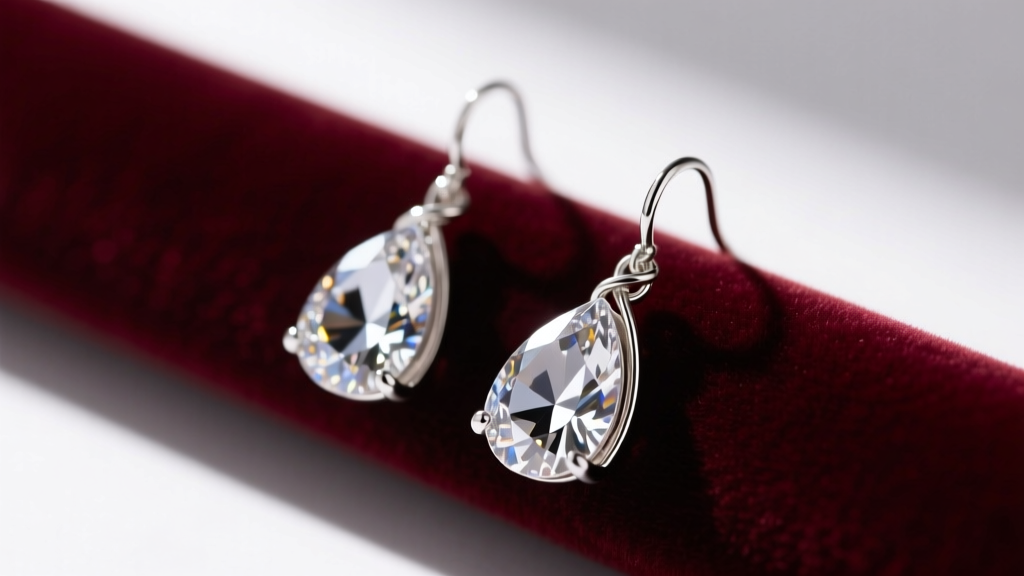
The Anatomy of a Teardrop Earring
Crystal teardrop earrings occupy a unique space in fine and fashion jewelry, bridging the gap between daytime subtlety and evening glamour. However, as we navigate the 2026 jewelry market, the term "crystal" has become a catch-all that obscures vast differences in material quality, cutting precision, and hardware durability. To make an informed purchase, you must first understand the structural anatomy of the teardrop silhouette.
Briolette vs. Pear Cut: Understanding the Shape
Not all teardrops are created equal. The two most common cuts you will encounter are the briolette and the pear cut. According to the Gemological Institute of America (GIA), a pear cut features a flat back, a rounded belly, and a single pointed tip, typically secured in a prong setting. A briolette, conversely, is a fully three-dimensional, teardrop-shaped gemstone covered in triangular or diamond-shaped facets and usually top-drilled to hang freely from a wire. Briolettes offer superior light refraction from every angle because they lack a flat "table" facet, making them the preferred choice for high-end crystal dangles.
Crystal Types: Natural vs. Precision-Cut
The optical performance of your earrings depends entirely on the material's refractive index (RI) and the precision of its faceting. When shopping, you will generally encounter three categories of crystal drops:
| Material Type | Refractive Index (RI) | Weight Profile | Best Hardware Setting |
|---|---|---|---|
| Precision-Cut Lead-Free Crystal | 1.52 - 1.58 | Lightweight | Wire-wrapped 20g hooks |
| Cubic Zirconia (CZ) | 2.15 - 2.18 | Heavy (Dense) | 18g Prong or Bezel |
| Natural Quartz / Rock Crystal | 1.54 - 1.55 | Medium | Wire-wrapped or Bezel |
In recent years, the industry has shifted heavily toward advanced lead-free crystal formulations. Historically, lead oxide was added to glass to increase its RI and brilliance. Today, top-tier manufacturers use barium and zinc oxides to achieve comparable sparkle without the toxicity, aligning with modern sustainability standards. Cubic Zirconia, while technically a crystal simulant, offers a much higher RI, resulting in intense "fire" (color dispersion), but its high density means a large CZ teardrop can easily overstretch an earlobe.
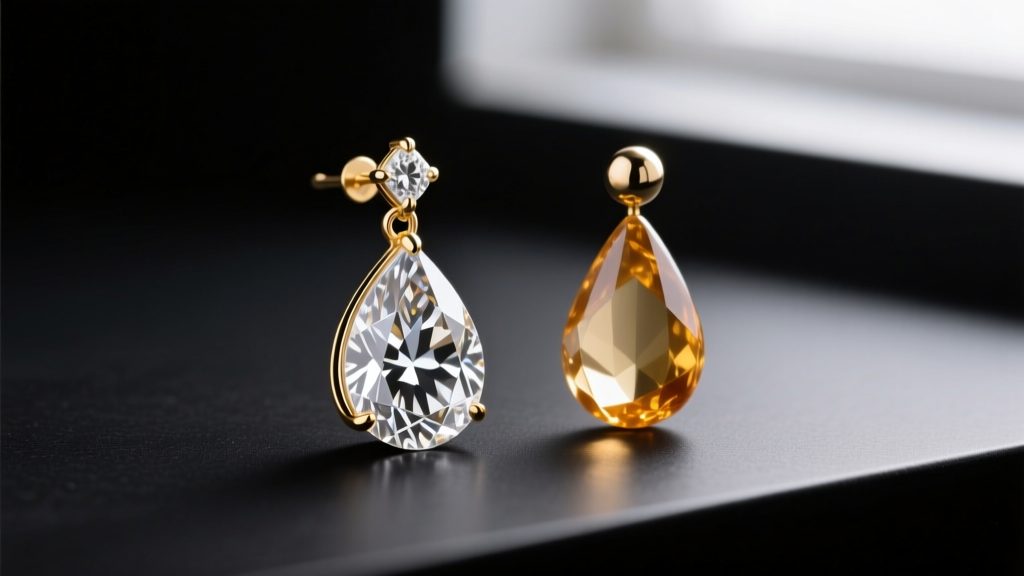
Metal Settings & Hardware: What Holds the Drop
The most common point of failure in teardrop earrings is not the crystal itself, but the hardware connecting it to the ear. The Federal Trade Commission (FTC) Jewelry Guides mandate strict accuracy in metal stamping, but they do not regulate wire thickness, which is crucial for your comfort.
Wire Wraps vs. Prong Settings
For briolette crystals, look for a tight, flush wire wrap at the top drill hole. The wire should be flush against the crystal with no sharp protruding ends that could snag on hair or knitwear. For pear-cut crystals, a four-prong or six-prong basket setting is ideal. Ensure the prongs are burnished smoothly over the crystal's girdle; if you can catch a fingernail under a prong, it will eventually snag and loosen the stone.
Post and Hook Gauges
Wire gauge dictates the thickness of the metal passing through your piercing. Standard earlobe piercings are typically done at 20-gauge (0.81mm) or 18-gauge (1.02mm). If you are buying heavy CZ teardrops, insist on an 18-gauge leverback. Using a thin 22-gauge wire for a heavy stone creates a "cheese cutter effect," where the thin wire slowly migrates through the earlobe tissue, causing irreversible stretching and tearing over time.
Weight & Ergonomics: Avoiding the "Earlobe Drag"
A beautiful earring is useless if it causes physical discomfort. The golden rule for daily-wear dangles is the 7-gram limit. Any single earring exceeding 7 grams will cause the earlobe to droop, forcing the teardrop to point forward rather than hanging straight down. This not only ruins the visual alignment of the facet cuts but also causes tension headaches and lobe soreness after a few hours of wear.
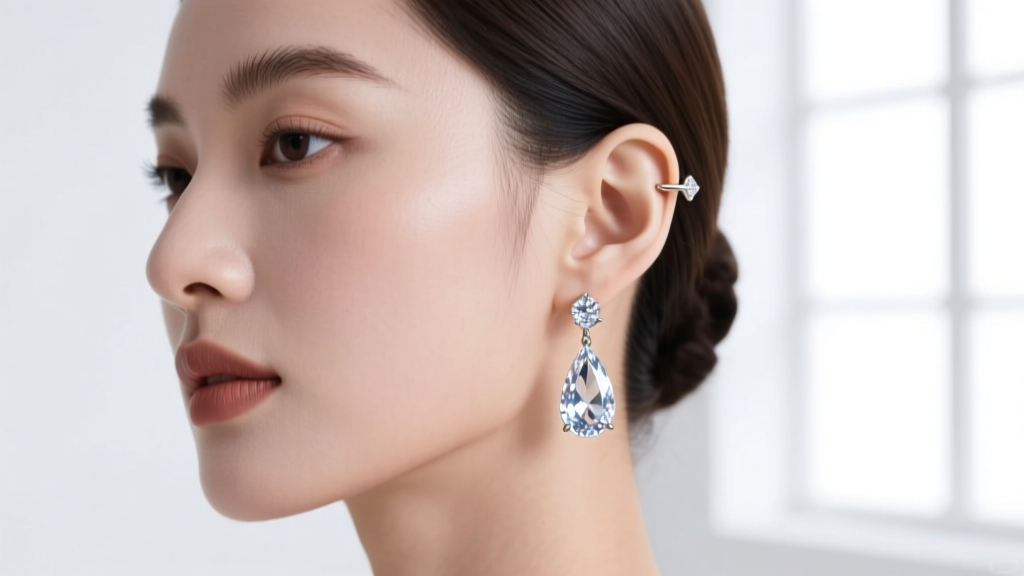
Styling & Face Shape Compatibility
Teardrop earrings are inherently elongating. Because of their directional pull, they interact differently with various facial structures:
- Round Faces: Long, narrow briolette teardrops (30mm+) are highly recommended. They create an optical illusion that lengthens the face and sharpens the jawline.
- Square Faces: Opt for softer, wider pear-cut crystals with rounded bellies. The curved lines of the crystal help soften angular jawbones.
- Heart-Shaped Faces: Choose teardrops where the widest part of the drop aligns with the narrowest part of your chin, adding visual weight to the lower half of the face.
Expert Styling Tip: When wearing statement crystal teardrops, keep your neckline clear. A deep V-neck or an off-the-shoulder top provides the negative space necessary for the light to catch the briolette facets without visual competition from busy patterns or high collars.
Final Checklist Before You Buy
Before adding a pair of crystal teardrop earrings to your cart, run through this rapid quality-assurance checklist to ensure you are getting a piece that will last:
- Facet Alignment: Look closely at the tip of the teardrop. The facets should meet at a single, precise point without any "windowing" (transparent, unfaceted dead spots).
- Hardware Security: If it is a leverback, test the hinge. It should snap shut with an audible click and show no lateral wobble.
- Metal Stamping: Verify the earring post or hook is stamped with a quality mark (e.g., 925 for Sterling Silver, 14K for Gold) as required by FTC guidelines.
- Weight Check: If buying online, check the product specifications for the exact gram weight. If it exceeds 7g per earring, ensure it features a specialized support mechanism, like a wider French wire or an earlobe stabilizer disc.
By prioritizing precise facet geometry, appropriate wire gauges, and ergonomic weight distribution, you can invest in crystal teardrop earrings that offer both breathtaking brilliance and all-day comfort.


