The 2026 Guide to Buying Female Earrings for Sensitive Ears
Discover what to look for when buying female earrings in 2026. Expert guide on implant-grade metals, gauge sizes, and closures for sensitive ears.
The Shift Toward Skin-Safe Jewelry in 2026
The landscape of ear adornment has evolved dramatically. In 2026, discerning buyers are no longer willing to sacrifice comfort for aesthetics, especially when shopping for female earrings designed for daily wear. The rise of advanced metallurgy and a deeper understanding of contact dermatitis have shifted the market away from mystery alloys and toward verifiable, implant-grade materials. If you experience redness, itching, or flaking after wearing standard mall-kiosk jewelry, you are likely reacting to trace nickel or poor finishing. This comprehensive buying guide breaks down exactly what to look for—from metal grades and gauge sizes to closure mechanisms—ensuring your next purchase is as kind to your skin as it is beautiful.
Decoding Metal Grades: The Foundation of Comfort
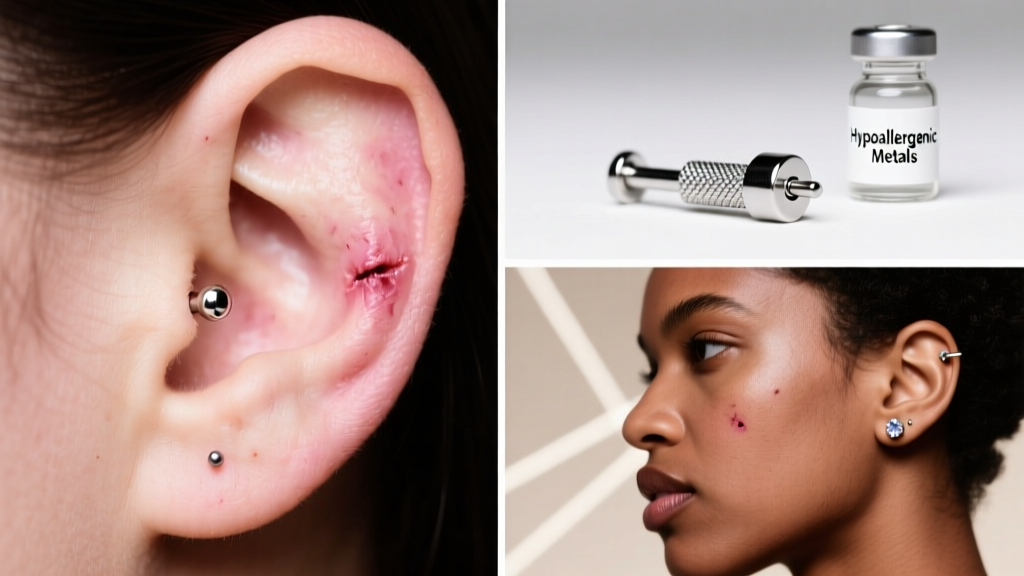
The term 'hypoallergenic' is largely unregulated in the jewelry industry and often serves as a marketing shield rather than a scientific guarantee. To truly protect sensitive ears, you must look for specific material standards. According to the Association of Professional Piercers (APP), only a few materials are consistently safe for long-term wear in sensitive or healing tissue.
The Safe List: What to Actually Buy
- Implant-Grade Titanium (ASTM F136): This is the gold standard for sensitive ears. It contains zero nickel, is highly polished, and is biocompatible. It is lightweight and will not tarnish.
- Niobium: A highly reactive metal that is naturally nickel-free. It is softer than titanium, making it ideal for intricate hoop designs and seamless rings.
- 14k or 18k Solid Gold (Nickel-Free): Gold must be alloyed for strength. Ensure the manufacturer explicitly states their white or yellow gold is alloyed with palladium or silver, not nickel. Avoid anything below 14k, as the higher percentage of base metals increases irritation risks.
- Platinum: Dense, durable, and inherently hypoallergenic, though it commands a premium price point.
| Material | Industry Standard | Nickel Risk | Avg. Price Range (Studs) |
|---|---|---|---|
| Implant-Grade Titanium | ASTM F136 / F1295 | Zero | $25 - $65 |
| Niobium | Reactive Metal | Zero | $20 - $50 |
| 14k Solid Gold | Palladium Alloyed | Very Low | $120 - $350 |
| 'Surgical' Stainless Steel | 316L / 316LVM | High (8-10%) | $10 - $30 |
Note: 'Surgical steel' (316L) contains up to 10% nickel. While the nickel is often bound in the alloy, body heat and sweat can cause it to leach, triggering reactions in sensitive individuals.
Anatomy of the Perfect Fit: Gauge and Post Length

Buying the right metal is only half the battle; the physical dimensions of the post dictate whether the earring will sit comfortably or cause tissue embedding. Most mass-market female earrings use a 'one-size-fits-all' approach, which is a primary culprit for chronic earlobe irritation.
Understanding Gauge Thickness
Gauge refers to the thickness of the post. Counterintuitively, the higher the number, the thinner the metal.
- 20G (0.81mm): The standard for basic, lightweight fashion studs and wire-wrapped hoops.
- 18G (1.02mm): Slightly thicker, offering more stability for diamond studs and everyday huggies. This is the most common size for standard lobe piercings.
- 16G (1.29mm): The standard for cartilage piercings (helix, tragus, conch) and high-end body jewelry brands. It provides structural integrity and prevents the 'cheese-cutter effect' in delicate tissue.
Post Length Matters More Than You Think
If a post is too long, the earring will droop and catch on hair. If it is too short, the backing will compress the earlobe, restricting blood flow and trapping bacteria. High-quality brands offer varying post lengths:
- 5mm to 6mm (1/4 inch): Ideal for fully healed, standard-thickness earlobes.
- 8mm (5/16 inch): Necessary for thicker lobes, cartilage piercings, or newly pierced tissue that requires room for swelling.
- 10mm (3/8 inch): Used primarily for industrial scaffolds or heavily swollen fresh piercings.
Closure Mechanisms: Security vs. Comfort
The backing of your earring is the unsung hero of comfort. The traditional 'butterfly' or friction back is notorious for trapping dead skin, soap residue, and moisture against the neck, leading to localized contact dermatitis. The American Academy of Dermatology frequently notes that trapped moisture and friction are primary aggravators of metal allergies. Here is what to look for instead:
1. Threadless (Push-Pin) Flat Backs
The pinnacle of modern earring engineering. A slightly bent pin is pushed into a hollow post, creating tension that holds the jewelry securely in place. There are no threads to harbor bacteria, and the flat disc sits flush against the back of the ear, making it perfect for sleeping.
2. Internally Threaded Flat Backs
The screw is located on the inside of the post rather than the backing. This means the smooth post passes through your piercing, preventing the micro-tears caused by externally threaded jewelry. Always look for 'internally threaded' when buying screw-back earrings.
3. Hinged Seamless Hoops
For cartilage and helix piercings, hinged segment rings with a click-closure offer security without the need for tiny, easily lost captive beads. Ensure the hinge is machined smoothly so it does not snag the fistula.
Styling Female Earrings for Your Unique Face Shape

While material safety is paramount, the visual architecture of your earrings plays a crucial role in balancing your facial features. In 2026, the trend leans toward intentional, sculptural pieces that complement individual anatomy.
Round Faces
The Goal: Create vertical elongation and add sharp angles. What to Look For: Elongated drop earrings, geometric dangles, and linear threaders. Avoid large, chunky hoops or wide cluster studs, which emphasize the width of the cheeks.
Square Faces
The Goal: Soften a strong, angular jawline. What to Look For: Oval hoops, teardrop dangles, and curved huggies with organic, fluid shapes. Round pearls or bezel-set cabochons work beautifully to offset sharp bone structure.
Heart-Shaped Faces
The Goal: Balance a wider forehead with a narrower chin. What to Look For: Chandelier earrings or teardrops that are wider at the bottom than the top. This draws the eye downward and adds visual weight to the lower half of the face.
Oval Faces
The Goal: Maintain natural balance. What to Look For: Almost any style works, from bold geometric studs to oversized textured hoops. You have the versatility to experiment with avant-garde ear cuffs and asymmetrical pairings.
Red Flags to Avoid When Shopping
As you browse online boutiques and luxury jewelers, keep your guard up against these deceptive marketing tactics:
- 'Nickel-Free' Plating: If an earring is made of brass or copper and merely plated with a 'nickel-free' metal, the plating will eventually wear off, exposing your skin to the highly reactive base metals underneath.
- Externally Threaded Posts: If you can feel the ridges of the screw on the post that goes through your ear, put it back. This outdated manufacturing method damages the piercing channel.
- Vague Material Descriptions: Terms like 'white metal,' 'surgical alloy,' or 'base metal' are red flags. Reputable jewelers will explicitly state 'Implant-Grade ASTM F136 Titanium' or 'Solid 14k Palladium-White Gold.'
By prioritizing verifiable metallurgy, precise anatomical fits, and ergonomic closures, you can build a collection of female earrings that you never have to take off. Invest in pieces that respect your biology, and your ears will thank you for decades to come.