Complete Care Guide for Heavy Clip On Statement Earrings
Learn how to clean, adjust, and restore heavy clip on statement earrings. Expert tips on tension screws, alloy polishing, and comfort pad replacement.

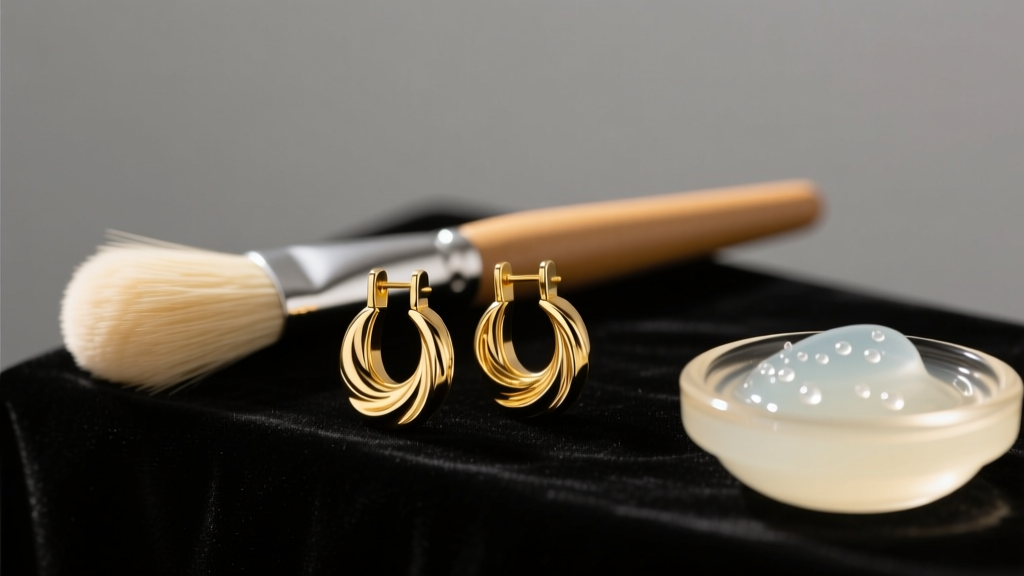
Heavy, ornate ear jewelry offers unparalleled glamour without the commitment of a piercing, but it also demands a highly specialized maintenance routine. Unlike lightweight studs, heavy clip on statement earrings endure immense mechanical stress at the hinge, accumulate cosmetic debris in intricate pavé settings, and rely on precise tension to stay attached to the earlobe. Whether you are maintaining modern brass-alloy pieces from contemporary designers or restoring mid-century vintage finds from estates, improper care can lead to lost earrings, ruined rhinestone foils, and severe earlobe fatigue.
In this comprehensive guide, we break down the exact protocols for cleaning, adjusting, and storing your collection, utilizing professional jeweler techniques adapted for at-home maintenance.
The Unique Anatomy of Clip-On Mechanisms
Before applying any cleaning solution or adjusting tool, you must identify the specific mechanism of your earrings. The hardware dictates how much pressure the metal can withstand and where moisture is most likely to cause rust.
- Omega Clips: The modern standard. Features a hinged, curved wire that snaps into a catch. Highly adjustable but prone to bending if forced.
- Screw-Backs: Common in vintage (1930s-1960s) pieces. Uses a threaded screw to push a paddle against the earlobe. The threads are easily stripped if over-tightened or corroded by sweat.
- Invisible/Spring Clips: Uses a hidden internal spring. These are sealed units; introducing liquid cleaners into the hinge will rust the internal steel spring, permanently seizing the mechanism.
Step-by-Step Cleaning Protocols by Material
Statement earrings often combine base metals, plated finishes, and glued-in glass or acrylic stones. A one-size-fits-all approach will destroy these complex pieces.
Base Metals and Plated Alloys
Most contemporary statement earrings are cast from brass or zinc alloys and plated with gold, silver, or rhodium. When the underlying copper or brass oxidizes, it creates a dark, greenish-black tarnish. For unplated solid brass, a paste of baking soda and lemon juice will strip the oxidation. However, applying this to plated jewelry will strip the plating entirely.
For plated pieces, use a damp microfiber cloth with a single drop of pH-neutral dish soap (like Dawn). Gently wipe the metal, avoiding the hinge. According to Jewelers of America, you should never use toothpaste or baking soda on plated alloys, as the abrasive silica particles will create micro-scratches that accelerate future tarnishing.
Rhinestone and Pave Embellishments
The most critical rule in cleaning crystal-encrusted statement pieces is to never submerge them in water and never use an ultrasonic cleaner. Ultrasonic cavitation will shatter the delicate foil backing on vintage stones and dissolve the cyanoacrylate adhesives holding modern pavé stones in place.
Professional Tip: To clean glass rhinestones, spray a small amount of glass cleaner onto a cotton swab—never directly onto the earring. Gently roll the swab over the table (top facet) of the stone. Avoid touching the prongs, as liquid can wick under the setting and cloud the foil backing.
Adjusting Tension for Comfort and Security
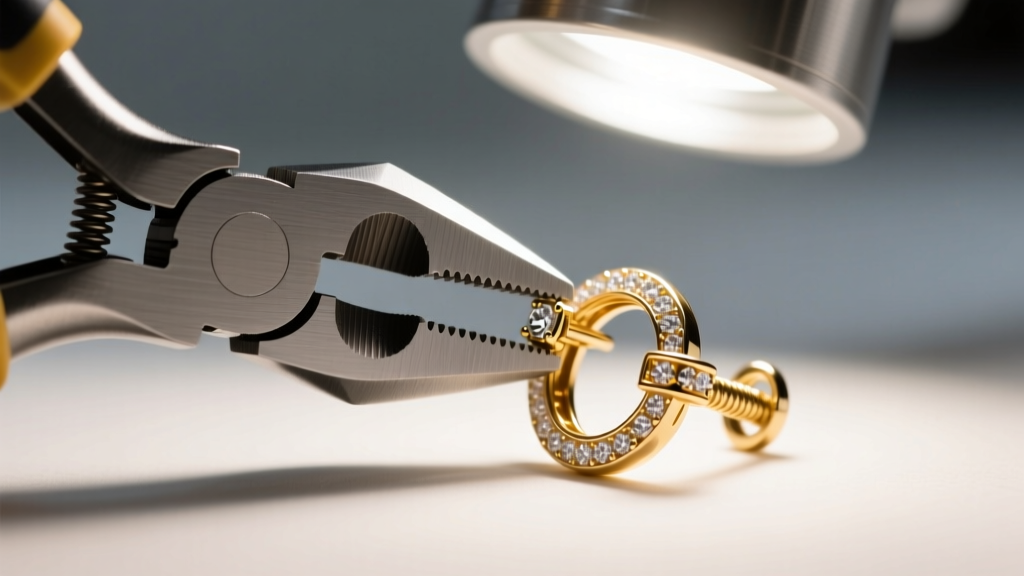
The most common complaint regarding heavy clip on statement earrings is the 'migraine effect'—the clip is too tight, cutting off circulation to the earlobe. Conversely, loose clips will drop a $200 earring onto the pavement. Tension adjustment requires precision and the right tools.
Fixing Over-Tightened Clips (The Plier Trick)
Never use standard steel jewelry pliers to bend a clip arm; the hardened steel teeth will instantly crush and scratch the soft brass or silver plating. Instead, invest in a pair of nylon-jaw pliers (typically 5-inch or 6-inch size).
- Open the clip arm fully so it is parallel to the earring back.
- Place the nylon jaws gently around the base of the hinge wire, not the tip.
- Apply a micro-millimeter bend outward (away from the earring face).
- Test on the ear. You can always bend it back, but bending it back and forth repeatedly will cause metal fatigue and snap the wire.
Easing Loose Omega Clips
If the earring slides off when you turn your head, the omega wire has stretched. Using your nylon-jaw pliers, grip the very tip of the omega wire (the part that rests against the earlobe) and gently bend it inward toward the earring face by roughly 2 to 3 degrees. This increases the clamping force without stressing the hinge pin.
Chemical Compatibility Chart
Using the wrong chemical solvent is the fastest way to ruin a statement piece. Refer to this matrix before applying any liquid to your jewelry.
| Earring Component | Safe Cleaners | Destructive Agents (Avoid) |
|---|---|---|
| Gold/Rhodium Plating | Mild dish soap, microfiber | Baking soda, toothpaste, ammonia |
| Foil-Backed Rhinestones | Dry cotton swab, glass cleaner (swab only) | Water submersion, ultrasonic, steam |
| Acrylic/Resin Stones | Damp water cloth | Alcohol, acetone, Windex (causes clouding) |
| Steel Hinge Springs | Compressed air, dry brushing | Any liquid, oil-based lubricants (attracts dust) |
| Vermeil (Silver base) | Specialized silver dip (briefly) | Chlorine, bleach, salt water |
Replacing and Upgrading Comfort Pads
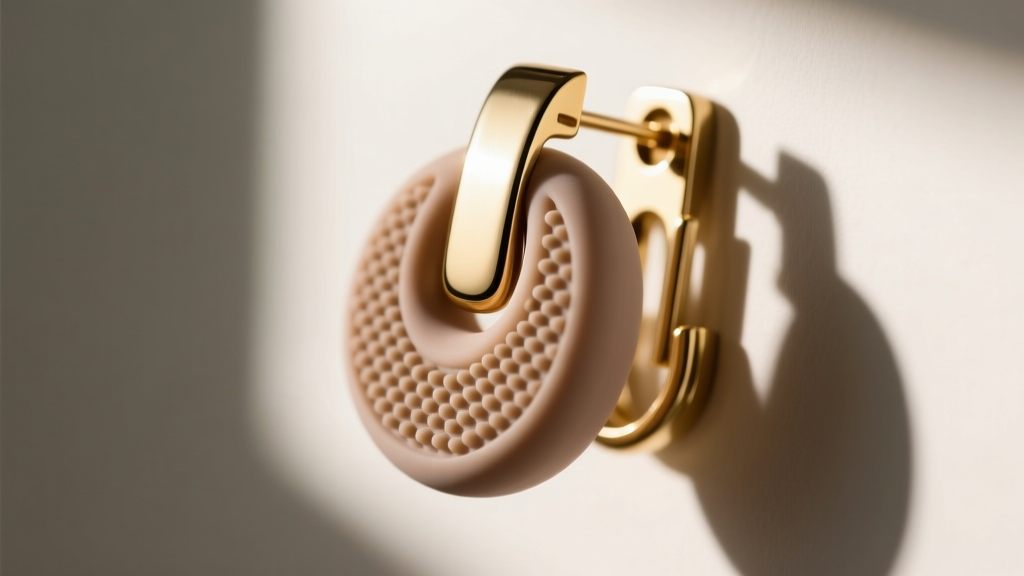
If your vintage or modern clip-ons feature a small cushion where the metal meets the ear, it is likely made of polyurethane foam. Over 2 to 3 years, this foam reacts with skin oils and UV light, degrading into a sticky, black residue that is impossible to clean and will stain your clothing.
As of 2026, the industry standard for restoration is replacing these with medical-grade silicone comfort pads. Silicone does not degrade, is hypoallergenic, and provides a higher-friction grip that prevents heavy earrings from sliding down the lobe.
- Use a wooden toothpick or a plastic spudger to scrape away the old foam and dried adhesive. Do not use metal scrapers.
- Wipe the metal paddle with a cotton swab dipped in 90% isopropyl alcohol to remove all residual oils. Let it dry completely.
- Apply a 3M double-sided jewelry adhesive tape to the back of the new silicone pad, or use a microscopic drop of E6000 craft adhesive (allow 24 hours to cure before wearing).
Proper Storage to Prevent Crushing and Tarnish
Statement earrings, by definition, feature large, protruding elements. Tossing them into a standard jewelry box guarantees that wire-wrapped elements will bend and glued stones will be crushed under the weight of adjacent pieces.
Compartmentalization and Humidity Control
Store each pair in its own individual flannel pouch or a dedicated compartment in a lined wooden box. The Gemological Institute of America (GIA) emphasizes that controlling the micro-climate of your storage environment is critical for preventing alloy oxidation.
Place a small packet of indicating silica gel inside your jewelry box to maintain a relative humidity below 40%. Furthermore, insert a 3M Silver Protector anti-tarnish strip into the drawer. These strips absorb airborne sulfur compounds—the primary catalyst for silver and copper tarnishing—sacrificing themselves so your heavy brass and plated statement pieces remain pristine.
Hanging Storage for Dangles
If your clip-on statement earrings feature long, articulated chandelier drops, hanging storage is mandatory. Use a jewelry tree or a wall-mounted rack with padded hooks. Hanging prevents the chains from tangling and keeps the weight of the dangles from permanently warping the primary clip-on hinge while in storage.
Conclusion
Maintaining heavy clip on statement earrings is an exercise in mechanical sympathy and chemical awareness. By avoiding ultrasonic cleaners, utilizing nylon-jaw pliers for micro-tension adjustments, and upgrading degrading foam pads to modern silicone, you can ensure your most dramatic, eye-catching pieces remain comfortable, secure, and visually stunning for decades. Treat the hardware with the same respect you give the gemstones, and your collection will never let you down.