Citrine Drop Earrings: A Gemologist's Technical Guide
Explore the gemological properties, grading metrics, and structural settings of citrine drop earrings in this expert technical deep dive.

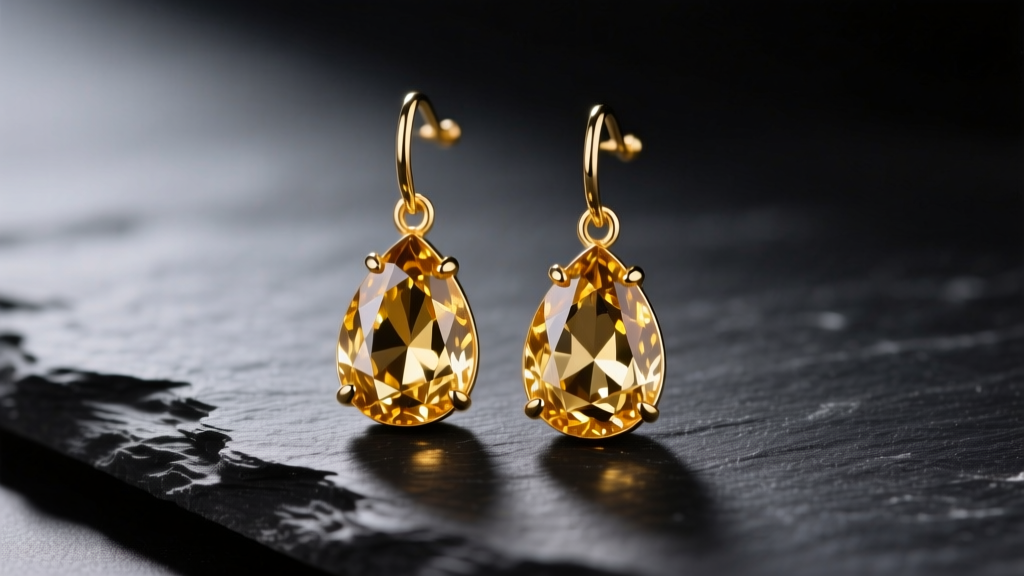
When evaluating citrine drop earrings, most consumers focus solely on the warm, golden hue of the gemstone. However, from a gemological and structural engineering perspective, drop earrings present a unique set of challenges and opportunities. The pendulum motion of a drop earring places continuous lateral torque on the finding, while the gemstone itself requires precise cutting to maximize light return without compromising structural integrity at the drill hole or apex. This technical deep dive explores the mineralogy, grading metrics, hardware specifications, and market valuations of citrine drop earrings for the discerning collector and jewelry professional.
The Gemological Profile of Citrine
Citrine is the yellow to orange-red variety of macrocrystalline quartz (SiO2). According to the Gemological Institute of America (GIA), natural citrine derives its color from trace amounts of iron (Fe3+) within the crystal lattice. It crystallizes in the trigonal system and exhibits a refractive index (RI) of 1.544 to 1.553, with a birefringence of 0.009. Its specific gravity (SG) sits at a consistent 2.65, and it registers a 7 on the Mohs hardness scale.
For drop earrings, the SG of 2.65 is a critical metric. Quartz is moderately dense; a large, 25-millimeter briolette drop can easily exceed 18 carats (approximately 3.6 grams). When suspended from the earlobe, this mass creates a downward and outward vector force during movement, necessitating specialized earring findings to prevent stretching of the ear piercing or deformation of the wire.
Natural vs. Heat-Treated: Identifying Your Citrine
The modern gemstone market is heavily saturated with heat-treated citrine. Approximately 95% of commercial citrine begins its life as amethyst or smoky quartz, subjected to temperatures between 470°C and 550°C to alter the oxidation state of iron impurities. While the Mindat mineralogical database confirms that both natural and heat-treated citrine share identical chemical and physical properties, their market values and visual signatures differ significantly.
Spectroscopic and Visual Identification
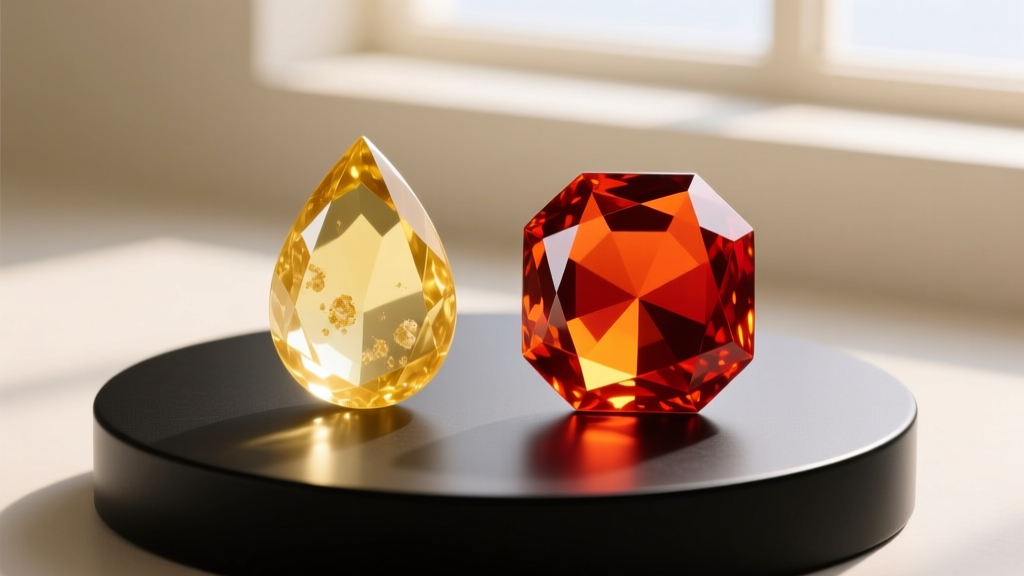
- Natural Citrine: Typically exhibits pale yellow to golden hues, often with subtle greenish undertones. Under magnification, it may contain two-phase inclusions (liquid and gas) and irregular color zoning.
- Heated Amethyst: Displays highly saturated reddish-orange or 'Madeira' tones. A telltale sign of heat treatment is the presence of 'zebra stripe' or 'tiger tail' color banding, which is a remnant of the original amethyst twinning structure.
For high-end drop earrings, gemologists utilize UV-Vis-NIR spectroscopy to definitively separate natural citrine from baked amethyst, though for standard jewelry purposes, the disclosure of heat treatment is the industry standard.
Structural Integrity: Hardware and Wire Gauges
Because drop earrings swing and catch on clothing, the structural failure point is almost always the finding or the wire wrap. Selecting the correct wire gauge and finding type is non-negotiable for durable citrine drops.
| Finding Type | Recommended Wire Gauge | Torque Resistance | Best For |
|---|---|---|---|
| Leverback | 18g (1.02mm) or 19g (0.91mm) | High | Heavy briolettes (15+ ct) |
| French Wire (Fishhook) | 20g (0.81mm) | Moderate | Standard pear drops (5-10 ct) |
| Ear Wire with Coil | 22g (0.64mm) wrapped on 18g | Low-Moderate | Lightweight faceted teardrops |
The Briolette Apex Vulnerability
Many citrine drop earrings utilize the briolette cut—a three-dimensional, fully faceted teardrop. To suspend a briolette, a channel must be drilled through the apex. If the drill hole is too close to the edge (less than 1.5mm clearance), the quartz is highly susceptible to chipping from the micro-vibrations caused by walking. Expert jewelers mitigate this by using a flexible wire-wrap technique or a specialized capped bail that absorbs kinetic shock, rather than resting the bare stone directly against a rigid metal loop.
Evaluating Cut and Light Performance in Drops
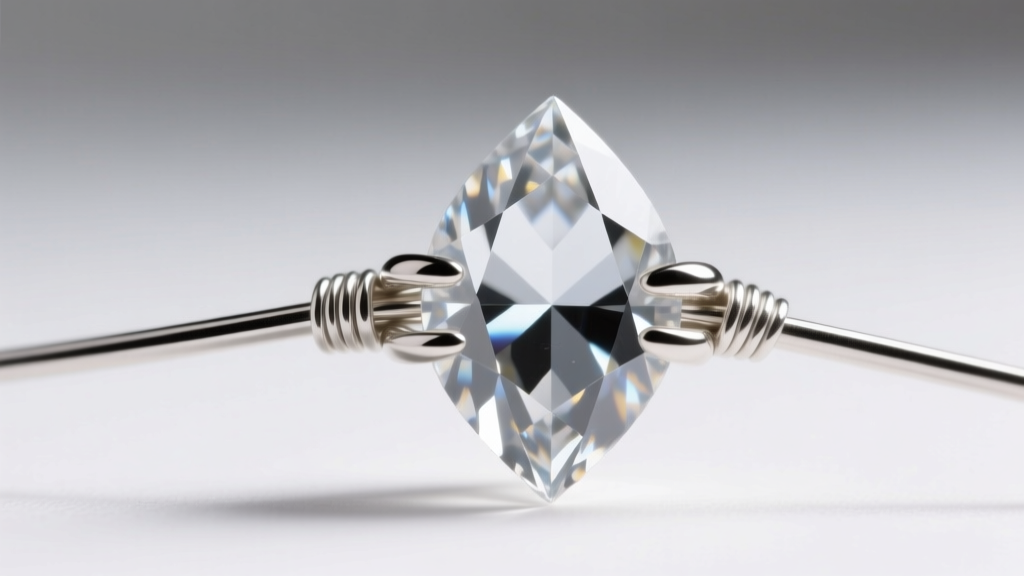
Unlike round brilliant diamonds, citrine drops are typically cut into pears, teardrops, or briolettes. The primary goal of these cuts is to maximize the stone's brilliance while managing the 'bow-tie' effect—a dark shadow that can appear across the center of elongated stones if the pavilion facets are poorly proportioned.
When inspecting citrine drop earrings, evaluate the following parameters:
- Length-to-Width Ratio: For pear drops, a ratio between 1.45 and 1.60 is generally considered the most aesthetically pleasing, providing an elegant elongation without looking overly narrow.
- Symmetry: The shoulders of the pear cut must be perfectly mirrored. Asymmetry in a drop earring is highly visible because the stone hangs freely and catches the light from multiple angles.
- Extinction and Windowing: Hold the earring at arm's length and rotate it. High-quality citrine will maintain a lively flash of light. Excessive 'extinction' (dark, lifeless areas) or 'windowing' (transparent areas where light leaks out the bottom without reflecting) indicates a poorly cut pavilion designed merely to retain carat weight.
Pricing Metrics and Market Valuations
The valuation of citrine drop earrings is dictated by the origin of the color, the precision of the cut, and the karat of the precious metal setting. While citrine is generally an affordable gemstone, the price per carat (PPC) scales exponentially for top-tier natural specimens and custom-cut drops.
- Commercial Heat-Treated (Madeira): $10 to $25 per carat. Readily available, heavily included, often cut with native windowing to save weight.
- Premium Heat-Treated (Custom Cut): $30 to $60 per carat. Eye-clean, precision-cut with optimal light return, often set in 14k or 18k gold.
- Rare Natural Citrine: $75 to $150+ per carat. Verified untreated, displaying natural golden hues without brown modifiers, typically accompanied by a gemological laboratory report.
Expert Valuation Tip: When purchasing vintage or estate citrine drop earrings, always request a UV fluorescence test. Natural citrine is typically inert under both long-wave and short-wave UV light, whereas some synthetic or heavily irradiated quartz simulants may display anomalous fluorescence.
Care, Maintenance, and Ultrasonic Risks
Citrine's Mohs hardness of 7 makes it resistant to everyday scratching, but it possesses indistinct cleavage and a conchoidal fracture. This means that while it won't easily scratch, a sharp impact against a hard surface can cause it to chip or shatter entirely.
Cleaning Protocols
For routine maintenance, a solution of warm water and mild dish soap applied with a soft-bristled brush is the safest method. Pay special attention to the gallery (the underside of the stone) where skin oils and lotions accumulate, dulling the stone's refractive properties and reducing the visual impact of the drop.
Ultrasonic Cleaner Warning: While solid, unfractured citrine can generally withstand ultrasonic cleaning, drop earrings with fracture-filled stones, heavy internal inclusions, or tension-set briolettes should never be placed in an ultrasonic bath. The high-frequency acoustic cavitation can propagate existing micro-fractures, causing the drop to split at the drill hole or setting prongs. Always rely on manual, gentle cleaning for high-value or antique citrine drops to preserve their structural integrity.


