Beyond the Claire's Earring Chart 2025: Expert Gift Guide
Upgrading from the Claire's earring chart 2025? Discover our expert 2026 occasion-matching gift guide with safe, implant-grade titanium picks for all ages.

The Search for the Claire's Earring Chart 2025: What Parents Are Missing
Every year, thousands of parents and gift-givers search for the Claire's earring chart 2025 to find age-appropriate milestones, starter kits, and gifting ideas for new piercings. While mall kiosks have long been the traditional gateway to body modification, the professional piercing industry has evolved dramatically. As we move through 2026, relying on outdated retail charts can lead to gifting jewelry that causes allergic reactions, embedding, and prolonged healing times.
This expert guide pivots away from mass-market retail standards. Instead, we provide a modern, medically sound gifting framework based on implant-grade metallurgy, precision mechanics, and professional studio standards. Whether you are shopping for a child's first lobe piercing or an adult's curated ear project, this guide ensures your gift is both beautiful and biocompatible.
Mall Kiosk vs. Professional Studio: A Metallurgical Breakdown
The most critical failure point in traditional retail starter earrings is the metal composition. Many mass-market brands advertise "surgical steel" or "hypoallergenic" metals, but these are largely unregulated marketing terms. True biocompatibility requires specific ASTM (American Society for Testing and Materials) certifications.
| Feature | Traditional Mall Standard | Professional 2026 Standard |
|---|---|---|
| Material | 316L Stainless Steel (Contains 8-10% Nickel) | ASTM F-136 Implant-Grade Titanium (Nickel-Free) |
| Backing Mechanism | Butterfly Friction Backs (Traps bacteria, restricts swelling) | Threadless or Internally Threaded Flat-Back Labrets |
| Sterilization | Ultrasonic cleaning or chemical wipes | Medical-grade Autoclave (Steam under pressure) |
| Gauge (Thickness) | 20g or 18g (Often too thin, causing the "cheese-cutter" effect) | 16g or 18g (Optimal for blood flow and tissue stability) |
| Average Price (Per Pair) | $25 - $40 | $80 - $250+ (Includes ends and posts) |
When gifting jewelry, avoid 316L stainless steel for fresh piercings. The nickel content can trigger contact dermatitis, leading to itchy, swollen, and weeping earlobes. Furthermore, butterfly backs feature sharp prongs and deep crevices that harbor dead skin and sebum, creating a breeding ground for staph bacteria. By upgrading to ASTM F-136 titanium flat-backs, you are gifting a frictionless, hypoallergenic experience that promotes rapid healing.
The 2026 Expert Gifting Chart: Occasion & Age Matching
While the original Claire's earring chart 2025 focuses primarily on age and basic styles, a professional gifting chart must account for anatomy, lifestyle, and jewelry mechanics. Below is our expert framework for matching the right jewelry to the right milestone.
Ages 5–10: The First Lobe Piercing Milestone
The Occasion: First ear piercings, early elementary school milestones.
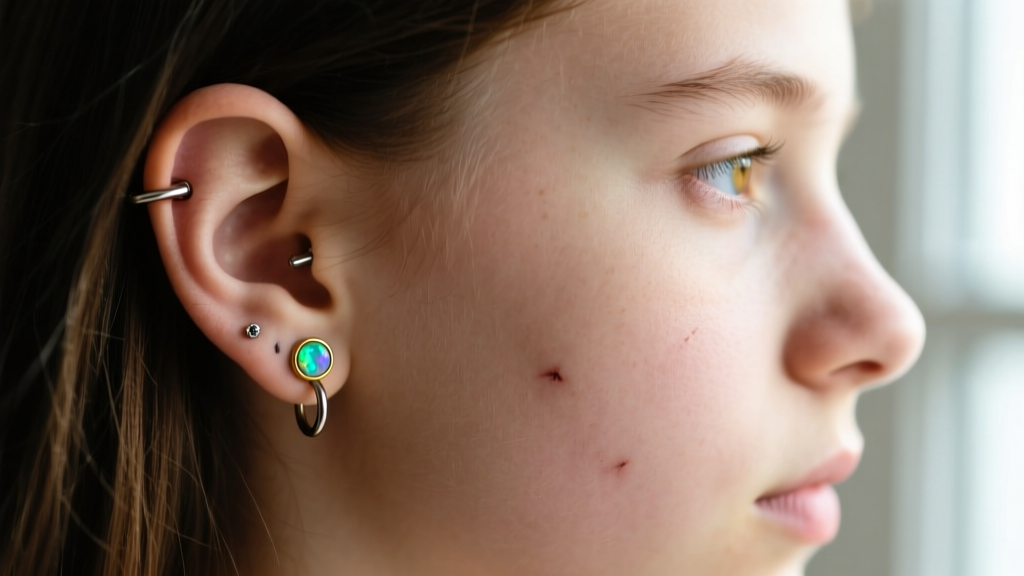
The Expert Recommendation: 18-gauge or 16-gauge flat-back labrets with threadless tension-fit ends.
Why: Children are active and frequently sleep on their sides. Traditional butterfly backs can poke the neck or get snagged on hair and clothing, tearing the delicate fistula (the piercing hole). A flat-back labret sits completely flush against the back of the earlobe.
Brand Picks & Pricing: Look for brands like Intrinsic Body or NeoMetal. A basic 3mm or 4mm bezel-set zirconia end paired with a titanium post will cost between $35 and $55 per ear. Avoid dangling styles entirely, as they pose a severe snag-and-tear hazard for young children.
Ages 13–16: Sweet Sixteen and Cartilage Upgrades
The Occasion: Sweet Sixteen birthdays, high school transitions, first cartilage piercings (helix or conch).
The Expert Recommendation: 16-gauge implant-grade titanium or solid 14k/18k nickel-free gold threadless ends.
Why: Teenagers often want to express individuality through gems and unique designs. Cartilage piercings take significantly longer to heal (6 to 12 months) and are highly prone to irritation bumps if the jewelry is too heavy or the metal is porous. Threadless jewelry utilizes a pin that is slightly bent (usually at a 5-to-10-degree angle) to create outward tension inside the hollow post, ensuring the gem never falls out during sports or daily activities.
Brand Picks & Pricing: BVLA and Maria Tash are the gold standards here. Expect to spend $80 to $180 per piece for high-quality gem settings. A brilliant-cut lab-grown diamond or high-grade CZ in a prong setting allows maximum light reflection without the bulk of a glued-in bezel.
Ages 18+: The Curated Ear Project
The Occasion: College graduations, major career milestones, or 21st birthdays.
The Expert Recommendation: A multi-piece curated ear project utilizing a mix of threadless studs, clicker segment rings, and ear cuffs.
Why: Adult gifting shifts from single piercings to aesthetic composition. A curated ear involves mapping out 3 to 5 piercings that complement the individual's unique ear anatomy (such as the antihelix and scapha ridges). Gifting a consultation with a professional piercer, followed by a high-end seamless hoop or an ornate ear cuff, provides an experience rather than just a product.
Brand Picks & Pricing: LeRi and Anatometal offer stunning 14k gold clickers and intricate threadless clusters. Budget $200 to $600+ for a complete, high-end curated setup.
The Ultimate Jewelry Gifting Checklist
Before finalizing your purchase for any occasion, run through this professional checklist to ensure your gift meets modern safety and aesthetic standards:
- Verify the Alloy: Ensure the product description explicitly states "ASTM F-136 Titanium" or "Nickel-Free Solid 14k/18k Gold." Avoid "gold-plated" or "surgical steel" for fresh or sensitive piercings.
- Check the Threading: Opt for threadless (push-pin) or internally threaded jewelry. Externally threaded jewelry (where the screw is on the post) tears the tissue upon insertion and should never be gifted.
- Measure the Post Length: For fresh piercings, an 8mm or 10mm post is required to accommodate initial swelling. For healed piercings, a 6mm or 6.5mm post provides a snug, flush fit.
- Include Proper Aftercare: Skip the harsh alcohol wipes. Gift a 12-pack of sterile, single-use 0.9% sodium chloride wound wash (such as NeilMed or H2Ocean). This is the only aftercare solution endorsed by professional piercers.
Final Thoughts on Modern Piercing Gifts
While the search volume for the Claire's earring chart 2025 highlights a massive consumer desire for structured gifting guides, the modern jewelry landscape demands a more educated approach. By prioritizing implant-grade materials, secure mechanical fittings, and anatomy-specific sizing, you elevate a simple piece of jewelry into a lifelong, safe, and cherished accessory. In 2026, the best gift you can give is not just a beautiful gemstone, but the assurance of premium biocompatibility and expert craftsmanship.
Authoritative Sources & Further Reading
To learn more about safe piercing standards, metallurgy, and aftercare, consult the following industry authorities:
- The Association of Professional Piercers (APP) - Comprehensive guides on jewelry materials, healing timelines, and studio safety protocols.
- NeoMetal Body Jewelry - Industry leaders in threadless, implant-grade titanium jewelry mechanics and ASTM certifications.
- BVLA (Body Vision Los Angeles) - The premier manufacturer of high-end, nickel-free solid gold and gemstone body jewelry for curated ear projects.


