Ti Earrings: Technical Guide to Titanium Grades & Care
Discover technical differences in Ti earrings. We break down ASTM F136 vs F67 titanium, anodizing voltages, gauge sizes, and healing protocols.

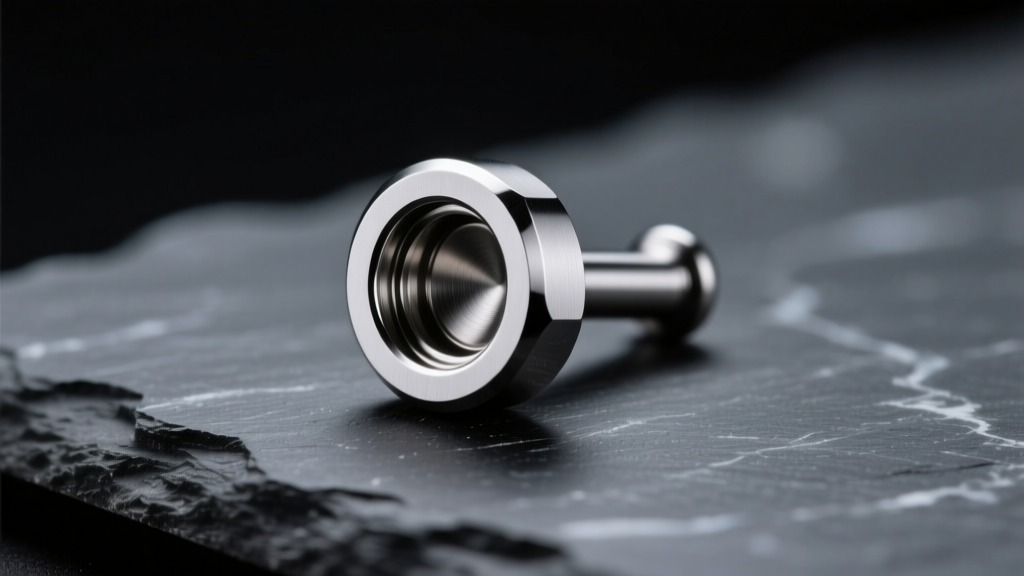
The Metallurgy of Ti Earrings: F136 vs. F67
When discussing high-performance body jewelry, the term "Ti earrings" refers specifically to titanium-based alloys. However, not all titanium is created equal. In 2026, the professional piercing and fine jewelry industries rely on two primary ASTM (American Society for Testing and Materials) standards for titanium: ASTM F136 and ASTM F67. Understanding the metallurgical differences between these two grades is critical for anyone managing fresh piercings, dealing with contact dermatitis, or engineering long-term cartilage stability.
ASTM F136: Ti-6Al-4V ELI (Implant Grade)
The gold standard for initial piercings and high-stress cartilage applications is Ti-6Al-4V ELI. This alloy consists of roughly 90% titanium, 6% aluminum, and 4% vanadium. The "ELI" designation stands for Extra Low Interstitial. During the smelting process, interstitial elements like oxygen, nitrogen, carbon, hydrogen, and iron are strictly limited. This purification drastically improves the alloy's fracture toughness and fatigue resistance at physiological temperatures. Because the aluminum and vanadium are tightly bound within the titanium crystal lattice, they do not leach into the body, making F136 highly biocompatible and entirely nickel-free. According to the Association of Professional Piercers (APP), F136 is the only recommended titanium alloy for fresh, unhealed fistulas.
ASTM F67: Commercially Pure (CP) Titanium
Commercially pure titanium (Grades 1 through 4) contains no aluminum or vanadium. While it is incredibly biocompatible, it is significantly softer and more malleable than F136. CP titanium is frequently used for the flexible posts of certain flexible retainers or heavily machined decorative ends. However, its lower tensile strength means it is prone to bending under the pressure of heavy gauge hoops or sleeping on cartilage piercings. For structural posts, F136 remains the undisputed leader.
The Physics of Anodizing: Voltage-to-Color Matrix
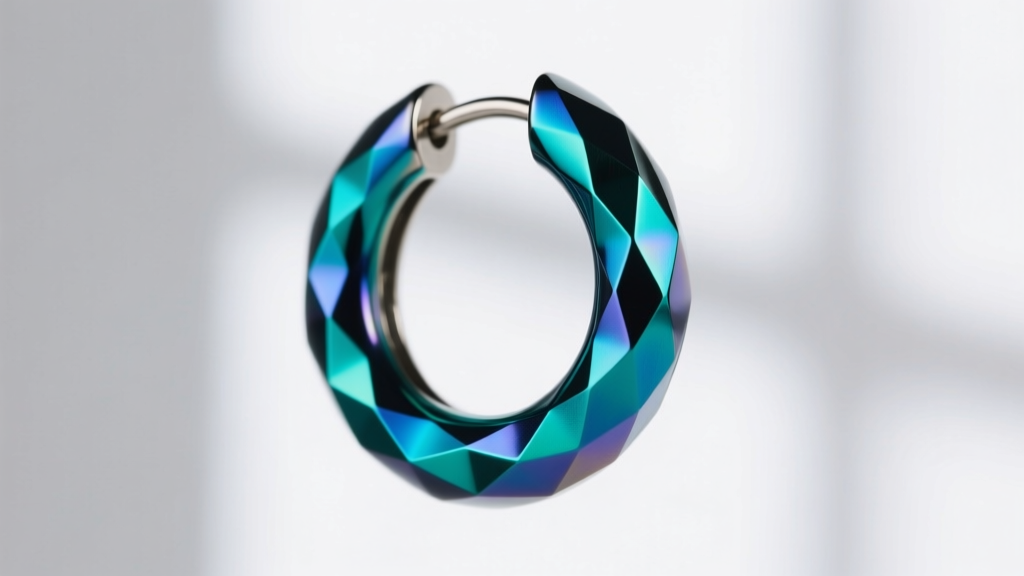
One of the most remarkable properties of Ti earrings is their ability to be anodized without the use of chemical dyes or paints. Titanium naturally forms a microscopic oxide layer when exposed to oxygen. By submerging the titanium jewelry in a mild alkaline electrolyte bath (such as sodium bicarbonate) and applying a direct electrical current, jewelers can artificially thicken this oxide layer. As the layer thickens, it interferes with specific wavelengths of light, producing vibrant, permanent structural colors. The color achieved is strictly dictated by the voltage applied, not the time spent in the bath.
| Voltage (DC) | Resulting Color | Oxide Layer Thickness (Approx.) |
|---|---|---|
| 15V - 20V | Copper / Bronze | 25 - 35 nm |
| 30V - 40V | Deep Purple / Violet | 50 - 70 nm |
| 45V - 55V | Royal Blue | 80 - 95 nm |
| 70V - 80V | Teal / Cyan | 120 - 140 nm |
| 90V - 100V | Bright Green | 150 - 170 nm |
| 110V - 120V | Gold / Rose Gold | 190 - 210 nm |
Because anodizing only alters the surface oxide layer, it does not compromise the underlying F136 metallurgy. However, the oxide layer can be scratched by abrasive polishing compounds or degraded by prolonged exposure to harsh chlorides, which will revert the jewelry to its natural silver-grey state.
Biomechanics: Gauges and the Cheese-Cutter Effect
Selecting the correct wire thickness for Ti earrings is a matter of biomechanical physics, specifically regarding pressure distribution across the fistula (the healed tissue tube). In the early 2000s, 20-gauge (0.81mm) and 22-gauge (0.64mm) wires were standard for earlobes. Modern anatomical science has largely abandoned these thin gauges in favor of 18-gauge (1.02mm) and 16-gauge (1.29mm) posts, particularly for cartilage and daith piercings.
"Pressure is defined as Force divided by Area. A 20-gauge titanium wire exerts nearly double the localized pressure on the inferior edge of a fistula compared to a 16-gauge wire under the exact same gravitational load from a heavy decorative end. This localized ischemia leads to tissue necrosis, migration, and the infamous 'cheese-cutter effect'."
For standard helix, conch, and tragus piercings, 16G (1.29mm) provides the optimal balance between structural rigidity and tissue preservation. For standard earlobes, 18G (1.02mm) is generally sufficient, provided the decorative end does not exceed 4 grams in weight. Upgrading to thicker Ti earrings prevents the slow, downward migration that plagues thin-gauge jewelry.
Hardware Mechanics: Threading vs. Threadless Tension
The method by which the decorative end attaches to the titanium post is just as critical as the metal itself. The internal architecture of Ti earrings dictates both ease of insertion and long-term tissue health.
Internally Threaded vs. Externally Threaded
Externally threaded jewelry (where the screw threads are on the post itself) is universally condemned by professional piercers. Dragging sharp, microscopic metal threads through a delicate fistula causes micro-tears, introducing bacteria and delaying healing. Internally threaded Ti earrings feature a smooth, polished post with the threading tapped into the inside of the decorative end. This allows the post to glide seamlessly through the tissue.
Threadless (Push-Pin) Architecture
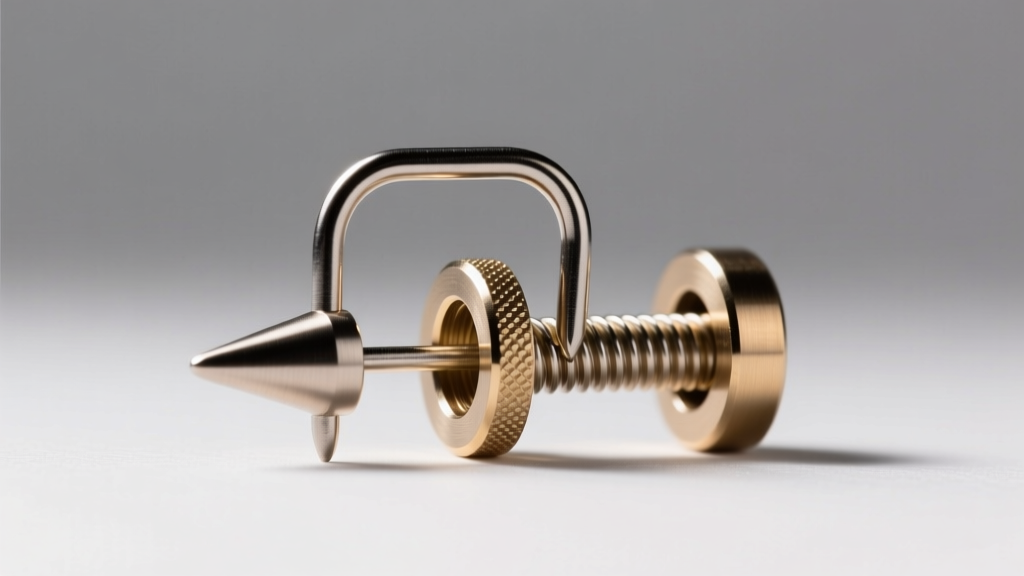
As of 2026, threadless titanium jewelry has become the dominant standard for high-end body modification. Threadless systems utilize a hollow, internally polished 16G or 14G titanium post. The decorative end features a solid titanium pin that is manually bent to a 5-to-10-degree angle before insertion. When pushed into the hollow post, the bent pin acts as a leaf spring, creating immense outward tension against the inner wall of the post. This mechanical interference fit is entirely secure, immune to the loosening caused by body heat expansion, and eliminates the risk of cross-threading.
Troubleshooting: Galvanic Reactions and MRI Safety
Titanium is highly prized for its corrosion resistance, stemming from its passive oxide layer. However, wearers of Ti earrings must be aware of galvanic corrosion. If a titanium post is coupled with a decorative end made of a dissimilar, less noble metal (such as low-grade brass or copper alloys) in the presence of an electrolyte (like sweat or saline wound wash), a galvanic cell is formed. The less noble metal will rapidly corrode, potentially releasing irritating ions into the piercing channel. Always ensure that both the post and the decorative end are crafted from implant-grade titanium or high-karat solid gold (14k or 18k, nickel-free).
Regarding medical imaging, ASTM F136 titanium is non-ferromagnetic. It will not react to the powerful magnetic fields of an MRI machine, making Ti earrings entirely safe to wear during scans. Unlike surgical steel, which contains ferromagnetic iron and can cause severe RF (radio-frequency) thermal burns during an MRI, titanium's paramagnetic properties ensure it remains inert and safe in clinical environments. For verification, authentic implant-grade Ti earrings will exhibit a very weak, almost imperceptible attraction to a rare-earth neodymium magnet, whereas counterfeit "titanium-plated" steel will snap to it aggressively.
For comprehensive metallurgical standards and safety data sheets regarding implant-grade alloys, refer to the ASTM International F136 Standard documentation. Investing in verified, properly engineered Ti earrings is not merely an aesthetic choice; it is a fundamental requirement for long-term anatomical compatibility and tissue health.


