How to Clean Complex Bead Patterns for Earrings Safely
Learn expert techniques to clean intricate bead patterns for earrings. Discover safe methods for thread-woven and wire-wrapped beaded jewelry care.

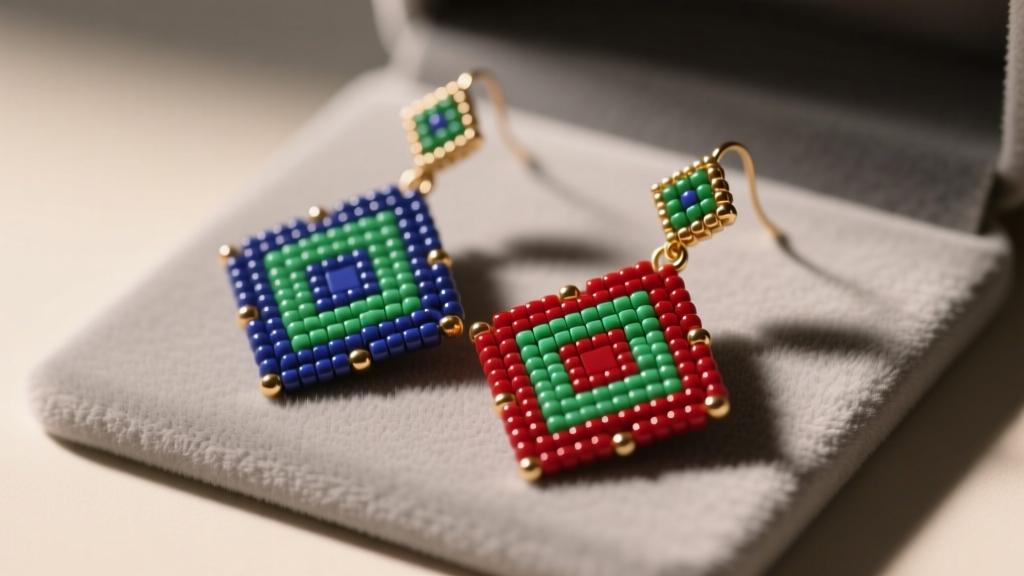
The Delicate Art of Beaded Earring Maintenance
Beaded earrings are a testament to artisanal craftsmanship, transforming tiny glass, gemstone, or metal components into wearable geometry. Whether you are rocking right-angle weave, herringbone, brick stitch, or peyote stitch, the structural integrity of these pieces relies heavily on the tension of the underlying framework. When it comes to maintaining bead patterns for earrings, standard jewelry cleaning methods are not just ineffective—they are actively destructive. Ultrasonic vibrations can shatter glass beads, while harsh chemical dips can strip specialized metallic coatings and degrade the structural threads holding your masterpiece together.
As we navigate the jewelry landscape in 2026, the rise of advanced nano-coatings and precision-cut Japanese seed beads (like Miyuki Delicas and Toho Treasures) means that cleaning protocols must be more precise than ever. This comprehensive guide breaks down the exact material science and mechanical care required to keep your intricate beadwork pristine without compromising the tension, thread, or wire that gives it shape.
The Material Matrix: Identifying Your Bead Coatings
Before applying any cleaning agent, you must identify the surface treatment of your beads. The Gemological Institute of America (GIA) emphasizes that porous materials and surface-treated stones require drastically different care than solid glass or crystal. Below is a vulnerability matrix for common bead types used in complex earring patterns.
| Bead Material / Finish | Vulnerability Level | Primary Failure Mode | Safe Cleaning Agent |
|---|---|---|---|
| Glass with Aurora Borealis (AB) Coating | High | Chemical stripping of the vacuum-sealed metallic layer | Dry dusting only |
| Dyed Howlite / Dyed Turquoise | High | Color bleeding and permanent matte dulling | Slightly damp microfiber |
| Galvanized / Metallic Seed Beads | Medium-High | Tarnishing and galvanization rub-off | Dry polishing cloth |
| Uncoated Crystal / Glass (e.g., Preciosa) | Low | Hard water spotting if not dried properly | Mild pH-neutral soap |
| Matte Opaque Seed Beads | Medium | Trapping oils in the microscopic surface pores | Diluted dish soap bath |
Dry-Cleaning Protocols for Thread-Woven Bead Patterns
Thread-woven bead patterns for earrings typically rely on specialized beading threads like Nymo (a flat, bonded nylon) or Fireline (a fused, gel-spun polyethylene). These threads are highly sensitive to alcohols, ammonia, and prolonged moisture exposure, which can cause the nylon to stretch, degrade, or snap under the tension of the beadwork.
The Soft-Brush and Air Method
For earrings featuring dense patterns like the Ndebele herringbone stitch, dirt and skin oils tend to accumulate in the microscopic crevices between the 0.3mm holes of the seed beads. To remove this buildup without stressing the thread:
- Compressed Air: Use a manual dust blower (avoid canned air, as the propellant can freeze and embrittle the thread) to dislodge loose particulate matter from the bead channels.
- Soft Bristle Dusting: Take a clean, unused makeup brush with natural or ultra-soft synthetic bristles. Gently sweep the brush in the direction of the beadwork’s tension lines. Never scrub against the grain of a brick-stitch pattern, as this can catch the inter-loop threads and pull them out of alignment.
- Microfiber Detailing: Wrap a corner of a lint-free microfiber cloth around a wooden toothpick to gently clean the grooves between larger glass beads without pulling the underlying Nymo size D thread.
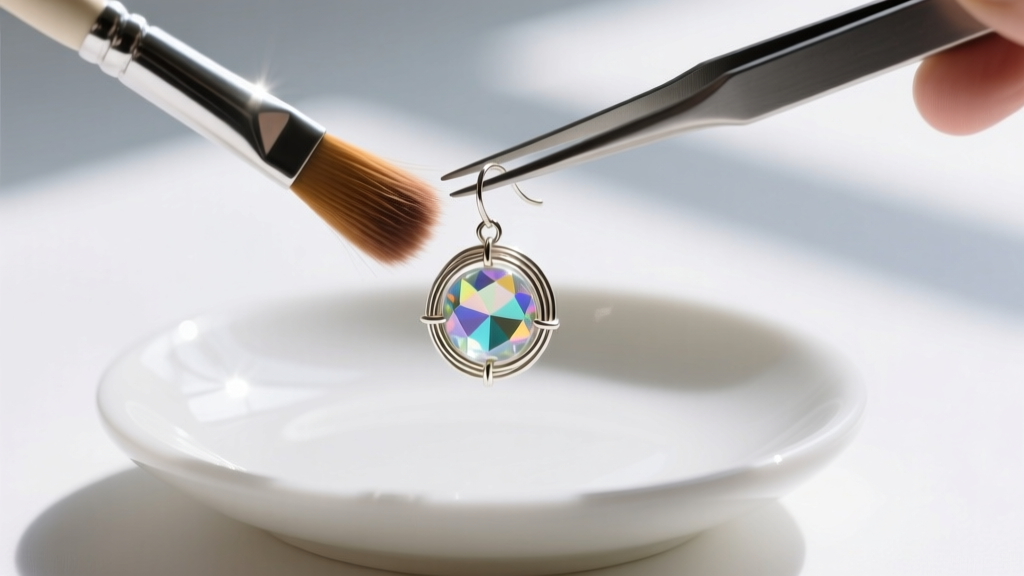
Wet-Cleaning Techniques for Wire-Structured Patterns
Wire-wrapped and wire-woven bead patterns for earrings offer a different set of challenges. These designs often utilize 24-gauge to 28-gauge dead-soft or half-hard wire (commonly copper, sterling silver, or gold-filled) to cage or string gemstone and glass beads. While the wire itself can withstand mild moisture, the mechanical structure cannot withstand bending or snagging.
The Distilled Water Bath Method
According to the American Gem Society (AGS), utilizing pure water sources prevents mineral deposits from ruining the optical clarity of crystal beads. If your wire-woven earrings feature non-porous beads (like uncoated glass or genuine quartz) and require a deep clean, follow this protocol:
- The Solution: Mix 2 cups of distilled water with exactly two drops of a pH-neutral, lotion-free dish soap (such as original Dawn). Avoid soaps with moisturizers, which leave a cloudy film on glass beads.
- The Soak: Submerge the earrings for no more than 3 to 5 minutes. Prolonged soaking can accelerate the oxidation of copper or brass wire cores, especially if the wire is unsealed.
- The Agitation: Do not scrub. Instead, gently swish the ceramic bowl in a circular motion to force the soapy water through the intricate wire weaves and bead holes.
- The Rinse: Dip the earrings into a secondary bowl of clean distilled water to remove all soap residue.
Drying and Long-Term Storage to Prevent Warping
The most critical phase of cleaning bead patterns for earrings is the drying process. Seed beads and small gemstones have drill holes ranging from 0.3mm to 0.8mm. Through capillary action, water becomes trapped inside these tiny cylinders. If left to air-dry at room temperature, this trapped moisture will slowly degrade nylon threads from the inside out or cause sterling silver wire to develop localized black tarnish spots.
Expert Tip: Never use a hair dryer or heat gun to dry beaded earrings. High heat will melt the polyethylene coating on Fireline thread and cause thermal shock in glass beads, leading to microscopic stress fractures that will eventually shatter the bead during wear.
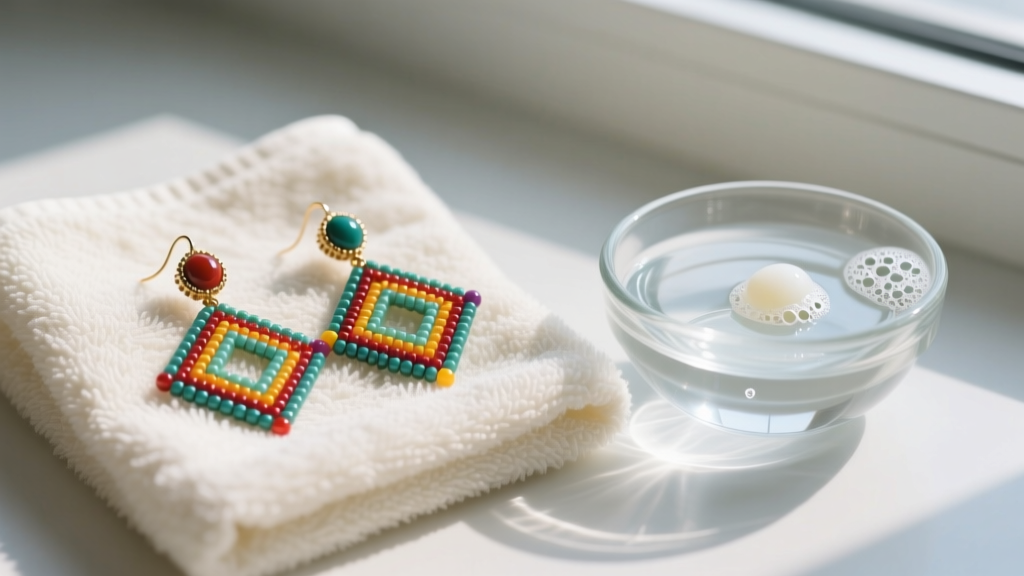
Instead, lay the earrings flat on a highly absorbent microfiber towel. Use a cool-setting air blower to force ambient-temperature air through the bead channels. Once completely dry, store thread-woven earrings flat in a rigid box to prevent gravity from stretching the nylon over time. Wire-woven earrings should be hung or stored in a way that prevents the 26-gauge or 28-gauge weaving wires from being crushed, as work-hardened wire will snap if bent back into shape.
Critical Maintenance Mistakes to Avoid
To preserve the structural and aesthetic integrity of your beaded jewelry, completely eliminate the following practices from your maintenance routine:
- Ultrasonic Cleaners: The high-frequency cavitation bubbles generated by ultrasonic machines will strip AB and Picasso coatings off glass beads and can easily shatter crystals trapped in tight wire-wraps.
- Isopropyl Alcohol: While great for sanitizing metal ear wires, alcohol will instantly dissolve the bonded nylon coating on Nymo thread and strip the dye from porous stones like dyed howlite or agate.
- Commercial Silver Dips: Never use liquid silver tarnish removers on earrings that combine silver components with beadwork. The sulfuric acids in these dips will permanently cloud glass beads and weaken beading threads.
By understanding the specific material vulnerabilities of your beads and the structural limits of your thread or wire framework, you can ensure your intricate bead patterns for earrings remain as vibrant and structurally sound as the day they were woven.


