Cuban Link Earrings: Technical Guide to Weight, Gauges & Alloys
An expert technical breakdown of Cuban link earrings, covering metallurgy, weight distribution, gauge sizing, and clasp mechanics for optimal wear.

The Engineering of Cuban Link Earrings
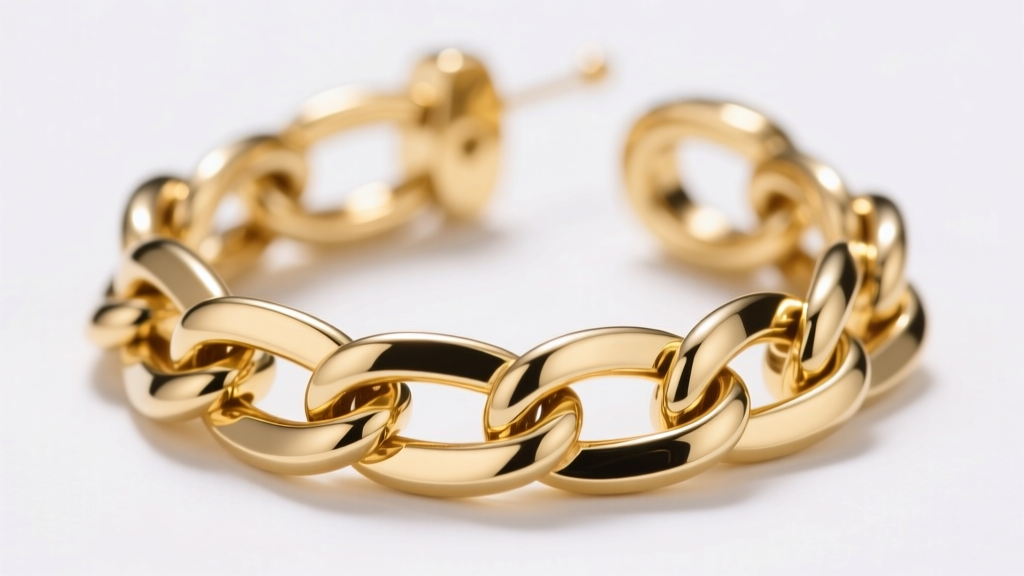
Cuban link earrings represent a fascinating intersection of streetwear aesthetics and micro-metallurgical engineering. Unlike standard cast stud earrings, a true Cuban link is fabricated from drawn wire, interlocked, soldered, and precision-filed. When adapted for ear piercings, the structural demands increase exponentially due to the pendulum effect and the biomechanical limitations of human cartilage and earlobe tissue. In this 2026 technical deep dive, we examine the exact alloy compositions, gauge requirements, and clasp mechanics that separate high-end Cuban link earrings from mass-produced, structurally compromised alternatives.
Link Geometry and Soldering Integrity
The signature look of a Cuban link relies on its flat-filed profile. After round wire is woven into a rope or cable chain, it undergoes a precision milling process where the top and bottom are shaved flat. This creates the flush, interlocking surface that prevents the links from twisting. For earrings, this geometry introduces a critical vulnerability: the filing process removes material, thinning the wire at the link joints. To counteract this, premium manufacturers use laser welding rather than traditional torch soldering. A concentrated Nd:YAG laser beam fuses the micro-joints using exact-karat match solder without heating the surrounding gold. This preserves the work-hardened state of the wire, preventing the links from becoming brittle or losing their tensile strength during the cooling process.
Metallurgy: Gold Alloys and Tarnish Resistance
Pure 24-karat gold is entirely unsuitable for Cuban link earrings. With a Vickers hardness of roughly 25 HV, it would deform under the friction of interlocking links and the sheer weight of the earring. According to data from the World Gold Council, alloying gold with copper, silver, and zinc is mandatory to achieve the structural integrity required for daily wear. However, the specific ratio of these alloying metals dictates not only the color but the tensile strength and tarnish resistance of the final piece.
For Cuban link earrings, 14-karat gold is often technically superior to 18-karat gold. The higher copper and silver content in 14k gold increases its Vickers hardness to approximately 120-140 HV, providing the necessary rigidity to keep the flat-filed links from warping when the earring swings. The Gemological Institute of America (GIA) notes that while 18k gold offers a richer yellow hue, its lower hardness (around 100-120 HV) makes it more prone to micro-scratching at the high-friction contact points between interlocking links.
| Alloy Grade | Composition Breakdown | Vickers Hardness (HV) | Best Earring Application |
|---|---|---|---|
| 14k Yellow Gold | 58.5% Au, 31% Cu, 10.5% Ag | 120 - 140 | Heavy interlocking links, high friction zones |
| 18k Yellow Gold | 75% Au, 15% Cu, 10% Ag | 100 - 120 | Lightweight huggies, low-impact studs |
| 14k White Gold | 58.5% Au, 20% Cu, 14.5% Ni/Pd | 130 - 150 | High-tension clasp components, structural hoops |
Weight Distribution and Lobe Biomechanics
The most common failure mode in Cuban link earrings is not the chain breaking, but the earlobe tearing. The human earlobe is composed of adipose tissue and loose connective tissue, lacking the dense cartilage found in the upper ear. When a heavy Cuban link earring swings, it generates a pendulum effect, multiplying the static weight into dynamic shear force against the fistula (the piercing hole).
Calculating the Drop: Mass vs. Gauge
To prevent the 'cheese-cutter effect'—a phenomenon where thin wire slowly migrates through tissue under heavy load—the post or wire gauge must scale proportionally with the earring's mass. Standard fashion earrings utilize 20-gauge (0.81mm) or 18-gauge (1.02mm) posts. However, a 5mm wide Cuban link drop earring can easily weigh 8 to 12 grams. At this weight, an 18-gauge post will cause immediate tissue fatigue and long-term stretching.
Expert Insight: For any Cuban link earring exceeding 6 grams, the post or hoop wire must be upgraded to a minimum of 16-gauge (1.29mm) or 14-gauge (1.63mm). This increases the surface area distributing the shear force across the fistula, reducing localized pressure and preventing tissue necrosis. Suppliers like Rio Grande Jewelry Supply provide specialized heavy-gauge ear wires specifically engineered for high-mass chain drops.
Clasp Mechanisms and Failure Modes
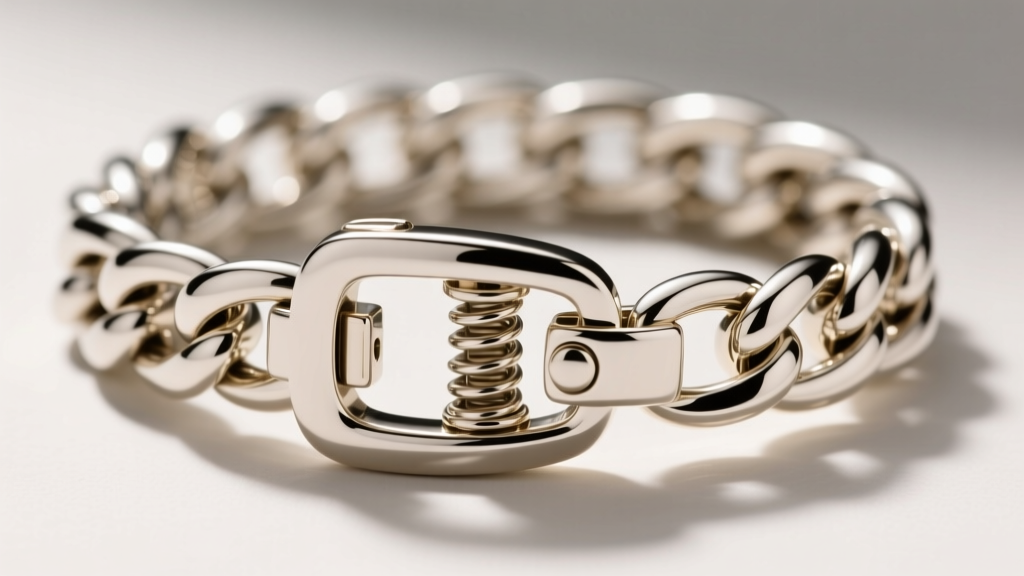
The clasp is the critical point of failure for Cuban link hoops and dangles. The standard 'butterfly' friction back relies on the tension of two small metal wings gripping a notched post. This mechanism is entirely inadequate for heavy Cuban links; the kinetic energy generated by a simple head turn can generate enough outward force to overcome the friction grip, resulting in a lost earring.
Engineered Solutions for High-Mass Earrings
- Locking Omega Backs: Utilizing a hinged, spring-loaded lever that snaps securely behind the earlobe. The retraction spring must provide at least 1.5 to 2.0 Newtons of force to ensure the backing does not dislodge during movement.
- Screw-Back Threads: The post is threaded, and the backing screws on. While secure, the threads can strip if cross-threaded or if the gold alloy is too soft (another reason 14k or 18k white gold is preferred for the post component).
- Hinged Saddle Clasps: For Cuban link hoops, a hinged saddle with a locking tab that clicks into a recessed groove on the opposite end of the hoop provides the highest level of security, distributing the weight across the entire curvature of the ear rather than a single friction point.
Sizing Matrix: Lobe vs. Cartilage Applications
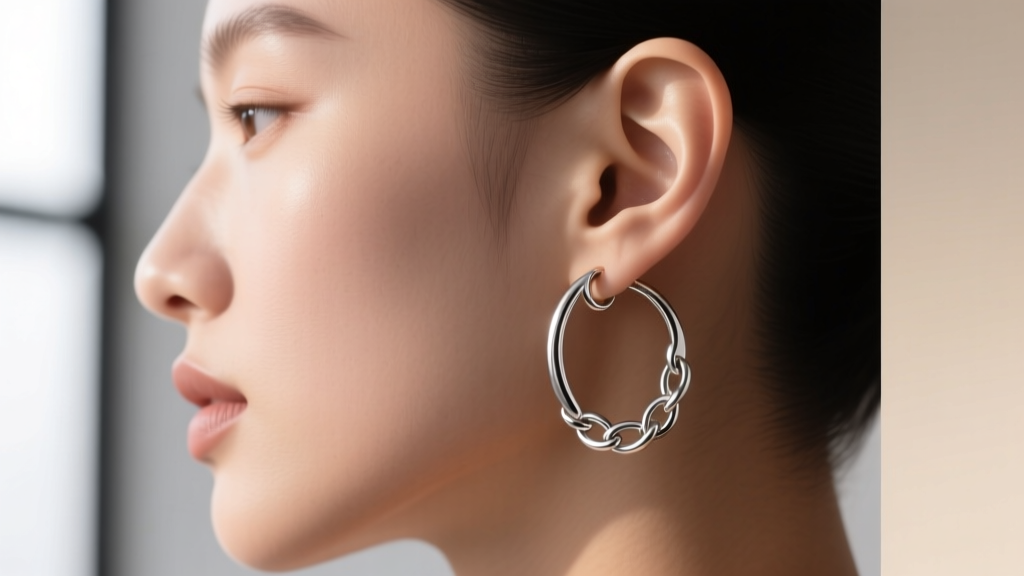
Adapting the Cuban link profile for cartilage piercings (such as the helix or tragus) requires a complete recalibration of weight and scale. Cartilage is avascular, meaning it lacks a direct blood supply and heals poorly from trauma. It cannot support the pendulum weight of standard lobe drops.
Gauge and Diameter Recommendations
When designing or selecting Cuban link earrings for cartilage, adhere to the following technical matrix to ensure tissue health and structural stability:
- Standard Lobe (20G - 18G): Max weight 5g. Link width 2mm - 3mm. Ideal for lightweight drops and standard studs.
- Heavy Lobe (16G - 14G): Max weight 15g. Link width 4mm - 8mm. Requires reinforced posts and omega backs.
- Helix / Cartilage (16G - 14G): Max weight 3g. Link width 2mm - 3mm. Must be a fixed hoop or huggie style to prevent swinging and cartilage irritation.
- Conch / Daith (14G - 12G): Max weight 4g. Link width 3mm - 4mm. Requires a precise inner diameter match to the specific anatomy of the ear fold.
Maintenance and Ultrasonic Cleaning Protocols
The flat-filed surfaces and tight interlocking joints of Cuban link earrings make them magnets for sebum, dead skin cells, and environmental particulates. Over time, this buildup acts as an abrasive paste, accelerating wear at the solder joints. Routine maintenance is not just cosmetic; it is a structural necessity.
For deep cleaning, ultrasonic cleaners are highly effective, but they must be used with precise parameters. Set the ultrasonic frequency between 40 kHz and 45 kHz. Frequencies lower than 35 kHz create larger cavitation bubbles that can physically impact and weaken micro-laser solder joints. Use a mild, alkaline-based jewelry cleaning solution (pH 8.0 - 9.0). Strictly avoid cyanide-based dips or highly acidic solutions, which can selectively leach the copper and silver alloying metals from the surface of 14k and 18k gold, leaving a porous, weakened layer of pure gold on the links. After ultrasonic cleaning, always rinse in distilled water and dry with compressed air to prevent water spots from forming in the recessed joints.


