2026 Trend Analysis: Styling The Perfect Gold Hoop Earring Set
Discover 2026 trends for the perfect gold hoop earring set. Learn to mix sizes, choose 14k vs 18k gold, and master the curated ear stack.


The Evolution of the Gold Hoop Earring Set in 2026
The era of buying single, isolated pairs of earrings is officially behind us. As we move through 2026, the dominant trend in ear styling is the curated stack, and at the heart of this movement is the meticulously assembled gold hoop earring set. Rather than relying on one oversized statement piece, modern jewelry enthusiasts are investing in multi-pack sets that offer a cohesive blend of huggies, mid-sized hoops, and statement anchors. This approach not only maximizes wardrobe versatility but also creates a harmonious visual flow across multiple piercings.
According to recent industry analyses, consumer demand for coordinated jewelry sets has surged, driven by the desire for effortless styling and the economic benefit of buying curated bundles over individual pieces. A high-quality gold hoop earring set allows you to mix textures—such as pairing a hammered 12mm huggie with a sleek, high-polish 35mm hoop—while maintaining a unified metallic tone. This guide breaks down the exact specifications, material grades, and structural anatomy you need to know to build, style, and maintain a premium hoop set this year.
Material Breakdown: 14k, 18k, and Vermeil Sets
When investing in a gold hoop earring set, understanding the metallurgy is non-negotiable. The longevity, color, and hypoallergenic properties of your stack depend entirely on the material grade. According to the Gemological Institute of America (GIA), the purity of gold dramatically affects its durability, which is a critical factor for hoop earrings that are prone to bending and snagging.
| Material Grade | Gold Purity | Durability & Use Case | Estimated Set Price (3-Piece) |
|---|---|---|---|
| 14k Solid Gold | 58.5% Gold | Highly durable, resists warping. Best for everyday wear and active lifestyles. | $250 - $600 |
| 18k Solid Gold | 75.0% Gold | Rich, deep yellow hue but softer. Prone to scratching; best for occasional wear. | $450 - $1,200 |
| Gold Vermeil | 2.5+ Microns over Sterling Silver | Moderate durability. Will eventually wear down to silver base. Requires careful maintenance. | $80 - $180 |
| Gold Plated (Brass Base) | < 0.5 Microns over Brass | Low durability. High risk of contact dermatitis and rapid tarnishing. Not recommended. | $20 - $50 |
For a permanent addition to your daily rotation, a 14k solid gold hoop earring set is the undisputed champion. It provides the necessary tensile strength to support the weight of larger hoops without the wire bending out of shape. If you opt for vermeil, ensure the manufacturer guarantees a minimum thickness of 2.5 microns of gold over a sterling silver base, as anything thinner will rub off at the friction points near the clasp within months.
Anatomy of a Curated Set: Sizes and Gauge Thickness
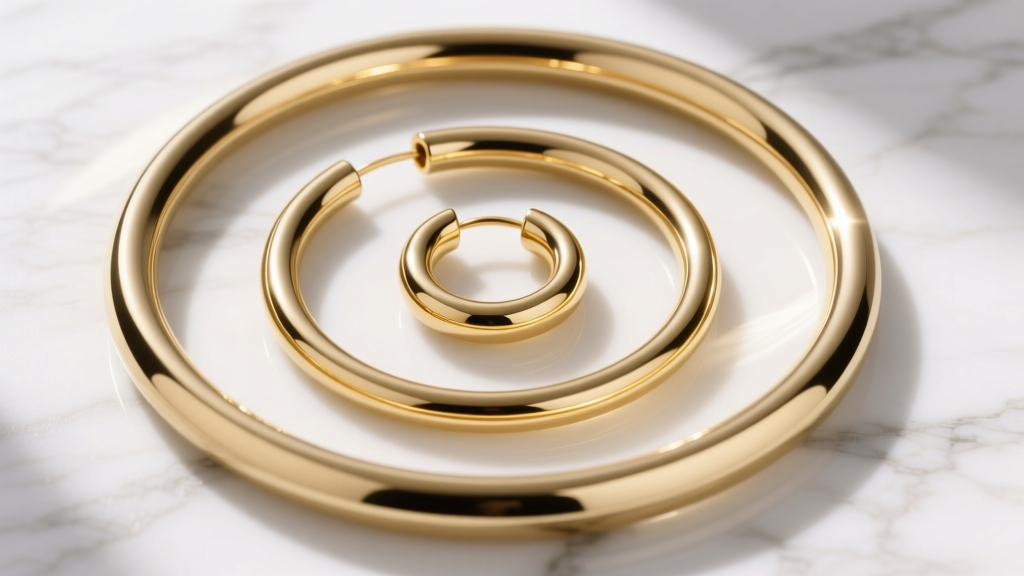
A well-engineered gold hoop earring set relies on a precise graduation of diameters and wire thicknesses (gauges). The interplay between the inner diameter and the wire gauge dictates how the earring sits on the ear and how much it weighs on the piercing hole.
The Huggie Base (10mm - 15mm)
Huggies are designed to 'hug' the earlobe closely. In a premium set, these should feature an 18-gauge (1.0mm) or 16-gauge (1.2mm) wire thickness. Because they sit tightly against the skin, a thicker wire prevents the earring from twisting awkwardly. Look for sets that utilize a clicker clasp mechanism rather than a traditional latchback, as clickers provide a secure, flush closure that won't catch on hair or sweaters.
The Mid-Hoop (20mm - 30mm)
The mid-hoop is the workhorse of the set. A 25mm diameter offers a classic, universally flattering silhouette that frames the jawline without overwhelming the face. These are typically crafted in 18-gauge (1.0mm) or 20-gauge (0.8mm) wire. If the set includes textured mid-hoops (such as rope or twisted wire designs), ensure the texture does not create sharp edges that could irritate the skin behind the earlobe.
The Statement Anchor (40mm+)
Large hoops demand structural integrity. A 40mm to 50mm hoop in a gold set must be crafted with a minimum of 18-gauge wire, or ideally a flattened tube design, to prevent the hoop from collapsing into an oval shape under its own weight. Hollow-tube statement hoops are popular for reducing weight, but they are highly susceptible to denting if dropped or slept in.
Lobe vs. Cartilage: How to Distribute Your Set
The versatility of a multi-piece gold hoop earring set shines when you distribute the pieces across both lobe and cartilage piercings. However, cartilage anatomy requires specific considerations regarding gauge and diameter.
- Lobe 1 (Primary): Reserve the 35mm+ statement hoop or the 25mm mid-hoop for the primary lobe piercing. The lobe tissue is soft and can accommodate heavier, thicker wires (16G to 20G).
- Lobe 2 (Secondary): Place the 12mm to 15mm huggie here. This creates a tight, secure anchor that contrasts beautifully with the movement of the larger hoop in the primary lobe.
- Helix / Flat Cartilage: According to the Association of Professional Piercers (APP), cartilage piercings are typically performed at 16G (1.2mm) or 18G (1.0mm). You can use the smaller huggies from your set in a helix piercing, provided the wire gauge matches the piercing hole. Forcing a 20G (0.8mm) huggie into a 16G cartilage hole can cause the 'cheese-cutter effect,' where the thin wire migrates through the tissue.
- Tragus / Conch: Avoid standard hoops in the tragus due to the tight spatial constraints. If your set includes specialized forward-facing huggies with a flat back, they can be utilized here.
Expert Troubleshooting: Sagging, Snagging, and Clasp Failure
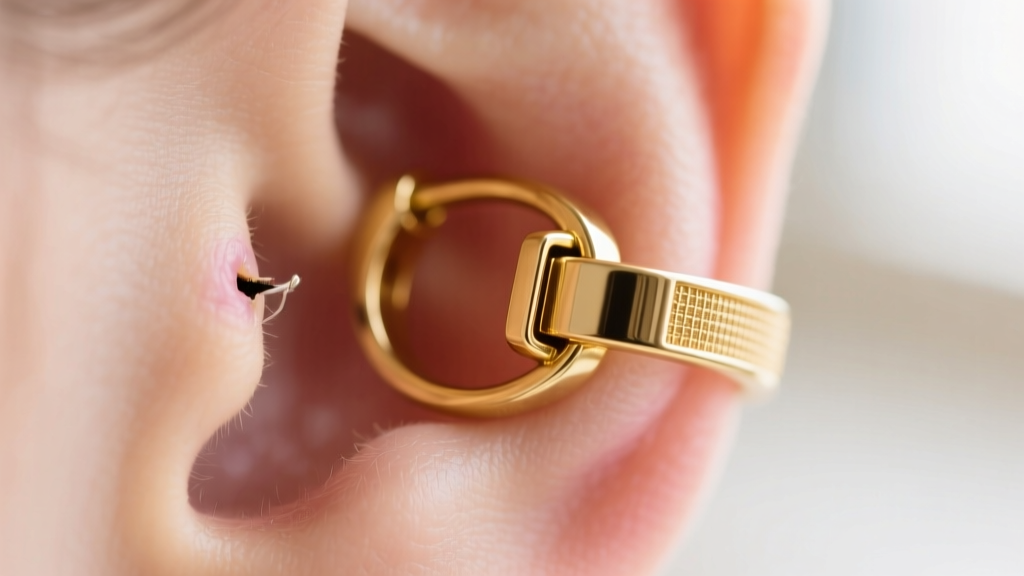
Even the most expensive gold hoop earring set can become unwearable if the mechanics fail or the fit is poor. Here is how to troubleshoot the most common issues associated with hoop stacks.
Combating Earlobe Sagging
Wearing heavy mid-hoops and statement anchors daily can stretch the piercing fistula over time. To counteract this, alternate your heavy hoops with lightweight huggies to give the tissue time to recover. If your lobes are already slightly stretched, avoid 20-gauge wires entirely; the thin metal will slice through the weakened tissue. Instead, use silicone o-rings (earring backers) on the back of the hoop wire to distribute the weight across a wider surface area of the lobe.
Clasp Mechanics: Clicker vs. Latchback vs. Continuous
The clasp is the weakest point of any hoop. Latchback clasps (where a thin wire hooks into a hollow catch) are notorious for loosening over time and losing the earring. Continuous hoops (where a thin wire threads through the hollow tube) are sleek but easily bent out of shape during insertion. For a 2026 gold hoop earring set, always prioritize clicker clasps. A well-machined clicker features a hinged segment that snaps into a tension-based groove, offering a distinct 'click' and a seamless, secure closure that is virtually invisible when worn.
Pro Tip: Never use chemical jewelry dips or ultrasonic cleaners on gold vermeil hoop sets. The harsh chemicals and high-frequency vibrations will strip the micron-layer of gold directly off the sterling silver base, particularly around the high-friction clasp areas. Stick to warm water, mild dish soap, and a microfiber cloth.
Final Verdict on Building Your Stack
The modern gold hoop earring set is an exercise in proportional styling and material science. By prioritizing 14k solid gold for durability, understanding the exact gauge requirements for your specific piercings, and mastering the graduation of diameters from huggie to statement, you can build a stack that is both trend-forward and built to last a lifetime. Invest in the mechanics as much as the aesthetics, and your curated ear will remain secure, comfortable, and effortlessly chic throughout 2026 and beyond.


