Material Guide for Dangling Hoop Earrings: Weight & Safety
Compare metals for dangling hoop earrings. Learn how titanium, gold, and brass affect weight, lobe stretching, and nickel allergies.

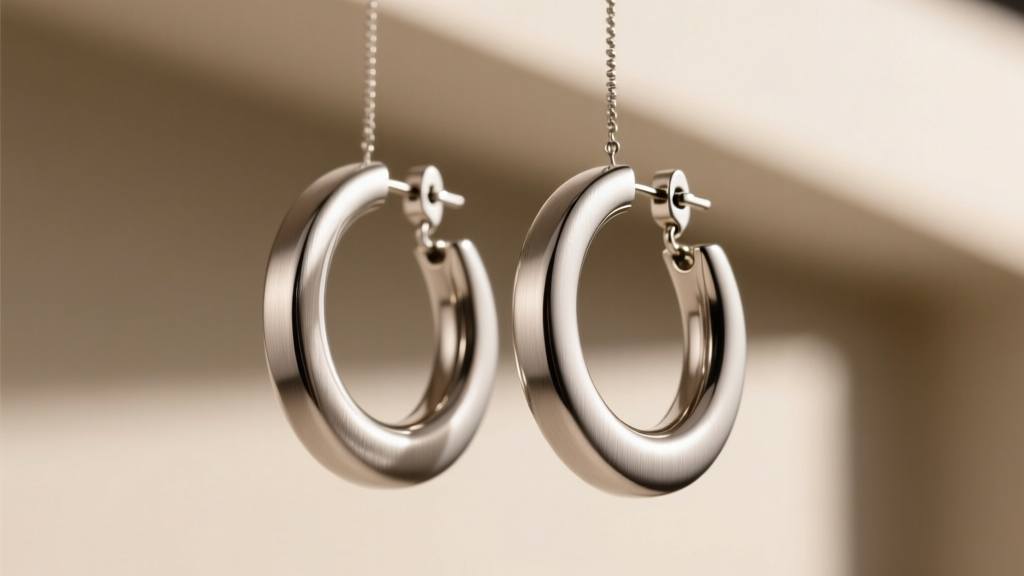
The Physics of Dangling Hoops: Why Material Weight Matters
When selecting dangling hoop earrings, the visual design often overshadows a critical physical property: material density. Unlike flat-back studs or lightweight huggies, dangling hoops operate on a pendulum effect. Every time you turn your head, walk, or take off a sweater, kinetic energy transfers through the earlobe piercing. If the metal is too dense, this repetitive micro-trauma leads to lobe stretching, migration, and the dreaded 'cheese cutter effect,' where thin wires slowly slice through the skin.
In 2026, jewelry manufacturers have access to a wider array of aerospace-grade alloys and refined precious metals than ever before. However, not all metals are suited for large-diameter drops. Understanding the specific gravity, tensile strength, and biocompatibility of your earrings is essential for long-term lobe health. Below, we break down the metallurgical properties of the most common materials used in dangling hoop earrings, categorized by their weight-to-durability ratio.
Tier 1: Ultra-Lightweight & Hypoallergenic Metals
For hoops exceeding 50mm in diameter, minimizing gravitational pull is paramount. These metals offer the best strength-to-weight ratios on the market.
Titanium (ASTM F136 Grade 23)
Titanium is the undisputed champion for oversized dangling hoop earrings. Specifically, you want Grade 23 Titanium (Ti-6Al-4V ELI), which meets the ASTM International standard for surgical implant applications. With a density of just 4.5 g/cm³, titanium is roughly 45% lighter than steel and nearly 75% lighter than pure gold.
- Density: 4.5 g/cm³
- Tensile Strength: Extremely high; resists warping even at thin 20-gauge (0.81mm) wire diameters.
- Biocompatibility: 100% nickel-free and highly biocompatible, making it the top recommendation by the Association of Professional Piercers for sensitive or healing lobes.
Niobium
Niobium is a reactive, hypoallergenic metal that is slightly denser than titanium (8.57 g/cm³) but significantly softer. While it is excellent for anodizing into vibrant colors without using chemical plating, its lower tensile strength means large niobium hoops can easily bend out of their perfect circular shape if snagged. It is best reserved for medium-sized dangling hoops (30mm-40mm) where its weight remains manageable.

Tier 2: The Precious Metal Standards
Precious metals carry unparalleled prestige and heirloom value, but their high density requires careful engineering when applied to dangling designs.
14k vs. 18k Solid Gold
Gold is inherently heavy. Pure 24k gold has a massive density of 19.3 g/cm³. To create durable jewelry, it is alloyed with other metals, which slightly alters the weight and drastically changes the skin safety profile.
- 14k Gold (58.5% pure): Density sits around 13.0 g/cm³. It is harder and more resistant to scratching, making it ideal for the structural wire of heavy drops.
- 18k Gold (75% pure): Density increases to roughly 15.6 g/cm³. While richer in color, 18k gold is softer. A large 18k gold hoop will pull noticeably on the lobe and requires a thicker wire gauge (16G or 1.29mm) to prevent permanent deformation.
Expert Warning: Always verify the alloying metals in white gold. Historically, nickel was used to bleach gold white, triggering severe contact dermatitis. The Mayo Clinic notes that nickel allergy is one of the most common causes of allergic contact dermatitis. Opt for palladium-alloyed white gold to ensure your dangling hoops remain hypoallergenic.
Platinum and Palladium
Platinum is incredibly dense (21.4 g/cm³)—even heavier than pure gold. While it is hypoallergenic and virtually indestructible, a pair of 60mm solid platinum dangling hoop earrings would cause significant lobe fatigue within hours. Palladium, a sister metal in the platinum group, offers a similar bright white luster but at less than half the weight (12.0 g/cm³), making it a vastly superior choice for large, luxurious drops.
Tier 3: Heavy & Reactive Metals to Avoid for Large Drops
While budget-friendly, these materials introduce structural and dermatological risks when scaled up into large dangling silhouettes.
Brass, Bronze, and Copper
Brass (an alloy of copper and zinc) has a density of roughly 8.4 g/cm³. Beyond the moderate weight issue, these reactive metals oxidize rapidly when exposed to the natural acidity of human skin. This creates verdigris, a green copper carbonate crust that can stain the earlobe and harbor bacteria. For large hoops that swing and constantly rub against the piercing channel, brass is highly discouraged.
Stainless Steel (316L)
Surgical steel (316L) is a staple in affordable jewelry, with a density of 8.0 g/cm³. However, it contains up to 12% nickel. While the EU Nickel Directive limits nickel release to 0.5 µg/cm²/week, the friction caused by heavy dangling hoops swinging through the piercing can degrade the passive oxide layer on the steel, increasing nickel leaching and triggering flare-ups in sensitive individuals.
Material Density & Lobe Stress Comparison Chart
To visualize how different materials impact your lobes, refer to the density and stress metrics below. This data assumes a standard 50mm diameter hoop with a 2mm tube thickness.
| Material | Density (g/cm³) | Estimated Weight (per 50mm hoop) | Lobe Stress Level | Recommended Max Diameter |
|---|---|---|---|---|
| Grade 23 Titanium | 4.5 | ~3.2 grams | Very Low | 80mm+ |
| Palladium | 12.0 | ~8.5 grams | Low-Medium | 60mm |
| 316L Steel | 8.0 | ~5.7 grams | Medium | 50mm |
| 14k Solid Gold | 13.0 | ~9.2 grams | Medium-High | 45mm |
| 18k Solid Gold | 15.6 | ~11.0 grams | High | 35mm |
| Platinum | 21.4 | ~15.1 grams | Extreme | 25mm (Huggies only) |
Hardware Mechanics: Wire Gauge and Clasp Integrity
The metal composition is only half the battle; the structural geometry of the wire dictates how that weight is distributed across your piercing. The 'cheese cutter effect' occurs when a heavy hoop is suspended on a wire that is too thin, concentrating the gravitational force onto a microscopic surface area of tissue.
Wire Gauge Minimums for Dangling Hoops
- 22-Gauge (0.64mm): Strictly for micro-hoops and lightweight sleepers. Never use for dangling drops.
- 20-Gauge (0.81mm): Acceptable for titanium or niobium hoops up to 40mm in diameter.
- 18-Gauge (1.02mm): The industry standard for medium-to-large drops. Provides adequate rigidity for gold and steel hoops up to 60mm.
- 16-Gauge (1.29mm): Mandatory for oversized statement hoops (70mm+) or heavy precious metals to prevent the wire from bending at the clasp hinge.
Clasp Engineering
For heavy dangling hoop earrings, traditional French wires (fishhooks) are a liability; they easily slip out when the hoop swings forward. Instead, look for saddleback clasps or hinged snap-back closures. A well-machined hinged clasp distributes the tension across a locking pin rather than relying on the friction of a bent wire, ensuring your expensive gold or platinum hoops remain securely attached during movement.
Final Verdict: Matching Material to Hoop Diameter
Designing or purchasing the perfect pair of dangling hoop earrings requires balancing aesthetic desires with anatomical realities. If your goal is massive, shoulder-grazing 80mm statement hoops, aerospace-grade Titanium is your only viable option to prevent lobe damage. For mid-sized, everyday hoops in the 30mm to 40mm range, 14k palladium-alloyed white gold or platinum-group Palladium offers the perfect intersection of luxury, weight management, and skin safety. Avoid heavy brass or high-nickel steel in large formats, and always prioritize an 18-gauge or 16-gauge wire thickness to protect your piercing channel from long-term migration. By respecting the physics of material density, you can enjoy dramatic, swinging silhouettes without sacrificing the health of your earlobes.


