Dangling Star Earrings: A 2026 Budget & Value Guide
Discover the true value of dangling star earrings in 2026. We compare materials, pricing tiers, and durability to help you find the best budget-friendly pairs.


Celestial jewelry has transitioned from a fleeting seasonal trend to a permanent staple in modern accessories, but the market is heavily saturated. When shopping for dangling star earrings, consumers are often caught between ultra-cheap $12 fast-fashion alloys and $800 solid gold luxury pieces. As we navigate the 2026 jewelry market, understanding the true cost-per-wear and material integrity of these celestial drops is essential for making a smart investment. This comprehensive budget and value assessment breaks down exactly what you are paying for, where the hidden costs lie, and how to identify high-quality budget options that won't turn your earlobes green or snap after a week of wear.
The Anatomy of Dangling Star Earrings: What You Are Paying For
Before assessing price, it is crucial to understand how dangling star earrings are constructed. The manufacturing method dictates both the visual crispness of the star's points and the structural integrity of the piece. Budget earrings are typically produced using one of two methods: die-striking or lost-wax casting.
Die-Struck vs. Cast Stars: High-value budget earrings often feature die-struck stars. This process involves stamping a sheet of metal under immense pressure, which compresses the metal molecules, resulting in a denser, more durable star with razor-sharp points. Conversely, cheap cast stars are made by pouring liquid metal into a mold. Cast pieces are prone to microscopic porosity, making them brittle and giving the star's edges a soft, melted appearance. If a budget pair features incredibly crisp, geometric star points, it is likely die-struck and offers superior value.
The Connection Point: The most critical failure point on any dangling star earring is the jump ring—the tiny metal loop connecting the star charm to the ear wire. In ultra-budget pairs, this jump ring is simply pinched shut. Over time, the friction of the ear wire moving against it will pry the gap open, and you will lose the star. High-value budget options will feature a soldered jump ring, meaning the gap is fused shut with a laser or torch, guaranteeing the charm stays attached to the wire.
Material Tiers & Price Breakdown (2026 Market Analysis)
The base metal and plating thickness are the primary drivers of cost. According to the Federal Trade Commission's Jewelry Guides, terms like 'gold vermeil' and 'gold plated' have strict legal definitions regarding thickness and base metal, yet fast-fashion brands frequently blur these lines. Below is a realistic 2026 pricing and value matrix for dangling star earrings.
| Material Tier | Base Metal | Plating / Finish | Avg. Price Range | Expected Lifespan | Hypoallergenic? |
|---|---|---|---|---|---|
| Zinc Alloy (Fast Fashion) | Zinc/Copper/Brass | Flash Gold (Under 0.1µm) | $8 - $18 | 3 - 6 Months | No (High Nickel Risk) |
| 925 Sterling Silver | 92.5% Silver, 7.5% Copper | Rhodium or E-Coating | $28 - $55 | 5+ Years | Yes (Usually) |
| Gold Vermeil | 925 Sterling Silver | 14k or 18k Gold (Min 2.5µm) | $45 - $85 | 2 - 4 Years | Yes |
| Solid 14k Gold | Gold, Zinc, Copper | None (Solid throughout) | $180 - $350 | Lifetime | Yes (If Nickel-Free) |
The Value Sweet Spot: For most buyers, Gold Vermeil offers the highest return on investment. You get the rich, warm luster of 14k gold and the hypoallergenic benefits of a sterling silver base, without the premium markup of solid gold. However, you must verify the plating thickness. If a brand cannot confirm their gold plating is at least 2.5 microns thick, it is merely 'gold plated' and will wear through to the silver base within months of daily wear.
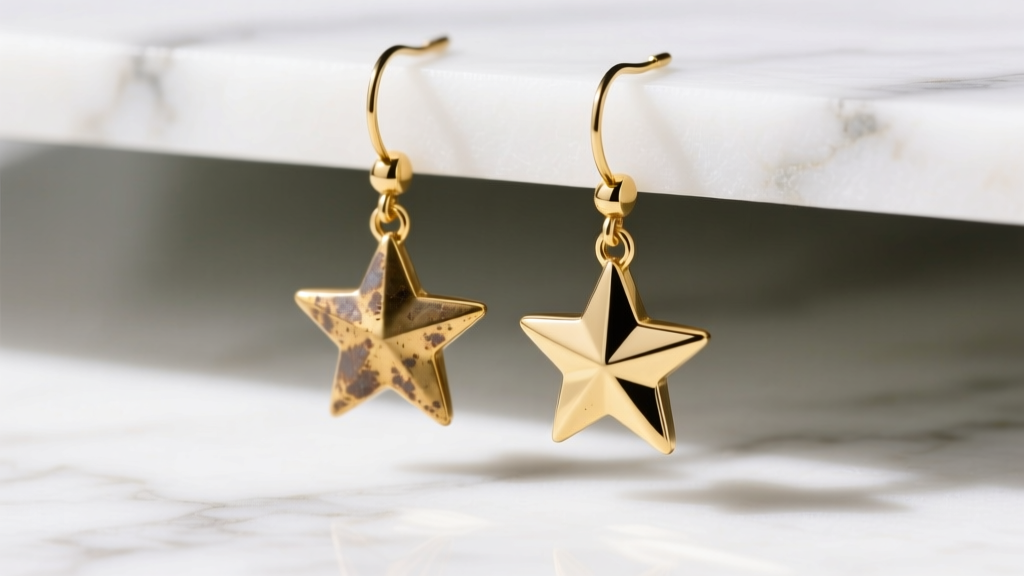
Hidden Costs: Durability, Hypoallergenic Needs, and Maintenance
When evaluating the budget tier (under $20), the initial low price often masks significant hidden costs, both financial and physiological. The most common issue with ultra-cheap dangling star earrings is contact dermatitis. To make base metals like brass or zinc alloy easier to cast and more durable, manufacturers frequently add nickel. The American Academy of Dermatology notes that nickel allergy is one of the most common causes of allergic contact dermatitis, resulting in itchy, red, and blistered earlobes.
Furthermore, cheap alloys react rapidly to the sulfur in the air and the natural acids in your skin. A pair of $15 brass star earrings with a microscopic flash-plating of gold will likely tarnish, turn your skin green (due to copper oxidation), and become unwearable within a single season. When you calculate the cost of replacing these earrings three or four times a year, the 'budget' option quickly becomes more expensive than a single $45 pair of rhodium-plated sterling silver stars that will last a decade.
Maintenance Realities by Material
- Alloy/Brass: Requires constant wiping. Cannot be cleaned with jewelry dips as it will strip the flash plating instantly. High maintenance, low reward.
- Sterling Silver (E-Coated): Virtually maintenance-free. The clear e-coating prevents sulfur from reaching the silver, meaning no polishing cloth is required. Simply wipe with a damp microfiber cloth.
- Gold Vermeil: Moderate maintenance. Must be kept away from harsh chemicals, perfumes, and ultrasonic cleaners, which will vibrate the 2.5-micron gold layer right off the silver base.
How to Spot High-Value Budget Dangling Star Earrings
Finding true value requires looking past the product photography and examining the specifications. Use this checklist when evaluating budget-friendly celestial drops online or in-store:
1. Inspect the Ear Wire Gauge and Clasp Type
The standard gauge for ear wires is 20-gauge (0.81mm). Some budget brands use 22-gauge (0.64mm) wire to save on metal costs. While 22-gauge is fine for lightweight studs, a dangling star earring has kinetic energy; it swings and catches on hair and clothing. A 22-gauge wire will easily bend out of shape, compromising the security of the earring. Furthermore, look for leverback closures rather than standard French fishhooks. A leverback features a hinged clasp that clicks securely into place, preventing the star earring from slipping off your ear when you take off a sweater or brush your hair.
2. Verify the Hallmarks and Stamps
Legitimate value brands will stamp their jewelry. Look for '925' stamped on the ear wire or the back of the star charm. According to the Gemological Institute of America (GIA), the 925 stamp guarantees the item is 92.5% pure silver. If the piece is vermeil, you may also see a 'Vermeil' stamp or a '14k' stamp alongside the 925. If the earring is entirely blank with no maker's mark or metal stamp, assume it is a base metal alloy.
3. Check the Packaging for Anti-Tarnish Measures
High-value budget brands protect their inventory and your purchase. If your dangling star earrings arrive in a simple plastic poly-bag, they are likely already beginning the oxidation process during shipping. Brands that invest in value will include anti-tarnish strips (small pieces of treated paper that absorb sulfur) inside a sealed ziplock or a lined jewelry box. This small detail is a strong indicator that the manufacturer cares about the longevity of their metal finishes.
Final Verdict: Where to Invest and Where to Save
When building a jewelry collection, dangling star earrings occupy a unique space. They are playful, statement-making pieces that catch the light beautifully, but they do not necessarily require the heavy financial investment of an engagement ring or a daily-wear wedding band.
Where to Save: Avoid solid 14k or 18k gold for this specific style unless you are buying from a heritage brand with lifetime repair guarantees. The delicate points of a star charm are prone to snagging, and losing a $300 solid gold earring to a caught sweater is a painful financial blow.
Where to Invest: The ultimate sweet spot for budget and value in 2026 is 14k Gold Vermeil over 925 Sterling Silver, priced between $45 and $85. Ensure the stars are die-struck for crisp edges, the jump rings are soldered for security, and the ear wires are a sturdy 20-gauge with a leverback clasp. By prioritizing these structural and material specifics over brand names, you can secure a pair of breathtaking, durable celestial earrings that will shine for years without breaking the bank.


