Custom Jewelry Buying Guide: Decoding Your Hoop Earrings Drawing
Learn how to read and request a professional hoop earrings drawing before commissioning custom jewelry. Master CAD specs, gauges, and metal grades.

Commissioning a custom pair of hoops is an exciting journey, but it requires far more than handing a jeweler a Pinterest mood board. Whether you are designing an oversized statement piece or a precision-engineered huggie, the foundation of your purchase relies entirely on the technical blueprint. When investing in bespoke jewelry, the hoop earrings drawing serves as your primary contract, dictating everything from structural integrity to everyday comfort. In 2026, with advanced CAD software like MatrixGold becoming the industry standard, buyers have unprecedented access to the exact specifications of their future pieces. Yet, many consumers lack the technical literacy to review these schematics before approving the final cast.
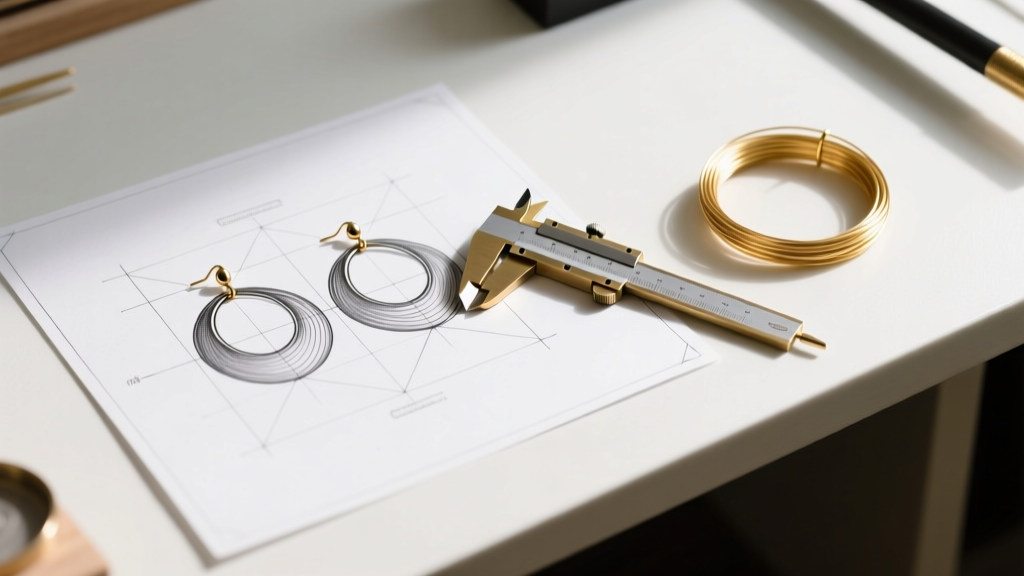
Why a Technical Drawing Matters in Custom Hoop Orders
A common mistake buyers make is confusing a fashion sketch with a manufacturing blueprint. A 2D artistic sketch might capture the aesthetic vibe of a diamond-encrusted hoop, but it completely fails to communicate the mechanical realities of the jewelry. A professional hoop earrings drawing, particularly a CAD-generated technical diagram, provides exact millimeter measurements, cross-sectional geometry, and mechanical tolerances. According to industry manufacturing standards reported by JCK Online, over 60% of custom jewelry revisions stem from misaligned expectations regarding weight, thickness, and clasp mechanics—issues that are entirely preventable if the buyer knows how to read the initial technical drafts.
Anatomy of a Professional Hoop Earrings Drawing
When your jeweler presents the schematic, you should immediately look for specific callouts that define the physical boundaries of the earring. A comprehensive diagram will break down the following metrics:
- Inner Diameter (ID): The measurement from the inside of the hoop to the opposite inside edge. This dictates how the earring will sit against your earlobe or cartilage. A standard lobe hoop usually features an ID of 15mm to 20mm, while huggies sit tightly at 10mm to 12mm.
- Outer Diameter (OD): The total exterior footprint. The difference between the OD and ID reveals the thickness of the metal.
- Cross-Sectional Profile: Hoops are not always perfectly circular wires. The drawing should specify if the cross-section is round, oval, square, or hexagonal, which drastically affects both the visual weight and the way light reflects off the metal.
- Wall Thickness (for hollow tubes): If you are commissioning lightweight, oversized hoops, the jeweler will use tubing rather than solid wire. The drawing must specify the outer wall thickness (ideally no less than 0.8mm to prevent denting).
Critical Hinge and Closure Specifications
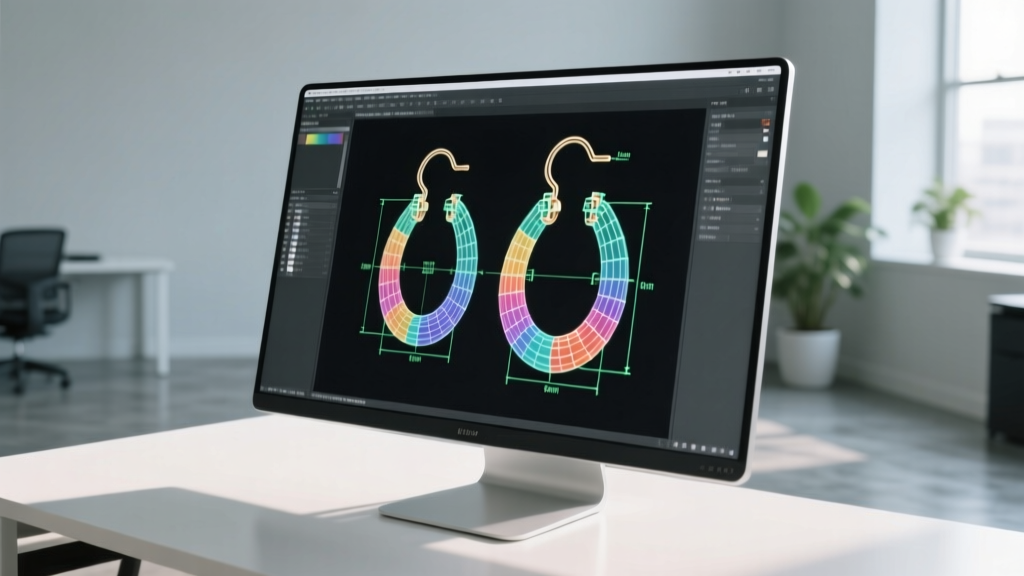
The most frequent point of failure in hoop earrings is the closure mechanism. Your technical drawing must explicitly detail the hinge type and its tolerances. If the schematic simply says "hinge here," request a revision. You need to know the exact engineering.
Clicker Hinges vs. Saddle Hinges
For huggies and cartilage hoops, a clicker hinge is the gold standard. A proper CAD drawing will show the male and female interlocking components with a tolerance of 0.05mm. If the tolerance is too loose, the earring will click open during sleep; if it is too tight, the metal will bind and snap. For larger, heavier hoops, a saddle hinge paired with an omega-back or a secure post-and-clutch is required to distribute the weight across the earlobe, preventing the dreaded "earlobe droop" over time.
Standard Dimensions and Weight Estimates
Understanding the relationship between diameter, gauge, and metal weight is crucial for pricing and comfort. Below is a reference chart to help you verify the specifications listed on your custom blueprint against industry standards for 14k gold.
| Hoop Style | Inner Diameter (mm) | Wire/Tube Gauge | Est. Weight per Earring (14k) | Recommended Closure |
|---|---|---|---|---|
| Tight Huggie | 10mm - 12mm | 12G (2.0mm) Solid | 1.8g - 2.2g | Precision Clicker |
| Standard Lobe | 15mm - 20mm | 10G (2.5mm) Solid | 2.5g - 3.5g | Saddle Hinge + Snap |
| Oversized Statement | 40mm - 50mm | 4mm Hollow Tube | 4.0g - 6.0g | Post with Friction Back |
| Cartilage Helix | 8mm - 10mm | 16G (1.2mm) Solid | 0.8g - 1.2g | Threadless Push-Pin |
Material Grades and Casting Shrinkage Allowances
A sophisticated hoop earrings drawing will also include notes on material science. When casting gold or platinum, the metal shrinks as it cools. Bench jewelers and CAD designers must account for a casting shrinkage rate of approximately 1.5% to 2.0%. If your drawing does not factor in this shrinkage, your final 15mm ID hoop might emerge from the casting tree at 14.7mm, potentially altering the way the clasp aligns.
Furthermore, pay close attention to the alloy callouts. As noted by the Gemological Institute of America (GIA), understanding your metal composition is vital for longevity and skin health. If the drawing specifies "White Gold," ensure it clarifies whether it is a nickel-based alloy (which can cause contact dermatitis) or a palladium-based nickel-free alloy. For high-wear items like everyday hoops, 14k gold is often recommended over 18k gold due to its higher tensile strength, which protects the delicate hinge pins from bending.
Red Flags to Watch For Before Approving Your Design
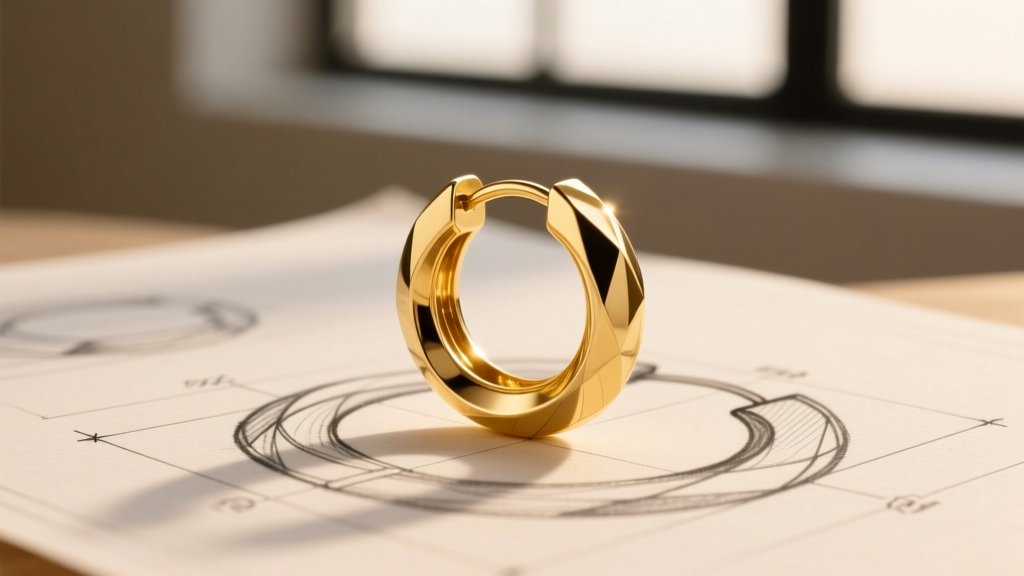
Before you authorize the 3D print and casting phases, scrutinize the drawing for these common engineering flaws:
- Under-Sized Hinge Pins: The pin connecting the hoop to the clasp should never be thinner than 0.8mm in solid gold. Anything less will eventually shear under the torsional stress of daily wear.
- Sharp Interior Edges: The cross-section diagram should show slightly beveled or polished interior edges. Sharp 90-degree angles on the inside of the hoop will cause micro-abrasions on the earlobe.
- Missing Stone Setting Depth: If your hoops feature pavé diamonds, the drawing must indicate the metal bearing (the tiny prongs holding the stones). A lack of bearing depth in the CAD file means the stones will sit too high and snag on hair and clothing.
"Never approve a custom jewelry render based solely on the photorealistic ray-traced image. The aesthetic render hides structural compromises. Always demand the orthogonal wireframe drawing with dimensional callouts to verify the engineering."
Finalizing Your Custom Purchase
Treating your custom jewelry purchase with the rigor of an engineering project ensures you receive a piece that is not only beautiful but mechanically sound. By learning to decode the hoop earrings drawing, you transition from a passive consumer to an informed collaborator. Ask your jeweler for the STL file dimensions, verify the hinge tolerances, and ensure the metal weight aligns with your comfort thresholds. When you bridge the gap between artistic vision and technical reality, the resulting custom hoops will become a flawless, lifelong staple in your jewelry wardrobe.


