Double Diamond Earrings: A Material & Metal Comparison Guide
Discover the ultimate material comparison for double diamond earrings. We analyze natural vs lab stones and platinum vs white gold settings.

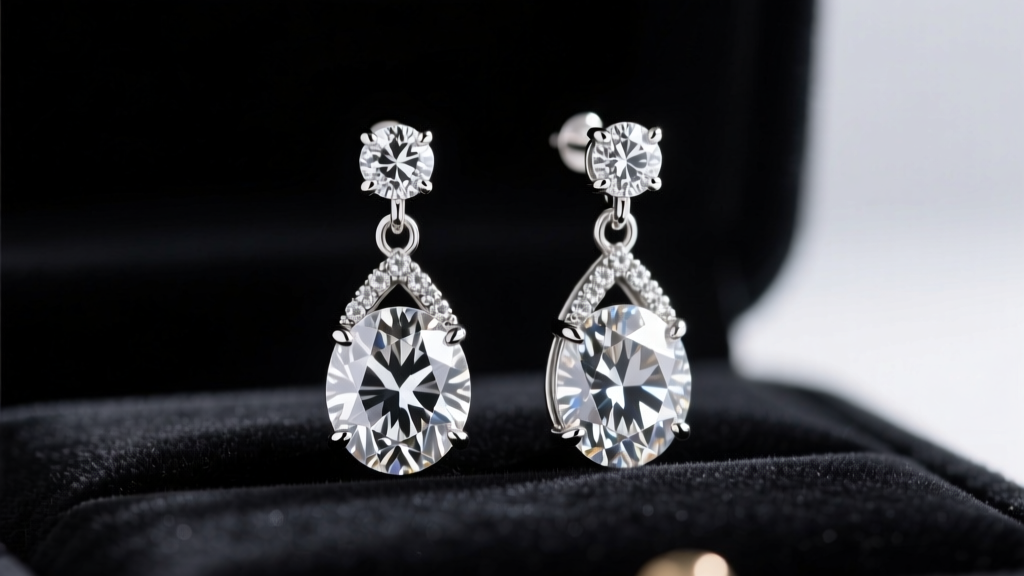
When curating a fine jewelry collection, double diamond earrings represent a masterclass in structural elegance and optical brilliance. Unlike standard single-stone studs, a double diamond configuration—typically featuring a primary stud connected to a secondary drop stone or a curved jacket—introduces complex physical dynamics. The interplay of light across two distinct focal points per ear demands absolute precision in both gemological selection and metallurgical engineering. As we navigate the jewelry landscape in 2026, the choices between natural and lab-grown stones, alongside the debate over platinum versus white gold alloys, have never been more nuanced. This comprehensive guide dissects the material properties that dictate the longevity, brilliance, and structural integrity of your double diamond earrings.
The Gemological Core: Natural vs. Lab-Grown Diamonds
The foundation of any double diamond earring lies in the stones themselves. Because these designs utilize two diamonds per ear, the total carat weight and visual footprint are amplified, making the origin and clarity of the stones paramount. According to the Gemological Institute of America (GIA), both natural and lab-grown diamonds share identical physical, chemical, and optical properties. However, their formation environments result in distinct inclusion patterns and pricing structures.
Natural diamonds, forged deep within the Earth's mantle over billions of years, often contain microscopic inclusions such as crystals, feathers, or clouds. In a double-stone drop design, where light must travel through the pavilion of the top stone and reflect into the bottom stone, high clarity (VS1 or better) is recommended to prevent light obstruction. Lab-grown diamonds, produced via Chemical Vapor Deposition (CVD) or High Pressure High Temperature (HPHT) methods, frequently achieve VVS (Very Very Slightly Included) or IF (Internally Flawless) grades due to their controlled environments.
Comparative Gemological Matrix
| Property | Natural Diamond | Lab-Grown Diamond | Moissanite (Simulant) |
|---|---|---|---|
| Mohs Hardness | 10 | 10 | 9.25 |
| Refractive Index | 2.42 | 2.42 | 2.65 |
| Dispersion (Fire) | 0.044 | 0.044 | 0.104 |
| Typical Clarity | SI1 - VS1 | VVS2 - IF | FL (Flawless) |
| Inclusion Type | Mineral crystals, feathers | Metallic flux, striae | Needle-like tubes |
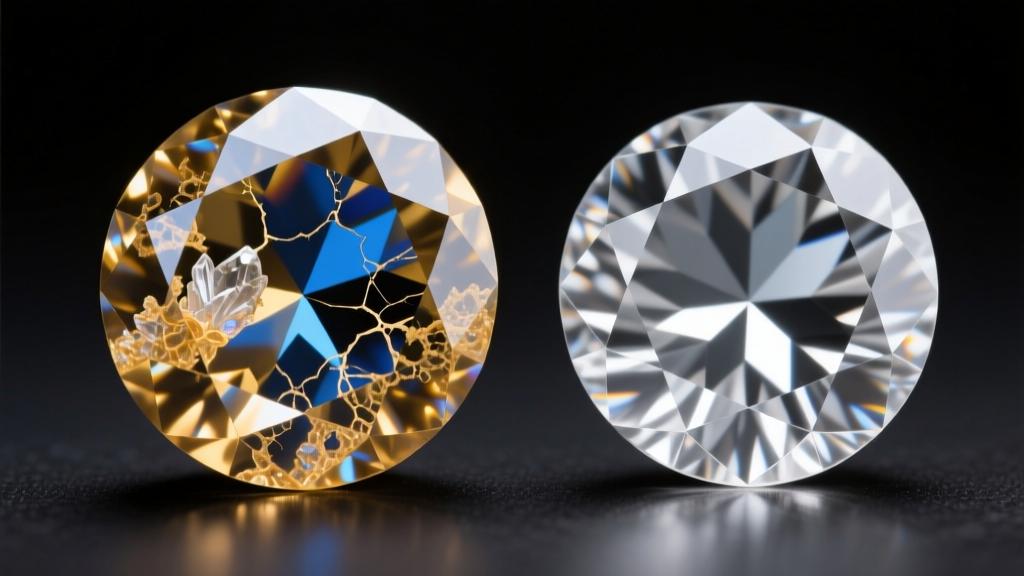
For double diamond earrings, the higher dispersion of Moissanite can sometimes create a 'disco-ball' effect that overpowers the delicate balance of a two-stone drop. Therefore, sticking to genuine diamond (natural or lab-grown) ensures the crisp, scintillating light return required for high-end double-stone designs.
The Metallurgy of the Setting: Platinum vs. White Gold
Once the stones are selected, the metal matrix must securely house them. The Federal Trade Commission (FTC) Jewelry Guides strictly regulate metal purity markings, but understanding the alloy compositions is critical for the wearer. The two dominant choices for diamond settings are Platinum 950 and White Gold (18k and 14k).
Platinum 950: The Heavyweight Champion
Platinum 950 consists of 95% pure platinum and 5% alloy metals, typically ruthenium or iridium. It is a dense, heavy, and naturally white metal. Its most significant advantage for double diamond earrings is its malleability combined with high tensile strength. When a jeweler sets a diamond, they push the prongs over the girdle. Platinum prongs can be bent and shaped without losing structural memory or becoming brittle, making them exceptionally secure for holding heavy double-stone drops.
18k and 14k White Gold: The Alloy Alternative
White gold is an alloy of yellow gold mixed with white metals like palladium, nickel, or silver, and then plated with rhodium to achieve a bright white finish. 18k white gold contains 75% pure gold, while 14k contains 58.5%. While 14k white gold is harder and more scratch-resistant than 18k due to the higher alloy content, it lacks the prong-security of platinum. Over time, the rhodium plating on white gold wears away, revealing the slightly yellowish alloy beneath, necessitating re-plating every 12 to 18 months.
"In double-stone designs, the lower stone acts as a pendulum. I always recommend Platinum 950 for the prongs and the connecting jump rings, as white gold prongs can fatigue and snap under repetitive pendulum stress." — Master Bench Jeweler
The Physics of Double-Stone Leverage
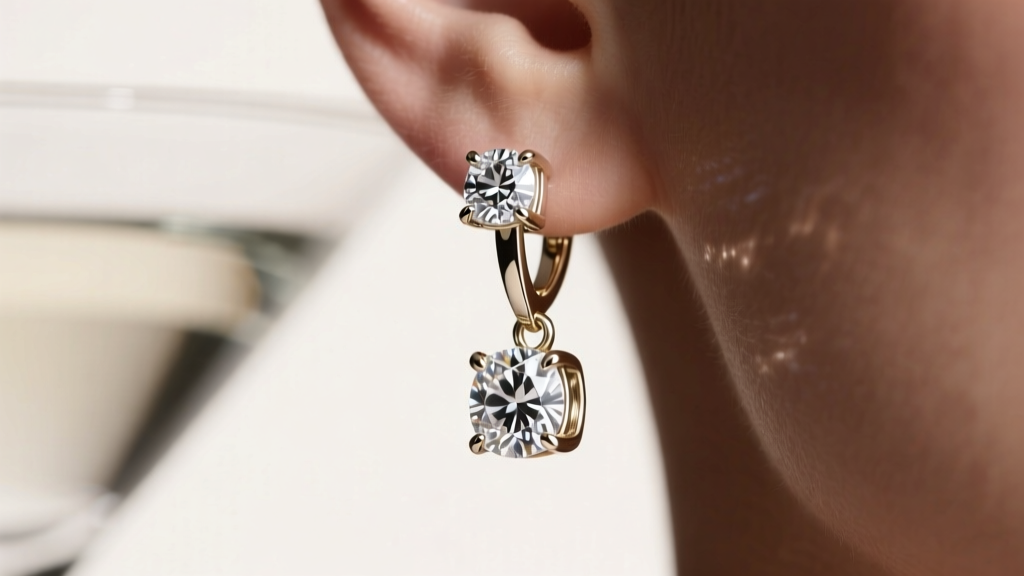
The most overlooked aspect of purchasing double diamond earrings is the physics of the setting. A standard 0.50ct stud sits flush against the earlobe, distributing its weight evenly. A double diamond earring, however, introduces a lever arm. If the top stone is a 0.25ct stud and the bottom is a 0.75ct pear drop, the center of gravity shifts downward and outward.
Post Gauge and Clutch Mechanics
To counteract this leverage, the earring post must be engineered for torque resistance. Standard earring posts are often 0.8mm in diameter. For double diamond drops, a heavier 1.0mm or 1.1mm gauge post is mandatory to prevent bending. Furthermore, standard butterfly friction backs are insufficient. The repetitive motion of a double drop will slowly work a standard back off the post. Experts mandate the use of La Pousette backs (which feature a locking mechanism), jumbo silicone disc backs to distribute weight across a wider area of the earlobe, or threaded screw-backs for ultimate security.
- La Pousette Backs: Utilizes a spring-loaded locking mechanism; ideal for heavy double drops.
- Jumbo Silicone Discs: Prevents earlobe drooping by dispersing the pendulum weight over a 10mm surface area.
- Screw Backs: Offers the highest security but requires precise threading on a thicker 1.0mm post.
Pricing & Value Retention Matrix
Material selection directly impacts both the initial acquisition cost and the long-term value retention of your earrings. As of 2026, the wholesale pricing for lab-grown diamonds has stabilized, offering exceptional value for multi-stone designs where total carat weight drives the price.
| Material Combination | Estimated Price (1.50ct TW) | Value Retention | Maintenance Cost |
|---|---|---|---|
| Natural Diamond + Platinum | $6,500 - $9,000 | Moderate to High | Low (Polishing only) |
| Lab-Grown Diamond + Platinum | $2,200 - $3,500 | Low | Low (Polishing only) |
| Natural Diamond + 18k White Gold | $5,800 - $8,000 | Moderate | Medium (Rhodium plating) |
| Lab-Grown Diamond + 14k White Gold | $1,500 - $2,500 | Low | Medium (Rhodium plating) |
Expert Verdict: Choosing Your Ideal Combination
Selecting the perfect materials for your double diamond earrings requires balancing aesthetic desires with practical lifestyle considerations. If your priority is generational longevity and absolute prong security, Platinum 950 paired with natural diamonds remains the benchmark for heirloom-quality jewelry. The dense metal will develop a soft patina over time, which many collectors prefer, and it will never require chemical re-plating.
Conversely, if you desire maximum visual impact on a modern budget, pairing VVS-clarity lab-grown diamonds with an 18k white gold setting offers unparalleled brilliance. The flawless nature of lab stones ensures that the light transfer between the top and bottom stones of your double drop is completely unobstructed, creating a blinding cascade of fire. Just be prepared to budget for annual rhodium maintenance and ensure your jeweler utilizes a heavy-gauge post with a locking clutch to manage the unique physics of the double-stone lever effect.


