Double Piercing Chain Earrings: An Expert Technical Guide
Explore the technical anatomy, material grades, and gauge mechanics of double piercing chain earrings for secure, stylish multi-piercing setups.

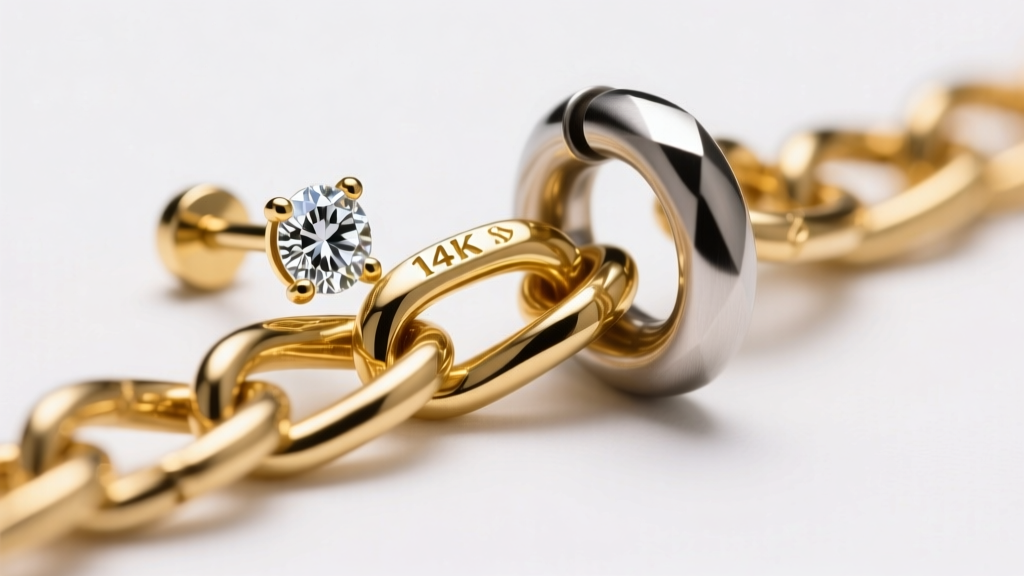
The Biomechanics of Connected Piercings
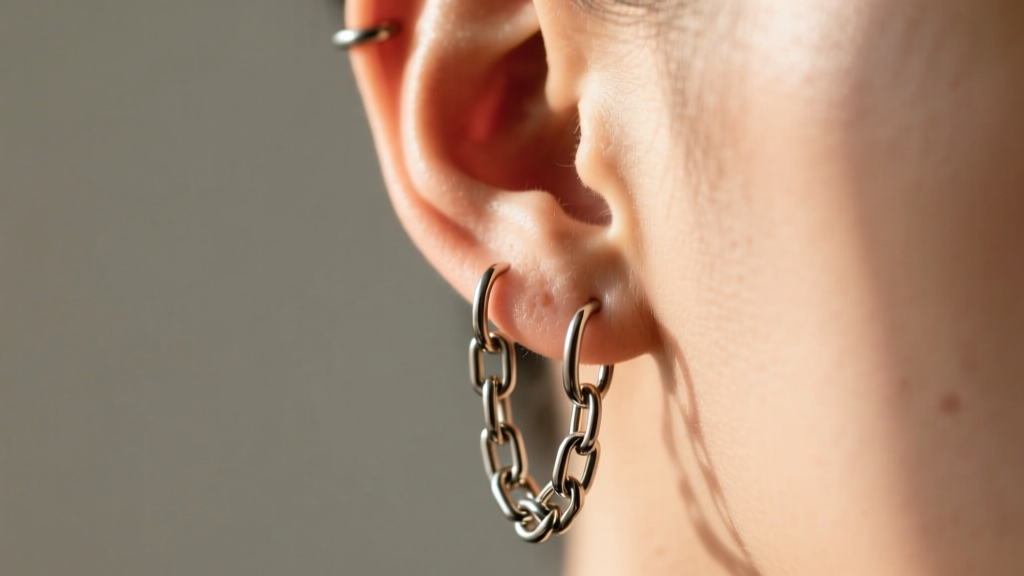
When styling multi-piercing setups, double piercing chain earrings introduce a unique mechanical challenge: the creation of a closed kinetic loop. Unlike standalone studs or hoops, a chain connecting two distinct fistulas (piercing channels) transfers physical torque and lateral tension from one site to another. If the geometry of the chain does not perfectly align with the anatomical distance between the piercings, the resulting tension can lead to tissue migration, delayed healing, or the dreaded 'cheese-cutter' effect, where the jewelry slowly tears through the skin.
To prevent this, expert piercers calculate the 'slack allowance.' The human ear is highly mobile; the auricular cartilage and earlobe shift during chewing, sleeping, and facial expressions. A rigid or overly taut chain will resist this natural movement. For a standard lobe-to-lobe connection, the chain must be exactly 2mm to 4mm longer than the measured distance between the two piercing centers. For lobe-to-helix configurations, the required slack increases to 5mm to 8mm to accommodate the broader range of cartilage flexion.
Metallurgy and Material Grades
The material composition of double piercing chain earrings is critical, particularly because the chain rests against the skin and can trap sebum, sweat, and skincare products. The Association of Professional Piercers (APP) strictly recommends implant-grade materials for any jewelry worn in healing piercings, but these standards should apply to connected jewelry regardless of healing status due to the increased friction.
For the posts that anchor the chain, ASTM F136 implant-grade titanium is the gold standard. It contains zero nickel and features a mirror-polished surface finish that prevents bacterial adhesion. However, the chain itself is often crafted from precious metals for aesthetic reasons. When selecting gold chains, you must differentiate between solid 14k/18k gold and gold vermeil. Vermeil (a thick gold plating over sterling silver) will eventually oxidize and wear through due to the constant friction against the neck and hair, exposing the underlying silver or brass alloys which can trigger contact dermatitis. High-end manufacturers like BVLA utilize solid 14k or 18k nickel-free gold for their chain links, ensuring long-term biocompatibility and structural integrity.
Chain Architecture and Tensile Strength
Not all chain links are engineered equally. The architecture of the link dictates the chain's tensile strength, flexibility, and snag risk. Selecting the wrong link type for a specific ear placement can result in frequent breakage or painful hair entanglement.
| Link Type | Tensile Strength | Snag Risk | Best Application |
|---|---|---|---|
| Cable Chain | Moderate | High (Oval links catch hair) | Low-tension lobe-to-lobe setups |
| Rolo Chain | High (Round, interlocking) | Low (Smooth profile) | Daily wear, lobe-to-helix connections |
| Box Chain | Very High (Square geometry) | Moderate (Edges can snag) | Heavy pendants, structural ear scaffolding |
| Snake Chain | Low (Prone to kinking) | Very Low (Flush surface) | Delicate, temporary event styling only |
For most double piercing chain earrings, the rolo chain is the superior choice. Its uniform, round links distribute stress evenly across the chain, preventing localized weak points. Furthermore, the smooth, rounded profile of a rolo link minimizes the risk of catching on fine hair or knit winter clothing, which is a primary cause of traumatic tearing in connected ear setups.
Gauge Sizing and Termination Mechanics
A frequent technical hurdle in connected jewelry is gauge discrepancy. A standard lower lobe piercing is typically 18-gauge (1.0mm) or 20-gauge (0.8mm), while an upper helix or forward helix is usually pierced at 16-gauge (1.2mm). A single, continuous chain cannot seamlessly integrate into two different post gauges without specialized termination mechanics.
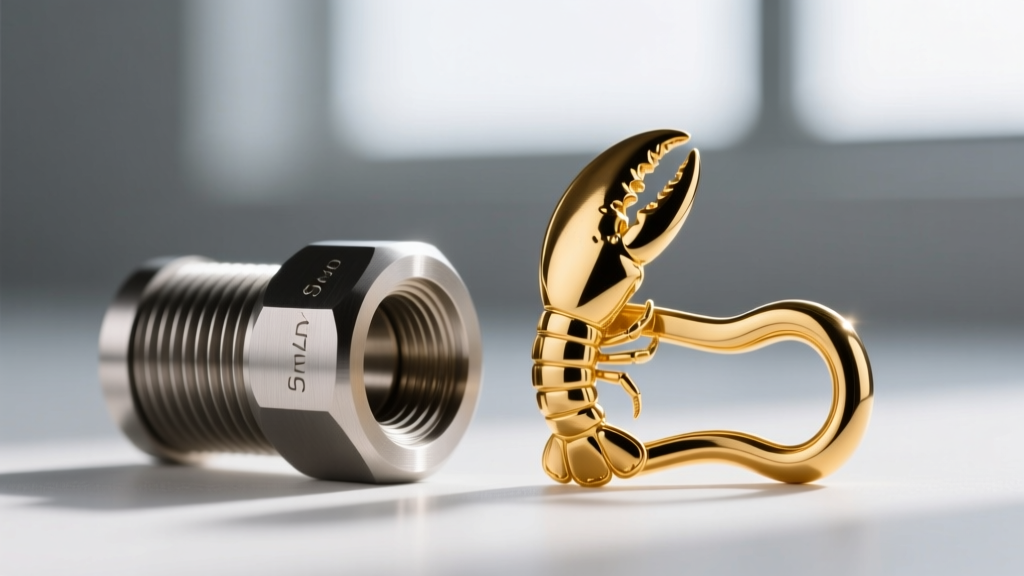
To solve this, premium body jewelry brands utilize modular threadless or internally threaded systems. The chain is fitted with removable ends that match the specific gauge of each piercing. For example, the lower termination might feature an 18g threadless pin that bends slightly to lock into the receiving tube, while the upper termination features a 16g internally threaded screw that secures into a helix labret post. This modularity not only ensures a secure fit but also allows the wearer to swap out the chain for different lengths or styles without removing the primary posts from the fistula.
Avoid jewelry that relies on cheap 4mm spring-ring clasps to connect to standard earring backs. These clasps lack the structural integrity to withstand lateral pulling and frequently fail, leading to lost jewelry. Instead, opt for chains that integrate directly into the post architecture or utilize heavy-duty 5mm lobster clasps with reinforced soldered jump rings.
Troubleshooting Common Failure Modes
Even with high-quality materials, improper fitting can lead to mechanical failures. Here is an expert troubleshooting guide for common issues associated with double piercing chain earrings:
- Issue: Upward Migration of the Lower Lobe.
Diagnosis: The chain is too short, creating constant upward tension on the lower fistula.
Solution: Increase the chain length by 3mm. The chain should drape with a visible, relaxed curve when the head is held in a neutral, forward-facing position. - Issue: Persistent Redness and Irritation in the Upper Piercing.
Diagnosis: Torque transfer. The weight of the chain, combined with the leverage of the lower earring, is pulling the upper post at an angle, causing the metal to rub against the interior of the fistula.
Solution: Switch to a flat-back labret post with a larger base disc (e.g., 4mm or 5mm) in the upper piercing to distribute the lateral load over a wider surface area of the cartilage. - Issue: Chain Kinking and Permanent Deformation.
Diagnosis: Sleeping in box or snake chains, which lack multi-axis flexibility.
Solution: Never sleep in connected jewelry. If continuous wear is required, switch exclusively to a micro-rolo or woven mesh chain, which can withstand compression without permanent structural deformation. - Issue: Galvanic Skin Reaction (Green/Black Discoloration).
Diagnosis: The chain is plated brass or copper, and the plating has micro-fractured, allowing skin acids to react with the base metal.
Solution: Discard the plated chain. Replace it with solid 14k gold, niobium, or platinum. Ensure any soldered jump rings are laser-welded using matching karat gold, rather than silver solder, which can also cause localized reactions.
Precision Styling for the Modern Collector
Mastering the use of double piercing chain earrings requires moving beyond simple aesthetics and understanding the underlying physics of body modification. By prioritizing implant-grade anchor posts, selecting high-tensile rolo or cable links, and meticulously calculating the slack allowance for your unique ear anatomy, you can create multi-piercing setups that are not only visually striking but mechanically sound and biologically safe. Always consult with an APP-certified professional piercer to measure your exact fistula distances before commissioning custom-length connected jewelry.


