Dragon Earring Guide: Cartilage Safety, Metals, and Gauge Specs
Discover the technical specs behind a safe dragon earring. Learn about implant-grade metals, weight distribution, and cartilage gauge requirements.

The Engineering Challenge of Fantasy Ear Jewelry
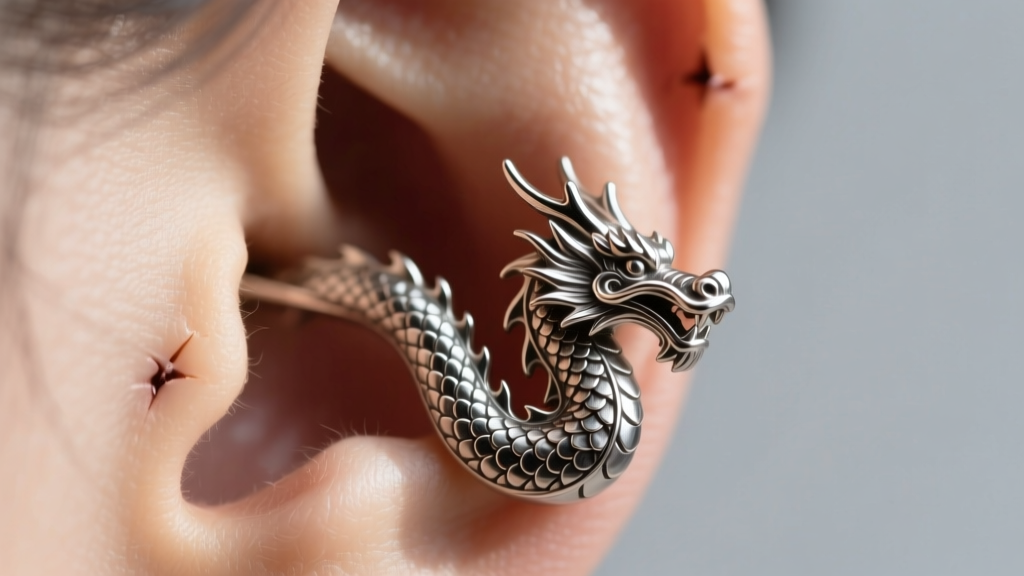
The fantasy jewelry market has seen a massive surge in demand for mythological motifs, but few designs present as many structural challenges as the dragon earring. Unlike minimalist studs or smooth hoops, a dragon earring features extreme asymmetry, deep undercuts, sharp protrusions (wings, horns, tails), and a high center of gravity. When these aesthetic choices are translated into wearable body jewelry, they create unique biomechanical stress points on the ear. For cartilage piercings—such as the helix, conch, or daith—wearing an improperly engineered dragon earring can lead to pressure necrosis, migration, or the dreaded 'cheese-cutter effect.' This guide breaks down the material science, weight tolerances, and architectural specifications required to wear intricate fantasy earrings safely and comfortably.
Material Science: Base Alloys vs. Implant-Grade Metals
The complexity of a dragon’s scales and wings usually necessitates investment casting (lost-wax casting) or high-resolution CAD milling. However, the chosen metal dictates both the safety of the piercing and the longevity of the piece.
The Titanium Standard (ASTM F136)
For any dragon earring intended for cartilage or fresh piercings, ASTM F136 implant-grade titanium (Ti-6Al-4V ELI) is the absolute gold standard. Titanium is highly biocompatible, non-magnetic, and lightweight. Because a dragon motif is inherently heavy, utilizing titanium reduces the overall mass of the earring by nearly 45% compared to surgical steel, significantly reducing drag on the fistula. Expect to pay between $120 and $250 for a genuine, CAD-milled titanium dragon earring from reputable body jewelry brands.
The Dangers of 'Mystery Metal' Fantasy Castings
Many mass-market fantasy earrings are cast in Zamak (a zinc alloy) or low-grade brass, then plated with a thin layer of silver or gold. According to the Association of Professional Piercers (APP) Metallurgy Guidelines, these porous base metals are highly problematic. During the investment casting process, low-grade alloys are prone to 'shrinkage porosity'—microscopic pits that trap dead skin cells, sebum, and bacteria. Furthermore, the friction of a heavy dragon wing rubbing against the ear will quickly wear through the plating, exposing the skin to nickel and zinc, triggering severe contact dermatitis.
Weight Distribution and Cartilage Biomechanics
The most common failure mode for heavy fantasy jewelry is improper weight distribution. A dragon earring often features a dense 'head' cluster at the top and a sweeping 'tail' at the bottom. If the post is placed at the exact geometric center of the design, the earring will tilt forward, pulling the top of the post into the front of the piercing channel and the bottom into the back.
Expert Insight: To counteract the forward tilt of a top-heavy dragon head, high-end jewelry designers offset the post placement slightly upward or utilize a flat-back labret post with a wider base disc (e.g., 4mm or 5mm) to distribute the leverage across a broader area of the inner ear.
Weight Tolerance by Piercing Location
Understanding the structural limits of your specific piercing is critical before purchasing a heavy statement piece. Below is a technical breakdown of weight tolerances based on standard tissue density and healing characteristics.
| Piercing Location | Max Daily Weight Limit | Standard Gauge | Primary Risk Factor |
|---|---|---|---|
| Standard Lobe | 15g - 25g | 20G (0.81mm) / 18G (1.02mm) | Lobe elongation / stretching |
| Upper Lobe | 8g - 12g | 18G (1.02mm) / 16G (1.29mm) | Migration / tearing |
| Helix / Cartilage | 4g - 7g | 16G (1.29mm) / 14G (1.60mm) | Pressure necrosis / irritation bumps |
| Conch | 8g - 12g | 14G (1.60mm) / 12G (2.00mm) | Post-angle shifting / discomfort |
Gauge Specifications and Post Architecture
The wire thickness (gauge) of the earring post must be proportionate to the weight of the dragon motif. If a 10-gram dragon earring is mounted on a 20-gauge (0.81mm) wire, the thin metal will act like a cheese wire, slowly slicing through the fistula tissue over time. For any cartilage dragon earring exceeding 4 grams, a minimum of 16-gauge (1.29mm) or 14-gauge (1.60mm) is strictly recommended to provide adequate structural rigidity.
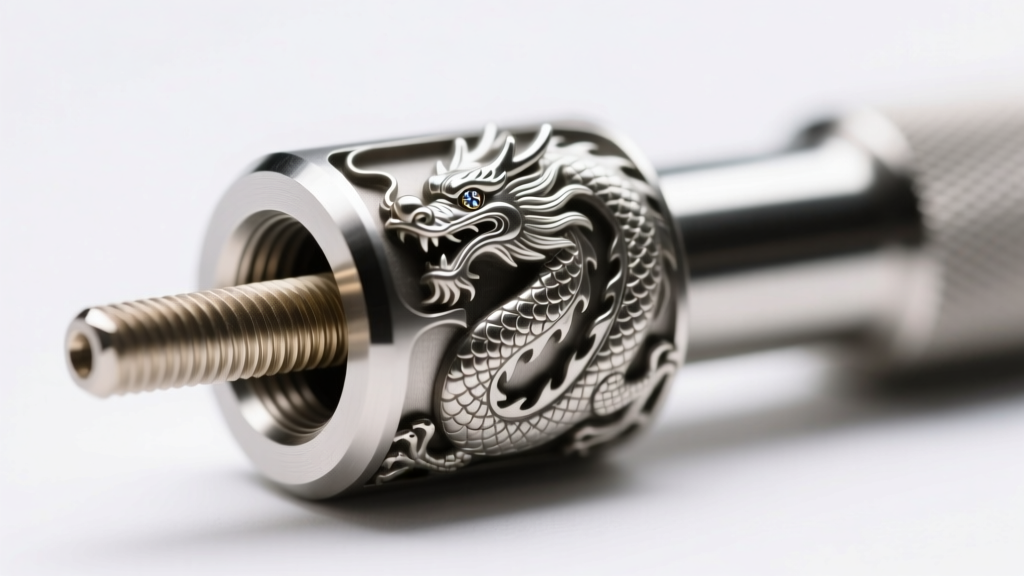
Additionally, the threading architecture is paramount. Avoid externally threaded posts at all costs; the sharp threads must pass through the piercing channel during insertion, causing micro-tears in the tissue. High-quality dragon earrings will feature internally threaded or threadless (push-pin) posts. In an internally threaded design, the screw mechanism is housed inside the hollow post, ensuring a perfectly smooth, mirror-polished surface glides through the ear.
Ear Cuffs vs. Pierced Mechanics
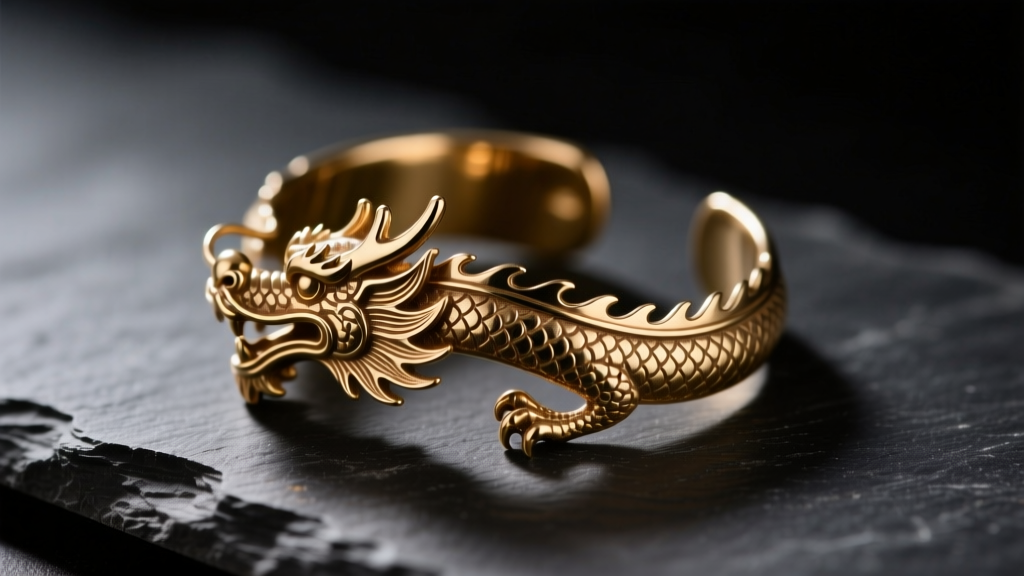
For those who want the aesthetic of a dragon wrapping around the helix without the commitment or weight restrictions of a piercing, tension-based ear cuffs are a viable alternative. However, the metallurgy of the cuff dictates its functionality. A true tension cuff should be forged from Niobium or spring-tempered Titanium. These metals possess 'memory,' allowing them to be gently squeezed to fit the ear and then spring back to maintain constant, gentle pressure. Conversely, cheap brass or copper cuffs rely on a rigid C-clamp design with a tension screw. These often pinch the skin, restrict blood flow, and cause localized ischemia (tissue blanching) within minutes of wear.
Maintenance: Cleaning Intricate Scales and Crevices
The deep undercuts of a dragon’s wings and the overlapping texture of its scales create prime real estate for sebum and environmental debris buildup. Standard wiping with a cloth is entirely insufficient for fantasy jewelry.
- Ultrasonic Cleaning: For solid titanium, niobium, or high-karat gold dragon earrings, a 3-minute cycle in an ultrasonic cleaner with a few drops of mild, phosphate-free dish soap will dislodge debris from microscopic crevices.
- Chemical Patina Care: If your dragon earring features an intentional oxidized (blackened) patina to highlight the scales, avoid ultrasonic cleaners and harsh chemical dips, as these will strip the oxidation. Instead, use a soft-bristled detailing brush (like a clean makeup blending brush) dipped in warm soapy water to gently agitate the crevices.
- Drying: Moisture trapped behind a dragon’s wing against the cartilage can lead to fungal or bacterial growth. Always use a hair dryer on the 'cool' setting to thoroughly dry the intricate sections of the earring and the piercing site after cleaning.
Expert Verdict: Choosing Your Dragon Earring
A beautifully crafted dragon earring is a masterpiece of wearable art, but it requires a technical approach to wear safely. Prioritize ASTM F136 titanium to minimize weight and eliminate allergy risks. Ensure the gauge thickness matches the mass of the motif to prevent tissue damage, and always opt for internally threaded or threadless post architectures. By respecting the biomechanics of your ear and the material science of the jewelry, you can comfortably showcase intricate fantasy designs without compromising your piercing health.


