Understanding Earring Carat Size: MM Spread, Depth, and Settings
Master earring carat size with our technical guide. Explore MM spread charts, TCW vs individual weight, cut depth impacts, and setting mechanics.

The Core Misconception: Weight vs. Physical Dimensions
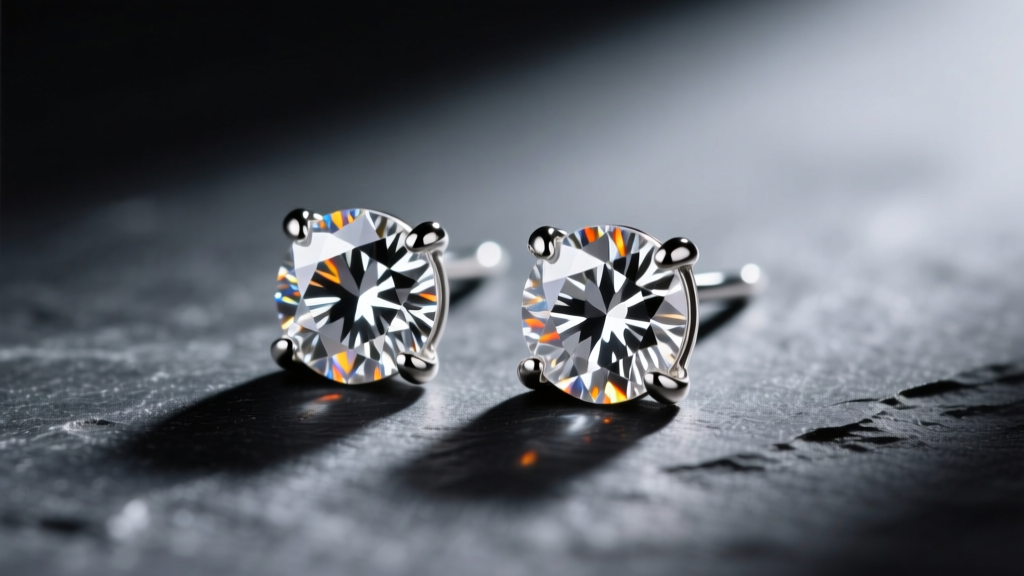
When evaluating diamond or gemstone studs, the term "earring carat size" is frequently misused by consumers and retail marketers alike as a proxy for physical diameter. Technically speaking, a carat is strictly a measure of mass (1 carat = 0.200 grams), not spatial volume or surface area. Two diamonds of the exact same carat weight can face up at drastically different millimeter (MM) spreads depending on their cut proportions, depth percentages, and geometric shape. Understanding the mechanical relationship between carat weight and millimeter spread is the first step in optimizing both the visual impact and the financial value of your earring purchase.
Total Carat Weight (TCW) vs. Individual Stone Weight
A common point of confusion in earring specifications is the distinction between Total Carat Weight (TCW) and individual stone weight. When a retailer advertises "1.50 Carat Diamond Stud Earrings," they are almost always referring to the TCW. This means the pair consists of two 0.75ct diamonds. Because diamond pricing scales exponentially rather than linearly, a single 1.50ct diamond is vastly more expensive than two 0.75ct diamonds of the same quality. Always verify whether the listed earring carat size refers to the combined pair or the individual ear, as this fundamentally alters the physical diameter you should expect.
Technical Data: Carat Weight to Millimeter Spread Chart
For round brilliant cut diamonds—the most popular choice for stud earrings—there is a predictable mathematical correlation between carat weight and physical diameter, assuming an Ideal or Excellent cut grade. The following table outlines the average millimeter spread and the resulting crown area (the visible surface area when worn in the ear).
| Carat Weight (Per Ear) | Avg Diameter (MM) | Crown Area (sq mm) | Visual Impact Category |
|---|---|---|---|
| 0.25ct | 4.1mm | 13.2 | Subtle / Everyday |
| 0.50ct | 5.1mm | 20.4 | Classic / Versatile |
| 0.75ct | 5.8mm | 26.4 | Prominent / Bold |
| 1.00ct | 6.5mm | 33.2 | Statement / High-Impact |
| 1.50ct | 7.4mm | 43.0 | Red Carpet / Heavy |
| 2.00ct | 8.2mm | 52.8 | Maximum Coverage |
Notice that doubling the carat weight from 0.50ct to 1.00ct does not double the diameter; it only increases the diameter by 1.4mm. However, the crown area increases by over 60%. This is why a 1.00ct earring looks significantly larger than a 0.50ct earring, even though the millimeter difference sounds marginal on paper.
How Cut Quality Hijacks Perceived Earring Carat Size
The cut grade is the most critical variable in determining how large an earring appears. According to the Gemological Institute of America (GIA), a diamond's proportions dictate how light enters and exits the stone.
The "Spready" Cut Trap
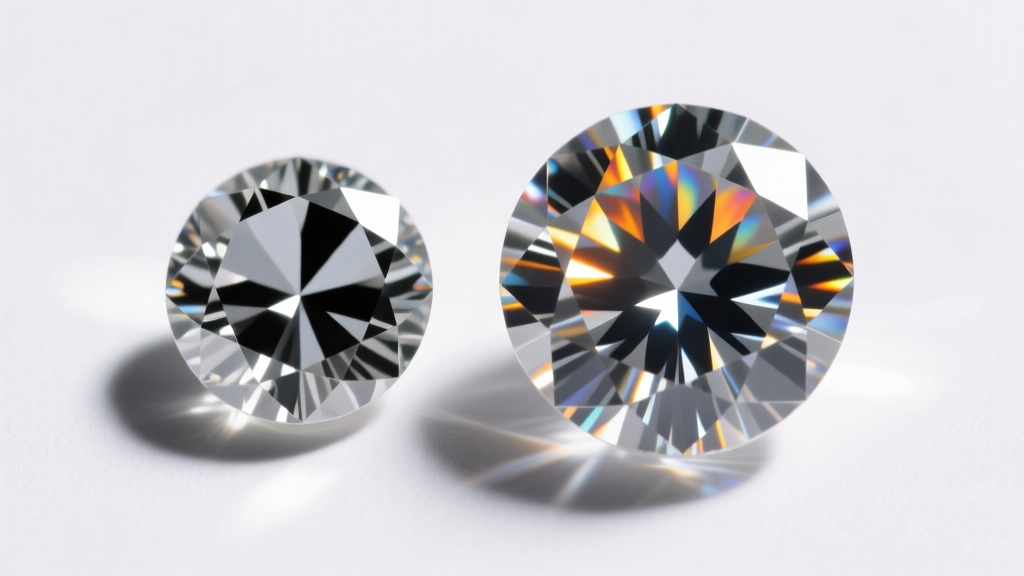
Some cutters intentionally fashion shallow diamonds to maximize the millimeter spread of a given carat weight. A shallow-cut 1.00ct diamond might measure 6.8mm across (facing up larger than an Ideal cut 6.5mm stone). However, because the pavilion depth is too shallow (often under 41%), light leaks out of the bottom rather than reflecting back to the eye. This creates a "fish-eye" effect—a dull, glassy center that makes the earring look lifeless. A smaller-facing Ideal cut diamond with edge-to-edge brilliance will actually appear larger to the human eye because the brain perceives the intense light return as physical boundaries.
Setting Mechanics: Prong Thickness and Bezel Illusions
The metalwork holding your earring carat size physically obscures a portion of the diamond's perimeter, altering its perceived size.
- 3-Prong and 4-Prong Settings: Standard martini or basket 4-prong settings use prongs that are typically 0.8mm to 1.0mm thick. This obscures roughly 1.5mm to 2.0mm of the diamond's total diameter, maximizing the visible crown area.
- 6-Prong Settings: While offering superior security for active lifestyles, the additional metal covers more of the diamond's edge, making a 0.75ct stone look closer to a 0.60ct stone from a distance.
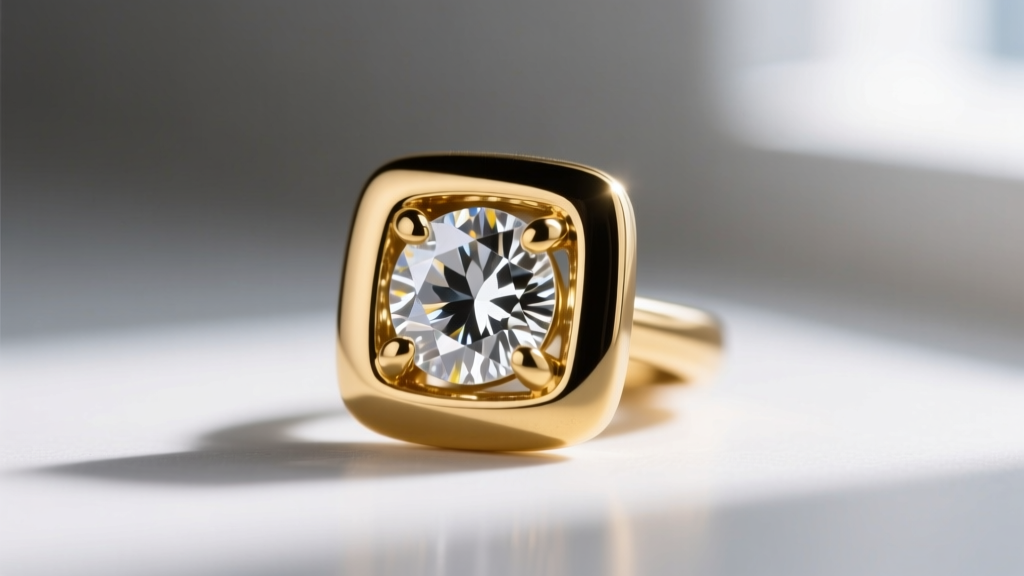
- Bezel Settings: A bezel requires a continuous metal wall, usually 1.2mm to 1.5mm thick, wrapping the entire circumference. This subtracts nearly 3mm from the total visible diameter. A 1.00ct (6.5mm) diamond in a bezel setting faces up with the visual footprint of a 0.70ct (5.5mm) prong-set stone.
Specific Gravity: Why Sapphire and Emerald Carat Sizes Differ
If you are exploring colored gemstone earrings, the concept of earring carat size becomes even more complex due to Specific Gravity (SG). Carat is a measure of weight, and different minerals have different densities. A 1.00ct round diamond (SG 3.52) measures roughly 6.5mm. However, a 1.00ct round blue sapphire (SG 4.00) is denser and will measure only about 6.0mm. Conversely, a 1.00ct round emerald (SG 2.70) is less dense and will measure closer to 7.0mm. When buying colored gemstone studs, always request the exact millimeter dimensions rather than relying solely on the carat weight to gauge the physical size on the earlobe.
Strategic Buying: Bypassing the "Magic Size" Price Jumps
Diamond pricing is structured around "magic sizes"—specific weight thresholds (0.50ct, 0.75ct, 1.00ct, 1.50ct) where the price per carat jumps exponentially. The difference in physical spread between a 0.95ct diamond (approx. 6.35mm) and a 1.00ct diamond (6.5mm) is a microscopic 0.15mm, entirely imperceptible to the naked eye once set in an earring post. However, because the 0.95ct stone falls into a lower pricing tier, it can cost 20% to 30% less per carat. Savvy buyers target these "undersized" weights to maximize physical millimeter spread while avoiding the premium attached to magic weight thresholds. Resources like Blue Nile's Diamond Education frequently highlight these non-linear pricing curves for consumer awareness.
Final Technical Takeaways
To master your earring carat size selection, discard carat weight as your primary visual metric and focus on the intersection of millimeter spread, cut grade, and setting profile. Prioritize Ideal cut grades to ensure edge-to-edge brilliance, choose 4-prong settings to maximize visible surface area, and target off-magic weights (like 0.90ct or 0.45ct) to exploit pricing inefficiencies without sacrificing physical presence on the ear.


