The Earring Earring Trend: Mastering Asymmetrical Stacks
Discover the 2026 earring earring trend. Learn how to master asymmetrical stacks, mix metals, and balance gauge sizes for a curated, high-fashion ear.

The Anatomy of the Earring Earring Aesthetic
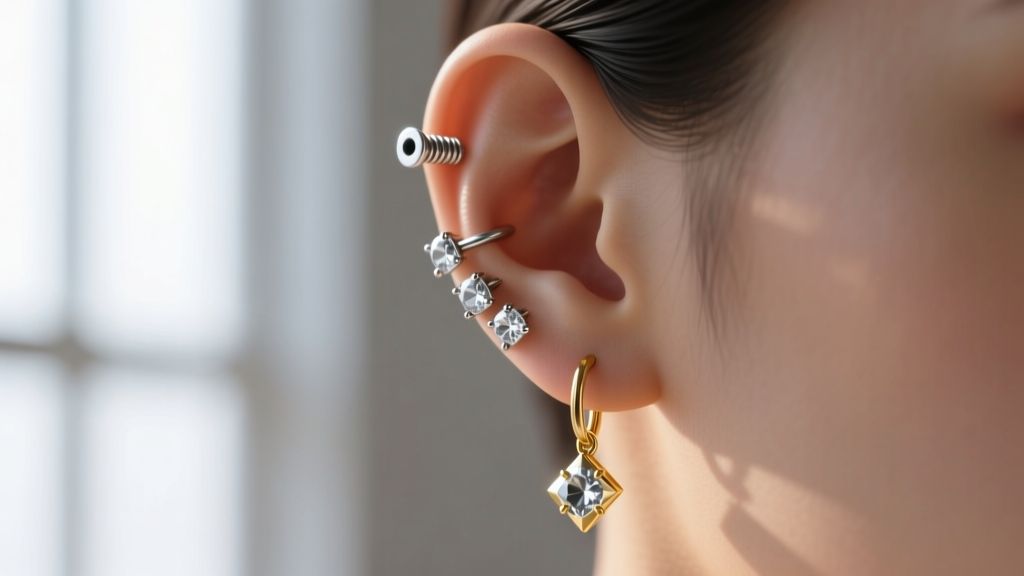
When high-fashion stylists and master piercers refer to the "earring earring" phenomenon, they are not making a typographical error. Instead, this industry colloquialism describes the deliberate, hyper-curated approach to asymmetrical ear stacking that has completely dominated the 2026 jewelry landscape. Moving far beyond the simple mismatched trends of the early 2010s, the modern earring earring aesthetic relies on balancing visual weight, negative space, and metallurgical harmony across both ears without relying on perfect symmetry. It is an exercise in intentional imbalance, where a heavy, singular statement piece on the left ear is counterweighted by a constellation of precision-set threadless gems on the right.
This shift represents a broader evolution in how consumers interact with body modification and fine jewelry. Rather than purchasing pre-packaged pairs, collectors are now sourcing individual components—threadless ends, captive bead rings, and seamless hoops—to build bespoke layouts. According to recent market analyses, the demand for single-sale fine body jewelry has outpaced traditional paired earring sales by over 40% in the luxury sector, signaling a permanent shift in how we conceptualize ear adornment.
Gauge Sizing and Lobe Real Estate Management
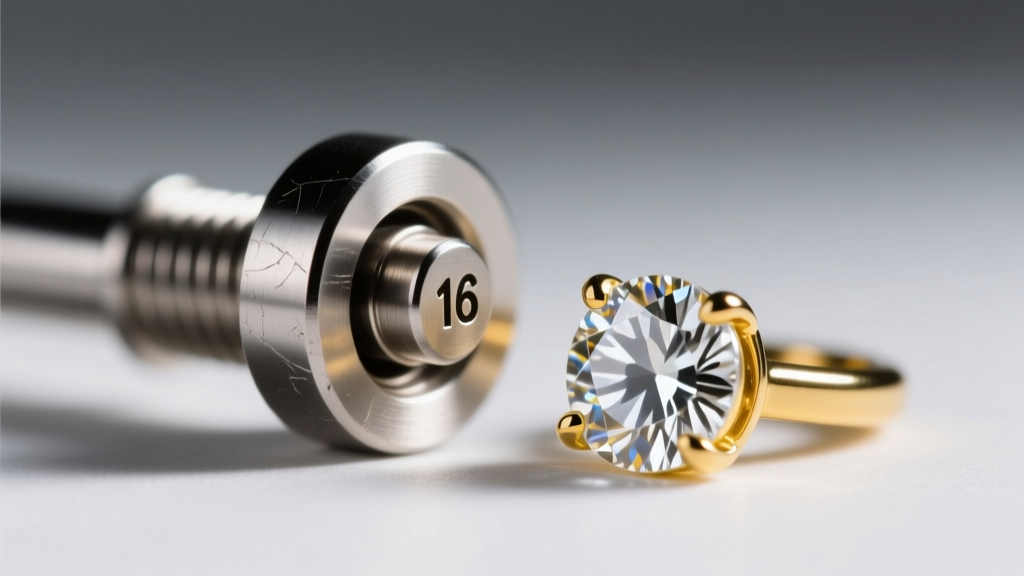
The foundation of any successful earring earring stack lies in understanding gauge sizing and fistula real estate. Standard mall-kiosk ear piercings are typically performed at 20-gauge (0.81mm) or 18-gauge (1.02mm). However, professional body piercers and organizations like the Association of Professional Piercers (APP) strongly advocate for 16-gauge (1.29mm) or even 14-gauge (1.63mm) for initial lobe piercings. The thicker post provides crucial structural integrity, minimizing the risk of migration and rejection.
When curating an asymmetrical layout, mixing gauges across different piercings is a common failure point. If you attempt to hang a heavy 14k gold chain dangle from a standard 20-gauge earlobe piercing, you will inevitably encounter the "cheese-cutter effect." The thin wire concentrates the downward force onto a microscopic surface area of the healing or healed fistula, slowly slicing through the tissue over a period of six to twelve months. To prevent this, high-end stackers reserve 16g or 14g placements for the lower lobe where heavier anchor pieces reside, while utilizing 18g or 16g for the upper ear cartilage where lighter, flush-fitting gems are preferred.
Material Mixing: The 2026 Metal Matrix
A hallmark of the contemporary earring earring style is the fearless mixing of metal tones—pairing warm 14k yellow gold with cool platinum or anodized titanium. However, mixing metals in a high-moisture, high-salt environment like the human ear requires a strict understanding of metallurgy to avoid adverse skin reactions and jewelry degradation.
| Material | ASTM Standard | Nickel Content | Best Use in Stacks |
|---|---|---|---|
| Implant-Grade Titanium | ASTM F136 | 0% | Base posts, sensitive cartilage, initial healing |
| 14k / 18k Solid Gold | N/A (Alloyed) | Varies (Must be Ni-Free) | Decorative ends, lower lobe anchors, threadless tops |
| Niobium | N/A (Pure Element) | 0% | Anodized color accents, seamless hoops, clickers |
| 316L Surgical Steel | ASTM F138 | 8% - 10.5% | Avoid entirely; high risk of contact dermatitis |
Avoiding Galvanic Corrosion in Mixed Stacks
While the Gemological Institute of America (GIA) frequently educates consumers on the durability of precious gemstones, the metals holding those stones require equal scrutiny. When two dissimilar metals (such as a silver alloy and a copper-based brass) come into contact in the presence of an electrolyte (human sweat and sebum), a galvanic cell is created. This micro-current accelerates the oxidation and corrosion of the less noble metal, leading to green skin discoloration and pitting on the jewelry surface. To safely execute a mixed-metal earring earring look, ensure that all pieces sharing the same piercing tract are made of the exact same base metal, utilizing mixed metals only across entirely separate, non-touching piercings.
Weight Distribution and Cartilage Migration
Cartilage piercings—such as the helix, flat, and conch—are inherently more fragile than earlobe piercings due to the lack of vascular blood flow in the auricular cartilage. This avascular nature means that cartilage heals slower and is highly susceptible to pressure-induced migration. In asymmetrical stacking, the physics of torque become a critical consideration.
Torque is calculated as Force multiplied by Distance. A 12-gram ornate dangle earring hanging from a standard helix hoop creates a significant lever arm, pulling the jewelry outward and downward. Over time, this constant shear force will cause the 16-gauge fistula to slowly migrate toward the edge of the ear cartilage, eventually resulting in rejection. To maintain the structural health of your ear while participating in the earring earring trend, restrict heavy statement pieces exclusively to the lower earlobe, and reserve the upper cartilage for lightweight, flush-fitting threadless ends, flat-back labrets, and snug huggies that do not protrude beyond the ear's natural profile.
Curating Your Asymmetrical Layout: A Step-by-Step Framework
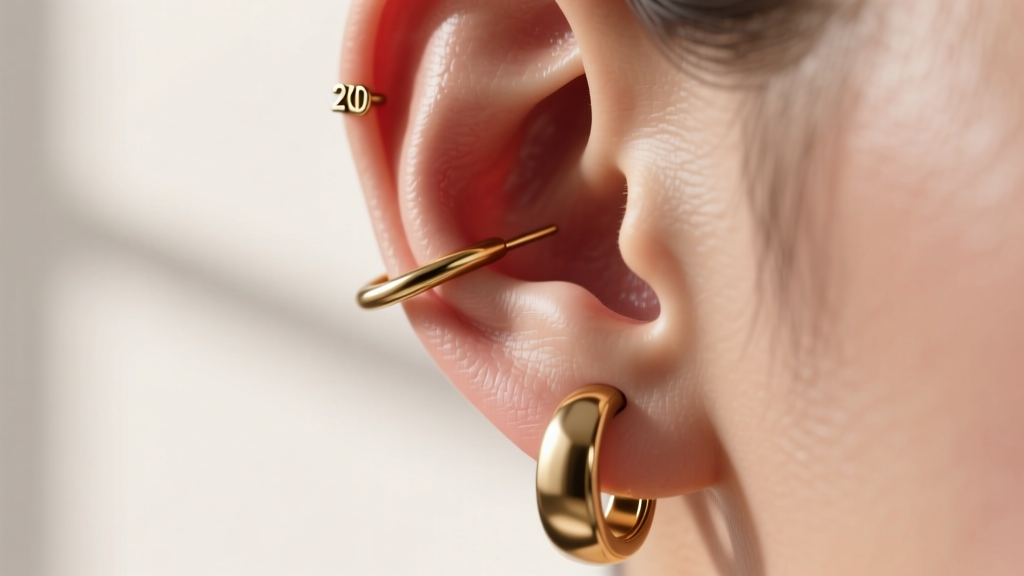
Achieving a balanced yet asymmetrical earring earring curation requires a methodical approach to visual weight. Master piercers utilize a specific framework to ensure the final layout feels cohesive rather than chaotic.
- Step 1: Establish the Anchor. Begin with your heaviest, most visually dominant piece in the lowest lobe piercing on one ear. This could be a large bezel-set gemstone, a thick gold hoop, or a moderate chain dangle. This piece dictates the visual gravity for the entire composition.
- Step 2: Build the Counterweight. On the opposite ear, avoid matching the anchor. Instead, distribute the equivalent visual weight across two or three upper-ear piercings. A cluster of three 3mm diamond threadless ends in the helix and flat can visually balance a single 10mm statement piece in the lower lobe.
- Step 3: Connect the Bridge. Utilize the mid-ear (such as the tragus, daith, or rook) to bridge the gap between your anchor and your counterweight. A simple, unadorned titanium clicker ring in the daith provides a necessary visual pause, preventing the stack from looking overwhelmingly cluttered.
- Step 4: Introduce Negative Space. Leave at least one piercing hole empty or fitted with a microscopic, barely-there titanium ball. The human eye needs resting points to appreciate the complexity of an asymmetrical stack.
Sourcing and Price Points for High-End Stacking
The earring earring trend has given rise to a thriving ecosystem of specialized body jewelry brands that cater specifically to the threadless and internally threaded market. Brands like BVLA (Body Vision Los Angeles) and Intrinsic Body have become the gold standard for collectors, offering precision-machined ends that snap securely into titanium posts without the need for tools.
When budgeting for a full asymmetrical curation, expect to invest significantly more than you would in traditional fashion jewelry. A single, high-quality 14k solid gold threadless end featuring a genuine, prong-set diamond typically ranges from $85 to $250, depending on the carat weight and stone quality. Custom anodized titanium pieces from boutique studios like NeoMetal start around $45 per end. While the initial investment for a full ear curation can easily exceed $1,500, the use of implant-grade materials and genuine gemstones ensures that these pieces will not tarnish, degrade, or cause allergic reactions, making them a permanent, heirloom-quality addition to your personal style arsenal.
Conclusion
The earring earring movement is a testament to the modern consumer's desire for hyper-personalization and anatomical awareness. By prioritizing implant-grade materials, respecting the physics of gauge sizing, and approaching asymmetry with a strategic framework, you can transform your ear into a masterclass of contemporary jewelry styling. Whether you are mixing warm golds with cool titaniums or balancing a heavy lobe anchor with a delicate cartilage constellation, the key lies in the meticulous attention to the microscopic details that separate a chaotic ear from a curated masterpiece.


