Earring Left or Right for Guys? Modern Rules & Metal Guide
Does earring left or right for guys still matter? We debunk placement myths and rank the best hypoallergenic metals for men's ear piercings.


When searching for the definitive rule on earring left or right for guys, you will quickly find that the old 'left is right, right is wrong' trope is entirely dead in 2026. Today, men wear earrings in the left, right, or both ears based purely on facial symmetry, hairstyle, and personal aesthetic. However, while the debate over which ear to pierce is now just a matter of styling, the debate over what metal to put in that ear is a critical issue of biology, metallurgy, and long-term skin health.
According to GQ's Men's Jewelry Guide, modern men's styling relies on balancing facial features rather than adhering to outdated cultural codes. If your hair is parted heavily to the left, a right-ear huggie or stud creates visual equilibrium. But once you choose the placement, you must select a material that will not trigger contact dermatitis or degrade from daily wear. This guide bridges the gap between modern styling placement and the hard science of jewelry materials.
The Death of the 'Side' Rule and the Rise of Material Science
In the late 20th century, the side on which a man wore an earring was used as a covert signaling mechanism. In 2026, that signaling is obsolete. High-fashion runways and streetwear aesthetics have normalized bilateral piercings, asymmetrical cartilage stacks, and single-ear statements on either side. The true differentiator in men's ear jewelry is no longer placement; it is the metallurgical integrity of the piece.
Human sweat has a pH ranging from 4.5 to 7.0, making it mildly acidic. When low-grade metals sit in the warm, acidic environment of a piercing fistula, they undergo galvanic corrosion. This leads to the dreaded 'green ear' effect, localized swelling, and in severe cases, systemic nickel sensitization. Therefore, choosing the correct alloy is vastly more important than choosing the left or right ear.
The Tier List: Men's Earring Materials Ranked
Not all 'silver' or 'steel' is created equal. Below is a comprehensive breakdown of the materials you should be looking for when shopping for men's studs, hoops, or barbells.
| Material | Standard / Grade | Nickel Content | Price Range (USD) | Best Use Case |
|---|---|---|---|---|
| Implant-Grade Titanium | ASTM F136 | 0% | $35 - $90 | Fresh piercings, highly sensitive lobes |
| Niobium | Commercially Pure | 0% | $30 - $75 | Cartilage hoops, anodized custom colors |
| Solid Gold | 14k or 18k (Nickel-Free) | 0% (if alloyed properly) | $150 - $500+ | Healed lobes, luxury statement pieces |
| Surgical Steel | 316L (Low Carbon) | 8% - 10.5% | $15 - $40 | Healed ears only, non-sensitive skin |
| Sterling Silver | 925 | Varies (often in plating) | $20 - $60 | Occasional wear (high tarnish risk) |
Deep Dive: Implant-Grade Titanium (ASTM F136)
If you are getting a new piercing or have a history of contact dermatitis, Implant-Grade Titanium (specifically Ti6Al4V ELI, conforming to ASTM F136 standards) is the undisputed gold standard. Unlike 'surgical steel'—a largely unregulated marketing term that often masks cheaper 304-grade stainless steel containing high nickel levels—implant-grade titanium is completely nickel-free and biocompatible.
One of the most remarkable properties of titanium is its ability to be anodized. By applying a specific voltage to the metal in an electrolytic bath, the jeweler can thicken the natural oxide layer on the surface, creating vibrant colors (like deep blues, golds, or bronzes) without using any dyes or paints that could flake off into the piercing. The Association of Professional Piercers (APP) strongly recommends ASTM F136 titanium for all initial piercings due to its inert nature and high strength-to-weight ratio.
Precious Metals: Navigating Gold Karats and Alloys
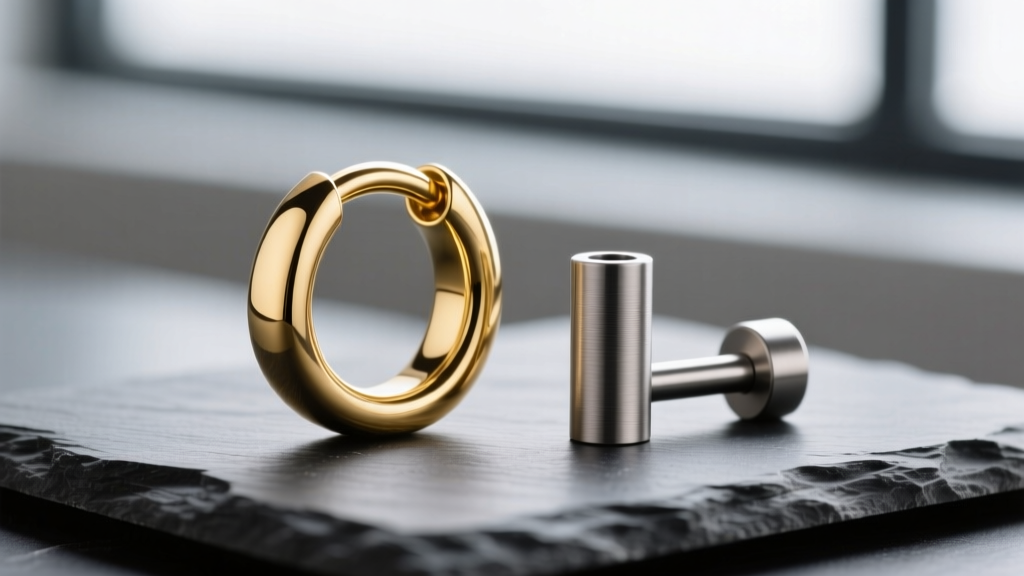
For men seeking a premium, luxury aesthetic in their left or right ear, solid gold is the traditional choice. However, understanding karat weights is essential to avoid structural failure.
- 24k Gold (99.9% Pure): Never buy 24k gold for body jewelry. It is far too soft. A 20-gauge or 18-gauge 24k wire will easily bend out of shape when you pull a shirt over your head.
- 18k Gold (75% Pure): Offers a rich, deep yellow hue and excellent biocompatibility, provided it is alloyed with metals like silver, copper, or palladium rather than nickel. It is slightly softer than 14k but ideal for healed lobe studs.
- 14k Gold (58.3% Pure): The sweet spot for durability and threading. If you are buying a threaded labret or barbell, 14k gold holds the microscopic threads much better than 18k, preventing the jewelry from stripping or seizing inside the post.
Warning on White Gold: Traditional white gold is alloyed with nickel to achieve its silver color, which is a massive trigger for allergies. Always seek out palladium-alloyed white gold, which achieves the same color without the nickel.
Failure Modes: When Metals Turn Your Ear Green
That green or black ring around your piercing isn't an infection; it's a chemical reaction. Sterling silver (925) contains 7.5% copper. When copper reacts with the sulfur and acidity in human sweat, it creates copper sulfide, which deposits onto the skin. Furthermore, many cheap men's earrings are made of brass or copper and merely 'plated' with silver or gold. Once the microscopic plating wears off from friction, the base metal is exposed, leading to rapid oxidation and severe skin irritation.
Gauge Sizing and Threading Standards
Material quality means nothing if the structural mechanics of the jewelry damage your fistula. Men's ear piercings generally fall into specific gauge categories:
- Standard Lobe Piercings: Usually 20g (0.81mm) or 18g (1.02mm). If you plan to stretch your lobes later, starting at 16g (1.29mm) is common.
- Cartilage (Helix, Tragus, Conch): Standardized at 16g (1.29mm) or 14g (1.63mm) to prevent the 'cheese-cutter effect,' where a thin wire slowly migrates through the cartilage due to tension.
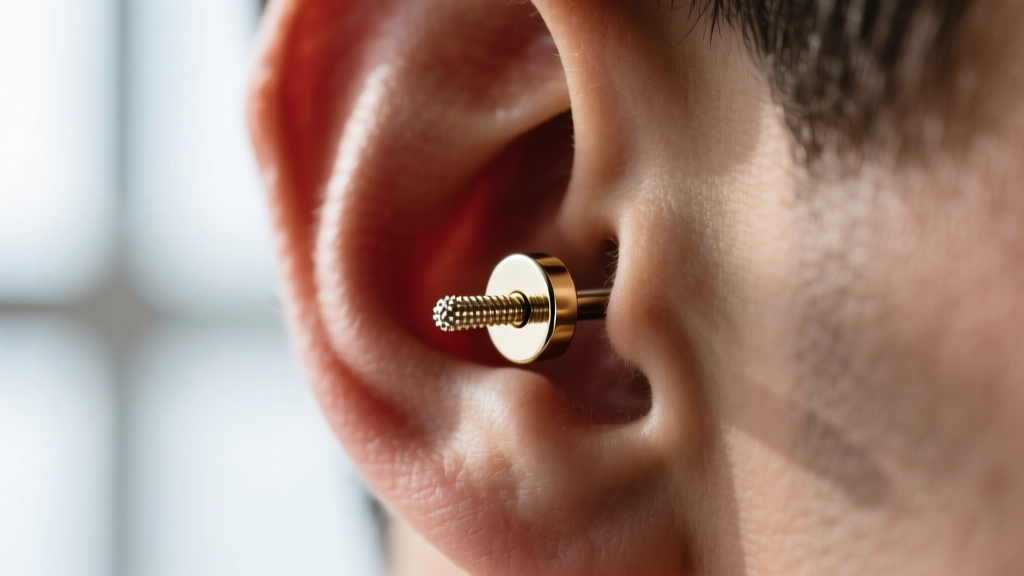
Crucially, you must pay attention to the threading. Avoid externally threaded jewelry at all costs; the screw threads are cut into the post, meaning they act like a file, tearing through the delicate tissue of the piercing every time you insert or remove them. Always demand internally threaded (where the screw is on the gem/ball and the post is smooth) or threadless (push-pin) jewelry, which relies on tension to stay secure without any threads crossing the fistula.
Final Verdict: Placement vs. Quality
So, what is the final verdict on earring left or right for guys? Look in the mirror. Part your hair, assess your jawline, and choose the ear that provides the best visual balance for your face. Once that decision is made, invest your budget into ASTM F136 titanium or nickel-free 14k/18k solid gold. By prioritizing metallurgical integrity and proper gauge sizing over outdated placement myths, you ensure your ear jewelry remains comfortable, safe, and sharply styled for decades to come.


