Earring Lost? Expert Troubleshooting, Recovery, and Prevention
Discover exactly what to do when an earring is lost. Expert recovery tactics, backing failure analysis, and prevention upgrades to secure your jewelry.

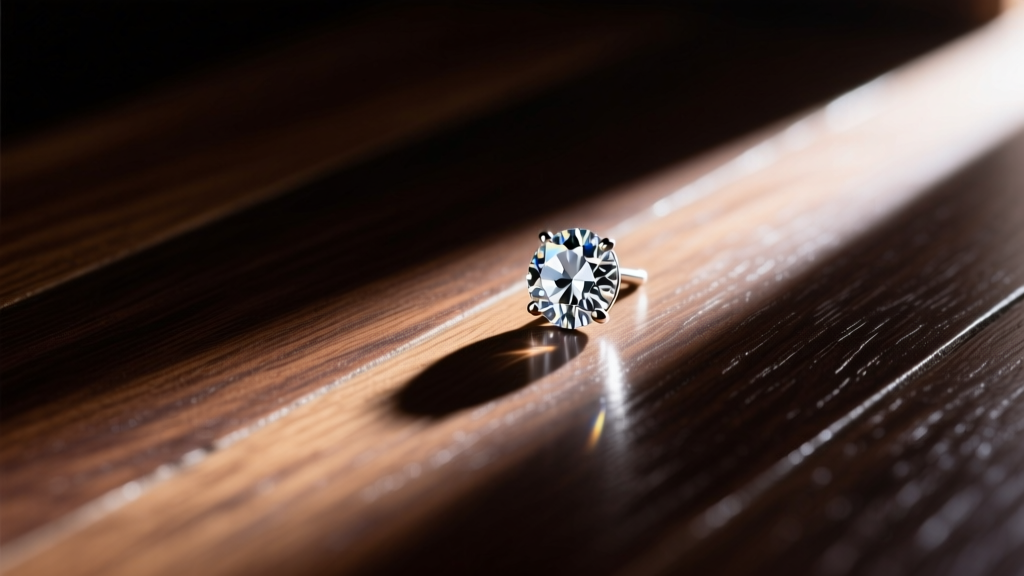
The sudden, sinking realization that reaches your hand to your ear and feels nothing but bare skin is a universal jewelry nightmare. Whether it is a family heirloom diamond stud or a vintage cartilage hoop, an earring lost to the environment requires immediate, calculated action. Most people resort to frantic, sweeping searches that only serve to kick the piece further under furniture. As jewelry professionals, we approach a missing earring not just as a search-and-rescue mission, but as a diagnostic opportunity to understand hardware failure and prevent future losses.
Tactical Recovery: How to Find an Earring Lost Indoors
Time is the enemy of recovery. The moment you realize the piece is missing, freeze. Do not take another step, as the earring may have dropped directly at your feet and could be crushed or kicked away. Begin with the raking light technique. Turn off the overhead room lights and use a high-lumen LED flashlight held parallel to the floor. This low-angle illumination causes the earring to cast a long, exaggerated shadow, making even a tiny 2mm diamond stud or a thin gold wire visible against carpet fibers or hardwood grain.
If the earring is lost in a high-traffic area or deep carpet, deploy the vacuum filtration method. Take a vacuum cleaner with a hose attachment and secure a piece of sheer pantyhose or a fine mesh nylon stocking over the nozzle using a rubber band. Turn the vacuum on and sweep the suspected area. The suction will pull the earring against the nylon barrier without swallowing it into the dustbin, allowing for safe retrieval.
The Metallurgy of Failure: Why Backings Give Up
To prevent future incidents, we must understand why the earring fell out in the first place. Standard friction backs (butterfly clutches) rely on the tension of two small metal loops pressing against the notches on the earring post. Over time, Jewelers of America notes that repeated insertion and removal cause metal fatigue. The inner loops stretch, and the notches on the post wear down, resulting in a catastrophic loss of friction.
Furthermore, post gauge thickness plays a critical role. Most commercial diamond studs use 20-gauge (0.81mm) posts. If you sleep in your earrings, the lateral pressure bends the 20G wire. Even a microscopic bend alters the geometry of the post, meaning the friction back no longer sits flush, creating a slip-plane for the earring to fall out.
| Backing Type | Mechanism | Common Failure Mode | Security Rating |
|---|---|---|---|
| Standard Friction | Tension loops on notched post | Metal fatigue, notch wear, post bending | Low |
| La Pousette | Spring-loaded locking tabs | Dirt/lint jamming the internal spring | High |
| Screw Back | Threaded post and nut | Cross-threading, stripped threads | Very High |
| Silicone O-Ring | Elastomeric friction grip | Hydrolysis (degradation from skin oils) | Medium |
Lobe vs. Cartilage: Different Loss Dynamics
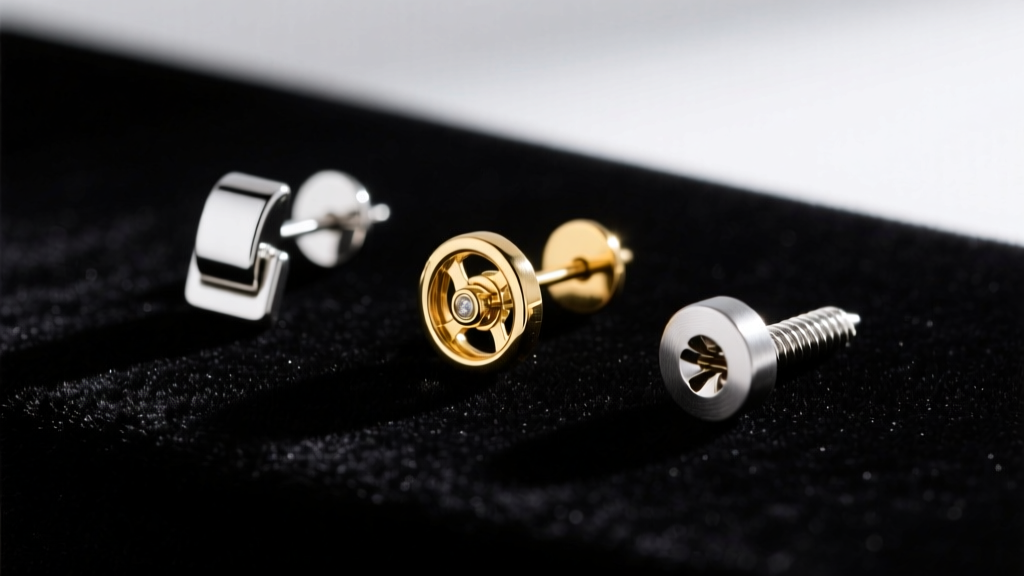
The mechanics of loss differ vastly between standard lobe piercings and cartilage placements. Cartilage piercings (like helix, tragus, or conch) are typically done at 16-gauge (1.2mm) or 18-gauge (1.0mm) to accommodate swelling and provide structural integrity. However, the jewelry used—often threadless push-pin ends or internally threaded flat-back labrets—presents unique failure points.
Threadless ends rely on a bent pin that creates tension against the inside of the hollow post. If the pin is not bent at the correct 15-to-20-degree angle, or if the jewelry is frequently swapped, the pin loses its spring tension. Conversely, internally threaded cartilage jewelry can unscrew due to the natural friction of hair brushing against the flat-back disc. To troubleshoot cartilage loss, always use a drop of surgical-grade, water-resistant threadlocker (such as Vibra-TITE VC-3) on the threads, or ensure your threadless pins are freshly scored and bent by a professional piercer.
Prevention Engineering: Upgrading Your Security Hardware
If you frequently experience an earring lost to daily activities, it is time to upgrade your hardware. For high-value lobe studs, transition to La Pousette backs or proprietary locking systems like Chrysmela. These feature a hidden internal clutch that grips the post and requires a simultaneous dual-pin squeeze to release, rendering accidental bumps harmless.
For hoop earrings and huggies, the failure point is almost always the hinge or the clicker closure. Over time, the tiny metal prong that snaps into the catch gets compressed. A master jeweler can use a laser welder to add a microscopic bead of gold or platinum to the prong, restoring the original tension and the satisfying 'click' that keeps the hoop secure. Never attempt to bend the prong with pliers, as this work-hardens the metal and leads to a brittle snap.
Sourcing and Replacing the Irreplaceable

When recovery fails, replacement becomes necessary. If the missing piece was part of a matched pair, you are now faced with a single earring. Do not attempt to mix and match with a different stud, as variations in diamond color grading (e.g., pairing a G-color with an H-color) and facet patterns will be immediately noticeable to the eye.
For vintage or discontinued designer pieces, modern CAD/CAM (Computer-Aided Design and Manufacturing) technology offers a lifeline. A skilled bench jeweler can take the surviving single earring, scan it using a high-resolution 3D optical scanner, and mill a precise wax mold. According to the Gemological Institute of America (GIA), casting tolerances in modern jewelry manufacturing are within 0.1mm, meaning the newly cast replacement will be virtually indistinguishable from the original. Be aware that precious metals shrink slightly during the cooling phase of lost-wax casting, so the jeweler must scale the CAD model up by approximately 1.5% to achieve a perfect match.
Financial Recovery: Navigating Jewelry Insurance
If the earring lost was a significant financial investment, your final step is filing an insurance claim. Standard homeowner's or renter's policies typically have a strict sub-limit for jewelry theft or loss (often capped at $1,500 per item). To be fully covered, the piece must be listed on a Scheduled Personal Property endorsement with a recent, independent appraisal.
When filing a claim for a single lost earring, insurers will often apply a depreciation factor or offer a cash settlement based on half the pair's appraised value. To force a full replacement, ensure your appraisal explicitly includes a 'pairing clause' or 'mating clause,' which stipulates that the loss of one item in a matched set constitutes a total loss of the set's functional value, requiring the insurer to cover the cost of replacing the entire pair or custom-remaking the single piece.
Pro Tip: Store the surviving single earring in a designated 'orphan' compartment in your jewelry box. If you ever decide to reset the stone or melt down the gold for a new custom design, having the original metal and gemstone significantly reduces the cost of your next bespoke creation.


