Stuck in the Twilight Zone by Golden Earring? Cartilage Fixes
Troubleshoot your cartilage piercing stall. Learn how to fix irritation bumps, manage the healing twilight zone, and choose titanium jewelry.

The Cartilage 'Twilight Zone': What a 1982 Hit Teaches Us About Healing
Much like the paranoid protagonist in the iconic 1982 hit song 'Twilight Zone' by Golden Earring, anyone attempting to heal a cartilage piercing knows the feeling of being trapped in a surreal, confusing landscape. The lyrics speak of a mind overwhelmed by shadows and sudden shocks. For those navigating the healing journey of a helix, conch, or flat piercing, the months between four and nine represent a biological 'twilight zone.' The initial swelling has subsided, the piercing looks deceptively calm on the surface, yet the moment you swap your jewelry or sleep on the wrong side, you are plunged back into a frustrating nightmare of irritation bumps, crust, and tenderness.
In 2026, with advanced metallurgical standards and a much deeper clinical understanding of fistula maturation, we no longer have to suffer through this stagnation. This comprehensive troubleshooting guide will help you decode the biological and mechanical failures keeping your cartilage trapped in the zone, providing actionable, expert-level solutions to finally achieve a fully healed, curated ear.
The Biology of the Stall: Why Cartilage Defies Logic
Unlike the highly vascular tissue of the earlobe, which heals in a predictable six-to-eight-week window, the upper ear is composed of dense, avascular cartilage. It relies entirely on the perichondrium—the thin membrane of connective tissue wrapping the cartilage—for its blood supply and nutrient delivery. When you pierce this area, the body must build a fistula (a tube of scar tissue) from the outside in.
The healing stall occurs when the outer layers of the fistula appear epithelialized (healed and closed), but the inner core remains fragile and immature. According to the Association of Professional Piercers (APP), a cartilage piercing requires a minimum of 9 to 12 months to fully mature. Swapping to a decorative hoop at month four introduces rotational movement that acts like a microscopic cheese wire, tearing the fragile inner tissue and resetting the healing clock to zero.
Diagnosing the 'Bullet Hits the Bone' Moment: Blowouts and Scarring
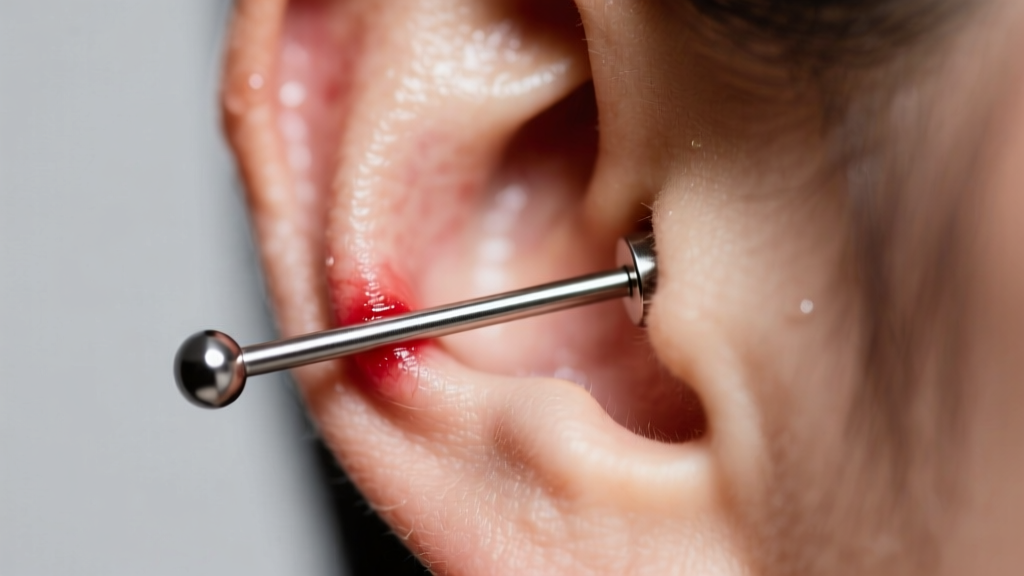
In the track, Golden Earring sings about the sudden, shocking moment 'when the bullet hits the bone.' In cartilage troubleshooting, this translates to the dreaded blowout or the sudden eruption of a hypertrophic scar. An irritation bump at the angle of the piercing is almost always hypertrophic scarring—a localized buildup of collagen caused by mechanical friction, improper jewelry angles, or moisture traps.
True keloids, which grow aggressively beyond the boundaries of the original wound, are genetic and relatively rare. If you spot a fleshy, red, or purple bump adjacent to your 16G or 14G post, do not reach for tea tree oil, aspirin paste, or iodine. These outdated home remedies cause chemical burns on delicate fistula tissue and guarantee a longer stay in the twilight zone.
Material Mismatches: The 316L vs. F-136 Titanium Debate
Many healing stalls are actually disguised allergic reactions. Standard 'surgical steel' (316L) contains up to 10% nickel. Over months of prolonged exposure in a healing wound, the body's immune system can develop a localized contact dermatitis, manifesting as persistent redness, itching, and weeping clear fluid. This is frequently misdiagnosed by amateurs as a bacterial infection.
The 2026 Implant-Grade Standard
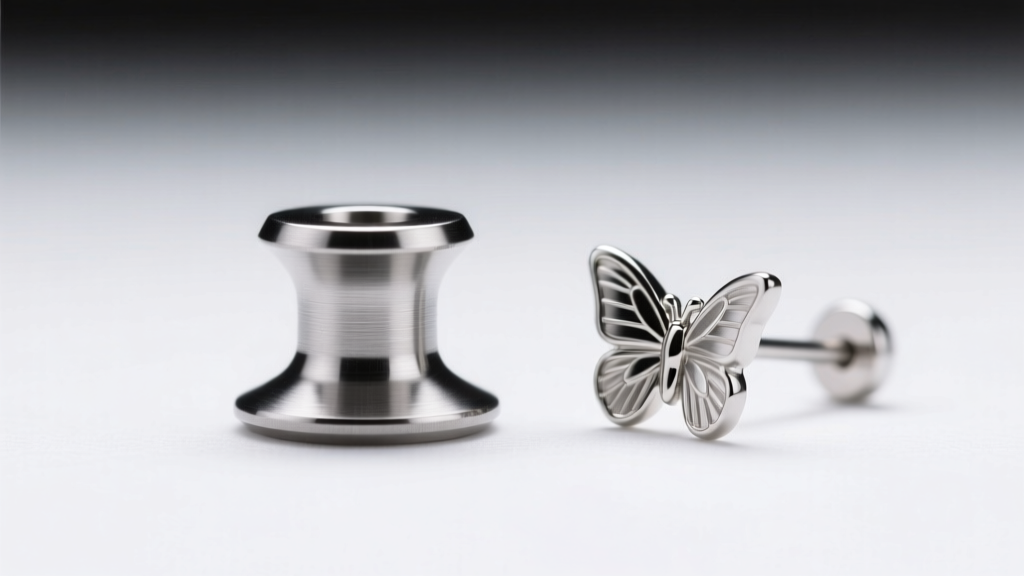
ASTM F-136 implant-grade titanium is the undisputed champion for troubled cartilage. It is entirely nickel-free and boasts a mirror-polished surface that prevents bacteria from adhering to microscopic scratches. If your helix has been stalled for six months, your first troubleshooting step should be visiting a reputable professional to swap the 316L steel for an internally threaded or threadless F-136 titanium flat-back labret. Furthermore, butterfly backings on standard fashion earrings create massive pressure necrosis traps; flat-back discs are mandatory for proper tissue respiration.
Troubleshooting Table: Symptoms, Causes, and Actionable Fixes
Use this diagnostic chart to identify exactly why your cartilage piercing is refusing to heal and apply the correct mechanical or chemical intervention.
| Symptom | The 'Twilight Zone' Cause | 2026 Actionable Fix |
|---|---|---|
| Angled Irritation Bump | Post too long, causing leverage and friction | Downsize to a 5/32" or 1/4" flat-back titanium post |
| Persistent Clear Weeping | Nickel allergy (Contact Dermatitis) | Upgrade to ASTM F-136 implant-grade titanium immediately |
| Crusties & Localized Redness | Moisture trap or over-cleaning with harsh soaps | Switch to sterile 0.9% saline spray 1x/day; air dry only |
| Hoop Snagging & Tearing Pain | Fistula tearing from tight ring rotation | Upsize hoop diameter to 5/16" or 3/8" to reduce tension |
| Inner Bump (Blowout) | Jewelry gauge too thin for the tissue weight | Upsize from 18G/20G to a structural 14G or 12G post |
Mechanical Stress: Post Mathematics and Sleeping Angles
The length of your jewelry post is just as critical as the material composition. Initial piercings are typically done with a 5/16" (8mm) or 3/8" (10mm) post to accommodate the inevitable inflammatory swelling. However, if you do not downsize to a 1/4" (6mm) or 5/32" (5mm) post after the initial swelling subsides (usually around week 4), the excess metal acts as a lever. Every time your hair catches on the backing, or your head hits a pillow, that lever multiplies the force, tilting the jewelry and forcing the fistula to heal at a crooked, irritated angle.
The American Academy of Dermatology emphasizes keeping healing wounds free from sustained pressure and friction. Investing in a U-shaped travel pillow or a specialized silicone ear shield is non-negotiable for side sleepers navigating the twilight zone. If you consistently wake up with a throbbing helix, your sleeping mechanics are sabotaging your cellular regeneration.
Cleaning Protocols: Ditching the Harsh Chemicals
A major reason piercings stall in the twilight zone is chemical irritation. The fistula is a mucous membrane-like structure that is highly sensitive to pH disruptions. Using rubbing alcohol, hydrogen peroxide, or antibacterial soaps strips the healing tissue of its natural lipid barrier, causing micro-tears and cellular death. In 2026, the only medically approved aftercare solution is sterile, preservative-free 0.9% sodium chloride (saline) wound wash. Spray it once daily in the shower, let the warm water gently rinse the area, and pat dry with a non-woven gauze. Leave it alone for the rest of the day. Over-cleaning is just as destructive as under-cleaning.
Escaping the Zone: The Final Verdict on Hoops and Dangles
When can you finally wear the decorative hoops, clicks, and dangles you have been dreaming of? The golden rule for modern cartilage care is the 'two-month buffer.' Once your piercing has passed the 10-month mark with zero swelling, zero crust, and zero tenderness when firm pressure is applied, wait two additional months before introducing a hoop.
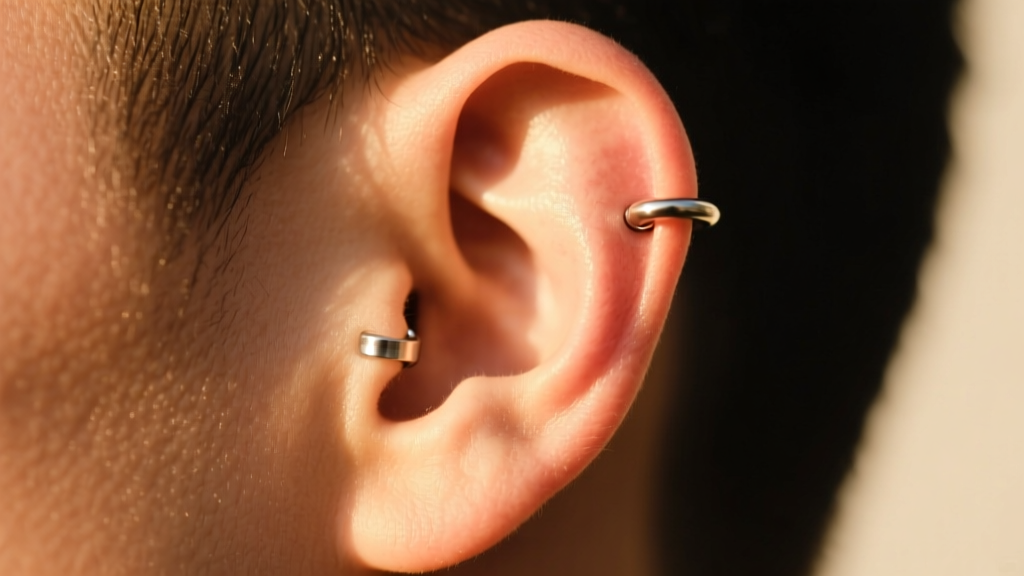
When you do make the switch, the diameter of the hoop is critical. A hoop that is too tight (e.g., 1/4" or 6mm) will pull upward on the fistula, causing the dreaded cheese-cutter effect and dragging you right back into the twilight zone. Opt for a 5/16" (8mm) or 3/8" (10mm) diameter to allow the jewelry to rest neutrally in the tissue. By respecting the biology of the cartilage, upgrading your jewelry mechanics, and ignoring outdated internet myths, you can finally turn off the paranoia, escape the zone, and enjoy a perfectly healed ear.


