What Is the Earring on Top of Ear Name? Cartilage Guide
Wondering about the earring on top of ear name? Explore our expert guide to helix, flat, forward helix, and industrial piercings, gauges, and jewelry.

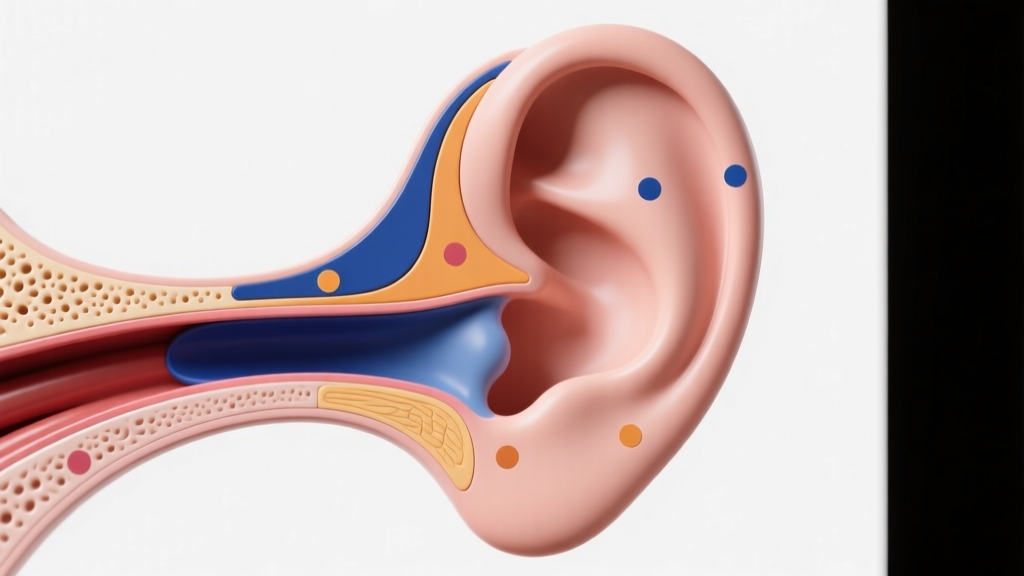
When browsing social media or visiting a high-end piercing studio, you will inevitably encounter intricate jewelry resting on the upper ridges of the ear. For many, this prompts a highly specific search query: what is the earring on top of ear name? The answer is not a single term, but rather a collection of anatomical designations based on the precise cartilage structures being pierced. The upper ear is a complex landscape of ridges, folds, and flat planes, each requiring distinct jewelry styles, gauge sizes, and healing protocols.
As a domain expert in body modification and jewelry metallurgy, I have compiled this technical deep dive to decode the anatomy of the upper ear. We will explore the exact names of these piercings, the biomechanical requirements for jewelry selection, and the material science necessary to avoid long-term complications.
Decoding the Anatomy: What Is the Earring on Top of Ear Name?
The "top of the ear" generally refers to the superior and anterior portions of the auricle. Unlike the earlobe, which is composed of soft, vascularized tissue, these upper regions are made of dense elastic cartilage covered by a thin layer of skin and the perichondrium. Here are the specific names for piercings located in this zone.
The Helix and Forward Helix
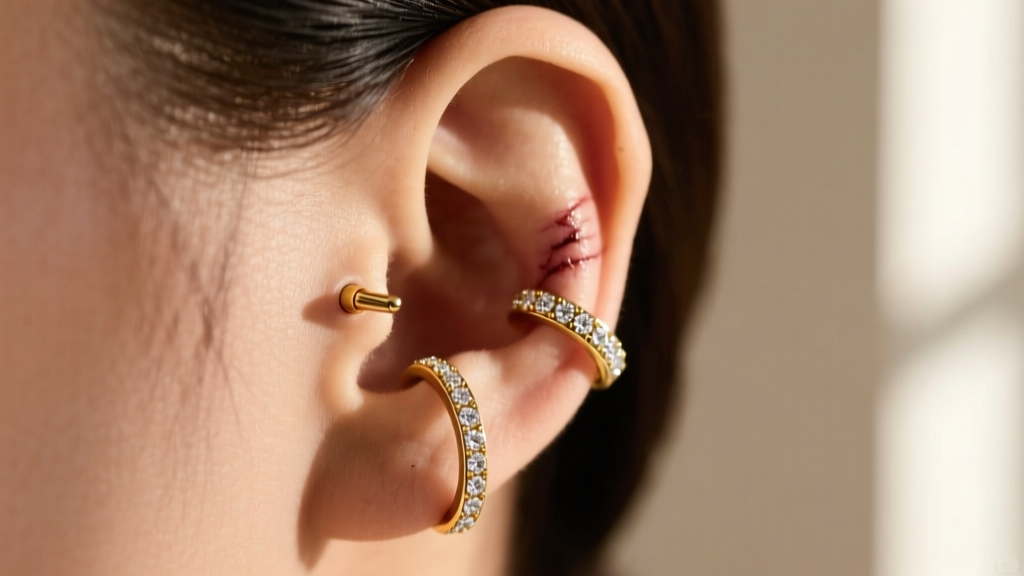
The Helix is the most common answer to the "earring on top of ear name" question. It refers to the outer, rolled rim of the upper ear. A standard helix piercing is placed anywhere along this outer curve. The Forward Helix, however, is located at the anterior root of the helix, where the cartilage ridge curves inward toward the face, just above the tragus. Because the tissue here is denser and the surface area is smaller, forward helix piercings are frequently done in multiples (double or triple forward helix) and require highly precise angling to accommodate the natural fold of the ear.
The Flat (Scapha) Piercing
If the earring you are looking at sits on the smooth, relatively flat plane of cartilage between the outer helix rim and the inner antihelix ridge, you are looking at a Flat piercing (anatomically known as the scapha). The flat is highly prized by jewelry designers because it offers a wide, flush canvas. This allows for larger, more ornate decorative ends—such as floral clusters or geometric shields—without the jewelry catching on the outer rim of the ear.
The Industrial (Scaffold) Piercing
When two piercings on the top of the ear are connected by a single, long straight barbell, this is called an Industrial piercing (also known as a scaffold or construction piercing). Typically, an industrial connects a forward helix to a standard helix on the opposite side of the ear. This is one of the most technically demanding piercings to perform, as both holes must be drilled at perfectly matching angles to prevent severe tension on the cartilage when the rigid barbell is inserted.
Technical Matrix: Gauges, Lengths, and Angles
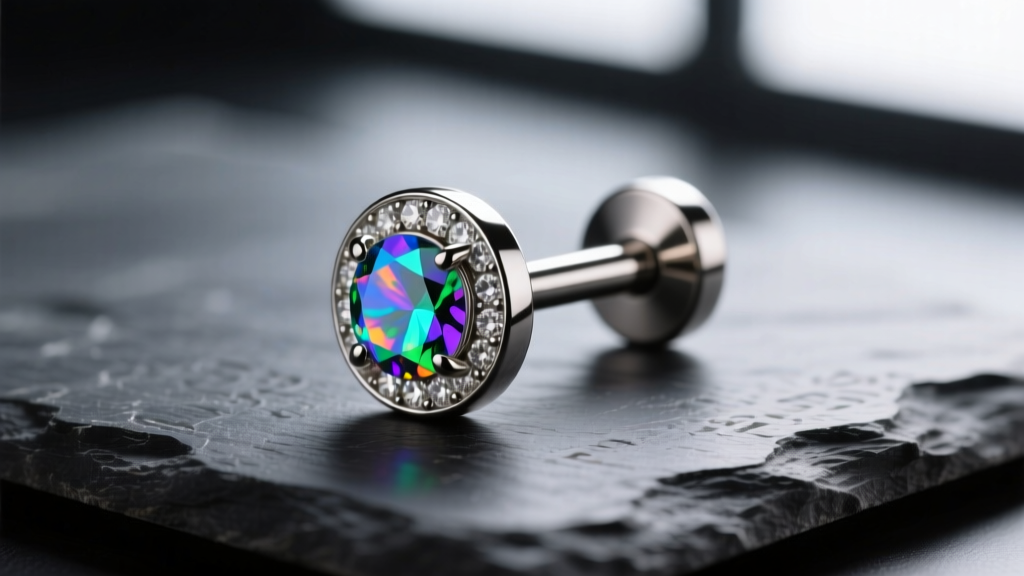
Cartilage piercings cannot be treated as one-size-fits-all. The thickness of the tissue and the angle of the fistula (the piercing channel) dictate the exact dimensions of the jewelry. Below is the standard technical matrix used by APP-certified piercers for upper ear placements.
| Piercing Name | Standard Gauge | Initial Post Length | Heeled Post Length | Optimal Jewelry Type |
|---|---|---|---|---|
| Standard Helix | 16G (1.2mm) or 14G (1.6mm) | 8.0mm - 10.0mm | 5.0mm - 6.0mm | Flat-back labret, Seamless ring |
| Forward Helix | 18G (1.0mm) or 16G (1.2mm) | 6.0mm - 8.0mm | 4.0mm - 5.0mm | Flat-back labret, Mini clicker |
| Flat (Scapha) | 16G (1.2mm) or 14G (1.6mm) | 8.0mm - 10.0mm | 5.0mm - 6.0mm | Flat-back labret (large decorative end) |
| Industrial | 14G (1.6mm) | Custom (usually 32mm - 38mm) | Custom fit | Internally threaded straight barbell |
Note: Initial post lengths are deliberately oversized to accommodate the severe swelling that occurs in avascular cartilage during the first 14 days. Downsizing to a healed post length is mandatory to prevent irritation bumps.
Metallurgy and Material Grades: What Belongs in Cartilage
The upper ear is notoriously unforgiving when exposed to reactive metals. Because cartilage lacks its own direct blood supply (it is avascular and relies on the perichondrium for nutrient exchange), immune responses to metal allergies are prolonged and often result in chronic inflammation.
The Danger of "Surgical Steel"
Many commercial jewelry brands market their products as "surgical steel" or "316L stainless steel." While 316L is fine for temporary surgical tools, it contains 8% to 10.5% nickel. When exposed to the saline environment of a healing fistula, nickel ions leach into the tissue, triggering contact dermatitis and hypertrophic scarring. According to the Association of Professional Piercers (APP), 316L steel should never be used for initial cartilage piercings.
Implant-Grade Titanium (ASTM F136)
The absolute gold standard for initial upper ear piercings is ASTM F136 Implant-Grade Titanium. This specific alloy is biocompatible, completely nickel-free, and features a passivation layer of titanium dioxide that prevents corrosion from bodily fluids. For those preferring the look of gold, 14k or 18k solid, nickel-free yellow or white gold (alloyed with palladium or silver, not copper or zinc) is the only acceptable alternative. Plated jewelry, vermeil, and gold-filled options are strictly prohibited for fresh piercings, as the microscopic friction of the fistula will wear away the plating within weeks.
Threading Mechanics: Internal vs. Threadless
Beyond the material, the mechanical construction of the jewelry dictates how smoothly it passes through the delicate cartilage channel. You must avoid externally threaded jewelry at all costs. Externally threaded jewelry has the screw pattern carved into the post itself. When pushed through a piercing, those sharp threads act like a cheese grater, micro-tearing the fistula and introducing bacteria.
Professional studios exclusively use two types of high-end threading for the top of the ear:
- Internally Threaded: The screw pattern is on the inside of the decorative end, while the post is completely smooth. This allows the jewelry to glide through the tissue without causing trauma.
- Threadless (Press-Fit): This system uses a smooth post with a tiny, bent pin on the decorative end. The pin is inserted into the hollow post and bent at a 5-degree angle, creating spring tension that locks the jewelry securely in place. Threadless jewelry is highly favored for flat and forward helix piercings because it allows for seamless, tool-free downsizing.
Avascular Healing and Troubleshooting Irritation Bumps
When researching the earring on top of ear name, you will frequently encounter discussions about "piercing bumps." It is vital to distinguish between a true keloid (a genetic, tumorous overgrowth of scar tissue that extends beyond the piercing site) and a hypertrophic scar or irritation bump.
Over 95% of cartilage bumps are irritation bumps. Because cartilage heals from the outside in via the perichondrium, it is highly susceptible to mechanical disruption. The primary failure modes include:
- Sleeping on the piercing: Direct pressure forces the jewelry at an angle, causing the internal disc to slice into the healing tissue.
- Failure to downsize: Leaving an 8mm post in a healed 5mm fistula creates a lever effect. Every time you brush your hair or put on a shirt, the long post catches and torques the jewelry, resulting in a localized fluid-filled bump.
- Improper piercing angle: If a flat piercing is not done at a perfect 90-degree angle to the tissue plane, the jewelry will constantly pull against the anatomy, leading to gradual migration and rejection.
"Cartilage piercings require immense patience. The healing window for a standard helix is 6 to 9 months, while industrials and flats can take 12 to 18 months to fully stabilize. Changing to a hoop before the 12-month mark is the leading cause of delayed healing." — APP Aftercare Guidelines
Expert Sourcing and Final Recommendations
If you are planning to get a helix, flat, or industrial piercing, bypass mall kiosks and jewelry stores that use piercing guns. Piercing guns use blunt-force trauma to shove a solid stud through cartilage, which can cause micro-fractures in the ear and severe tissue necrosis. Always seek out an APP-certified professional piercer who uses single-use, sterilized hollow needles and stocks only ASTM F136 titanium or solid gold jewelry from reputable manufacturers like Neometal, BVLA, or Maria Tash.
Understanding the correct earring on top of ear name is the first step toward curating a beautiful, anatomically correct ear project. By respecting the specific gauge requirements, investing in implant-grade metallurgy, and adhering to strict downsizing protocols, you ensure your upper ear jewelry remains a permanent, irritation-free statement of personal style.


