Buying Guide: Earrings for Earring Scar Tissue & Keloids
Discover the best metals, gauges, and styles to heal and accommodate earring scar tissue. Our expert buying guide covers keloids, blowouts, and sensitive lobes.

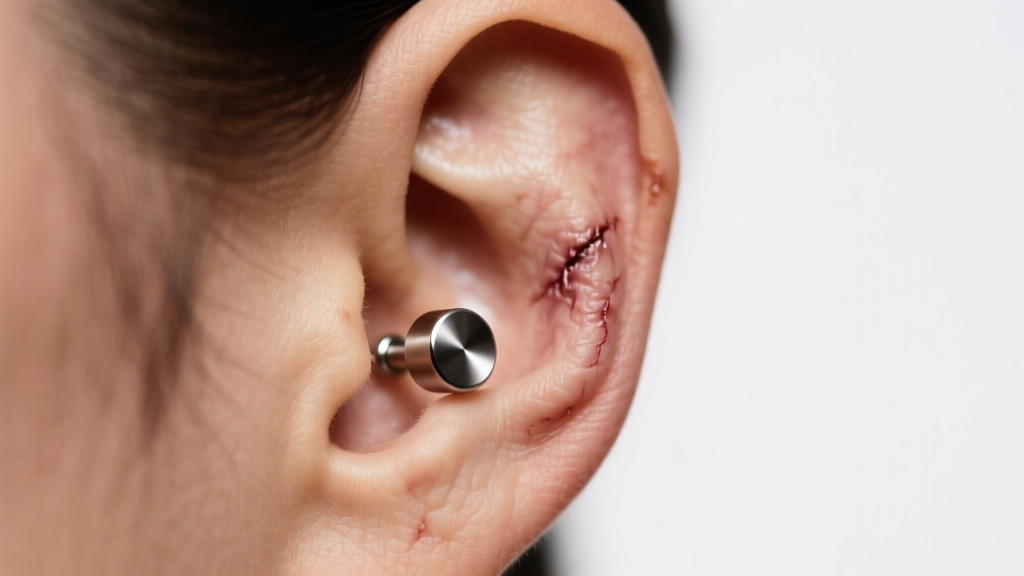
Dealing with earring scar tissue is one of the most frustrating challenges in body modification and everyday jewelry wear. Whether you are managing a raised keloid, a hypertrophic bump, or a thinned-out lobe from a previous blowout, the wrong earring can trigger inflammation, migration, or further tissue damage. In 2026, the jewelry market offers more biomechanically sound and metallurgically pure options than ever before, but navigating the terminology requires a strategic approach.
This comprehensive buying guide breaks down the exact material grades, gauge specifications, and closure mechanisms you need to look for when shopping for earrings that accommodate and protect compromised ear tissue.
The Anatomy of Earring Scar Tissue: What Are You Treating?
Before purchasing new jewelry, you must accurately identify the type of scar tissue you are dealing with. The structural integrity of the tissue dictates the weight, gauge, and style of the earring you can safely wear.
Hypertrophic Scars vs. Keloids
Hypertrophic scars remain within the boundaries of the original piercing hole and are usually caused by friction, pressure, or poor aftercare. Keloids, however, are a genetic overgrowth of collagen that extends beyond the piercing site. According to the Mayo Clinic, keloids require significantly more care and are highly reactive to the nickel content found in cheap fashion jewelry.
Piercing Blowouts and Thinned Lobes
A blowout occurs when a piercing is stretched too quickly, causing the tissue to extrude outward. This leaves the lobe paper-thin and highly susceptible to the "cheese-cutter effect," where heavy or thin-gauge earrings slowly slice through the remaining tissue.
Metallurgy Matters: Approved Metals for Compromised Tissue
When earring scar tissue is present, the skin's barrier is compromised, making it hyper-reactive to metal alloys. You must look for specific ASTM (American Society for Testing and Materials) certifications on product descriptions.
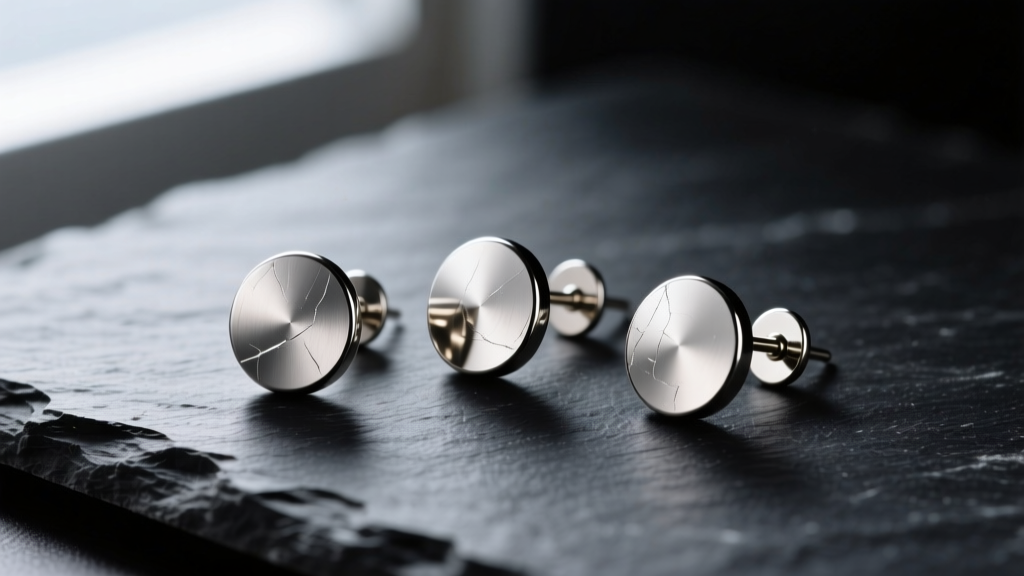
The Gold Standard: Implant-Grade Titanium
Always look for ASTM F136 compliant titanium. This is the exact alloy used in surgical joint replacements. It is entirely nickel-free, lightweight, and can be polished to a mirror finish that prevents bacteria from adhering to the post. Brands like Neometal and BVLA specialize in this grade.
Solid Gold Specifications
If you prefer gold, you must opt for 14k or 18k solid gold that is specifically alloyed for body jewelry (often palladium-based rather than nickel-based). Avoid anything labeled "gold-plated," "gold-filled," or "vermeil," as the friction from scar tissue will wear away the microscopic top layer, exposing reactive base metals underneath.
Warning: The term "Surgical Steel" (usually 316L) is a marketing trap. 316L steel contains up to 10% nickel. While fine for fully healed, non-reactive lobes, it is a primary trigger for inflamed earring scar tissue and should be strictly avoided during healing or flare-ups.
Gauge Physics: Preventing the Cheese-Cutter Effect
Counterintuitively, thicker earrings are often safer for scarred and thinned lobes than thinner ones. A standard 20-gauge (0.8mm) earring post concentrates the weight of the earring into a tiny surface area. If the lobe is weakened by scar tissue, this thin wire will slowly migrate downward, slicing through the skin.
The Association of Professional Piercers (APP) recommends upsizing the gauge to distribute weight across a wider surface area of the compromised tissue.
| Gauge Size | Millimeter (mm) | Best Use Case for Scar Tissue | Styles to Avoid |
|---|---|---|---|
| 20g - 18g | 0.8mm - 1.0mm | Only for standard, healthy cartilage/lobes with minor surface scarring. | Heavy dangles, large hoops. |
| 16g | 1.2mm | Ideal for hypertrophic bumps; provides stability without excessive stretching. | Butterfly-back studs. |
| 14g | 1.6mm | Highly recommended for thinned lobes and blowouts to prevent migration. | Seamless rings with sharp cut ends. |
| 12g - 10g | 2.0mm - 2.5mm | Necessary for severe blowouts or heavily stretched lobes with scar rings. | Any heavy hanging styles. |
Earring Styles and Closure Mechanisms
The physical design of the earring dictates how much pressure and friction is applied to your earring scar tissue. When browsing, filter your search by these specific structural features.
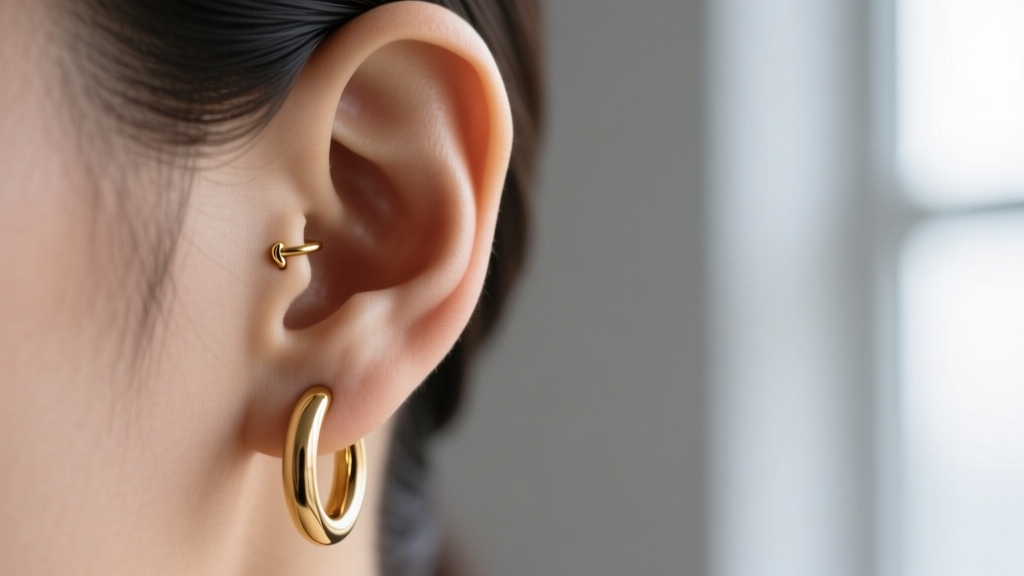
Flat-Back Labrets Over Butterfly Backs
Traditional butterfly backs (push-backs) trap dead skin, sebum, and bacteria against the back of the earlobe. More importantly, the sharp prongs of the butterfly clutch dig into the tissue, creating pressure points that aggravate keloids and hypertrophic scars. Flat-back labrets feature a smooth, flush disc that rests evenly against the back of the ear, distributing pressure uniformly and eliminating snag hazards.
Threadless vs. Internally Threaded
If you are buying post-style earrings, the threading mechanism is critical. Externally threaded earrings (where the screw is on the post) act like a file, tearing through the delicate fistula (the piercing channel) and aggravating internal scar tissue every time they are inserted.
- Threadless (Press-Fit): Uses tension to hold a slightly bent pin inside a hollow post. This offers the smoothest insertion and is the top choice for sensitive, scarred channels.
- Internally Threaded: The screw is on the decorative end, and the post is completely smooth. A close second to threadless jewelry.
Seamless and Continuous Hoops
If you must wear a hoop, avoid hinged clickers with visible seams or captive bead rings that require pliers to open. The microscopic gaps in these closures harbor bacteria and create rough edges that scrape the inside of a scarred fistula. Look for continuous seamless rings that are polished to a mirror finish, ensuring a completely smooth rotation through the tissue.
The Ultimate Purchasing Checklist
Before adding an earring to your cart, run it through this rigorous checklist to ensure it will not exacerbate your earring scar tissue:
- Material Verification: Does the product description explicitly state ASTM F136 Titanium, Niobium, or 14k/18k Palladium-based Solid Gold?
- Finish Quality: Is the metal polished to a mirror finish? (Avoid matte, brushed, or oxidized finishes on the post, as they create microscopic abrasions).
- Closure Type: Is it a flat-back labret, threadless end, or seamless hoop? (Reject butterfly backs and hinged clickers).
- Gauge Appropriateness: Is the post thick enough (14g or 16g) to support the weight of the jewelry without slicing through thinned tissue?
- Weight Check: If buying a dangle or drop earring, is the decorative element lightweight enough to prevent gravitational dragging on a compromised lobe?
When to Step Away from Jewelry: Medical Interventions
Sometimes, the best buying decision is to purchase nothing at all and seek professional treatment. If your earring scar tissue is actively growing, painful, or hot to the touch, jewelry will only act as an irritant.
Dermatologists frequently utilize intralesional corticosteroid injections to flatten hypertrophic scars and keloids. In cases of severe blowouts, a minor surgical revision by a board-certified plastic surgeon can excise the scar tissue and reconstruct the lobe, allowing for a fresh, healthy piercing to be placed months later. Always consult with a medical professional or an APP-certified piercer before attempting to force jewelry through an inflamed or heavily scarred fistula.
By prioritizing implant-grade metallurgy, appropriate gauge thickness, and biomechanically sound closure mechanisms, you can safely wear beautiful jewelry while protecting your ears from further trauma. Treat your earring scar tissue with the clinical respect it demands, and your jewelry collection will remain a source of joy, not irritation.


