Choosing an Earring With Cross: 2026 Budget & Value Guide
Discover how to evaluate an earring with cross motifs in 2026. We break down metal grades, gauge sizes, and pricing to help you find true value.


The cross motif remains one of the most enduring and versatile symbols in jewelry design. Whether you are drawn to its spiritual significance, its gothic edge, or its minimalist geometric appeal, finding the perfect earring with cross detailing requires navigating a crowded market. In 2026, the jewelry landscape is saturated with options ranging from $12 fast-fashion alloys to $2,500 solid platinum pieces. But how do you determine the actual value of these pieces? Budgeting for jewelry is not merely about finding the lowest price; it is about understanding metallurgy, structural integrity, and cost-per-wear.
This comprehensive value assessment breaks down exactly what you should expect to pay for an earring with cross elements, the material grades that justify premium pricing, and the hardware specifics that dictate whether your jewelry will last a season or a lifetime.
The True Cost of Materials: What Are You Actually Paying For?
When evaluating any earring with cross charms or engravings, the base metal and plating thickness dictate 80% of the price. Many consumers mistakenly believe that "gold tone" or "sterling silver" are universal standards, but the 2026 market requires a more critical eye. According to the Gemological Institute of America (GIA), understanding metal hallmarks and alloy compositions is the first line of defense against overpaying for misrepresented jewelry.
| Material Grade | 2026 Price Range (Per Pair) | Longevity & Tarnish | Best For |
|---|---|---|---|
| Surgical Steel (316L) | $15 - $35 | Highly durable, zero tarnish, may contain trace nickel | Cartilage piercings, budget buyers |
| 925 Sterling Silver | $30 - $85 | Prone to oxidation/tarnish, requires polishing | Everyday lobe studs, minimalist crosses |
| Gold Vermeil (2.5µm over 925) | $55 - $120 | 2-4 years before wear-through, high value | Statement dangles, fashion-forward styles |
| Solid 14k Gold | $180 - $450+ | Lifetime durability, waterproof, hypoallergenic | Heirloom pieces, permanent jewelry, sensitive ears |
If you are purchasing a solid 14k gold earring with cross pendants for under $100, you are likely being misled about the weight or the purity of the metal. True value lies in transparency: reputable jewelers will list the exact gram weight and the karat purity of their pieces.
Lobe vs. Cartilage: Gauge Sizes and Hardware Value
A critical yet frequently overlooked aspect of jewelry valuation is the gauge size—the thickness of the post or hoop that actually passes through your piercing. The anatomy of your ear dictates the necessary hardware, and ignoring this can lead to discomfort, migration, or tearing.
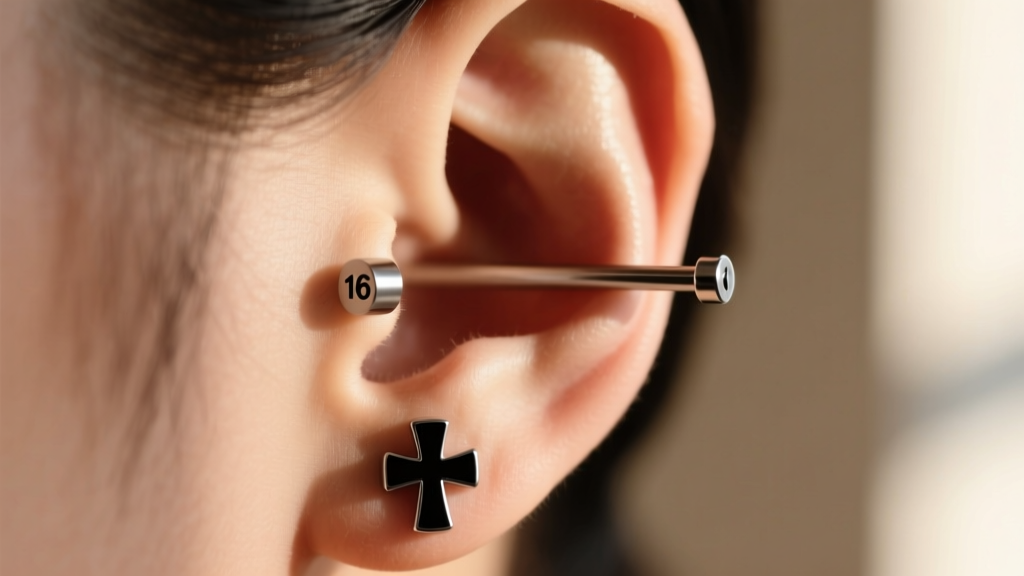
Standard Lobe Piercings (20G to 18G)
Most standard lobe piercings are done at 20G (0.81mm) or 18G (1.02mm). If you are buying a lightweight 5mm cross stud, a 20G post is perfectly adequate. However, if you are investing in a heavy, solid gold earring with cross dangles that drop 25mm or more, a 20G post is a structural liability. The weight of the charm will cause the thin post to act like a cheese wire, slowly stretching and damaging your earlobe over time. For heavy dangles, always seek out 18G or even 16G (1.29mm) posts to distribute the weight safely.
Cartilage and Helix Piercings (16G to 14G)
Cartilage piercings, such as the helix or tragus, are typically pierced at 16G (1.29mm) or 14G (1.6mm). Attempting to force a delicate 18G or 20G cross stud into a 16G cartilage hole can cause irritation bumps and rejection. When shopping for a cartilage earring with cross motifs, ensure the product description explicitly states the gauge size. Implant-grade titanium (ASTM F-136) is the gold standard for cartilage, offering superior biocompatibility compared to standard surgical steel.
Why Clasp Mechanisms Dictate Long-Term Value
The clasp is the unsung hero of earring longevity. A $400 solid gold cross dangle is a poor investment if it is secured by a cheap, easily dislodged friction back.
- Butterfly Friction Backs: The industry standard for budget jewelry. They harbor bacteria in their crevices and lose tension over time. Low long-term value.
- Screw Backs: The post is threaded, and the back screws on securely. Ideal for high-value diamond or solid gold cross studs. Prevents loss during sleep or activity.
- Clickers / Hinged Segments: Essential for hoops and cartilage cuffs. A high-quality clicker will produce an audible "snap" when closed, ensuring the earring with cross detailing stays securely in your helix or daith piercing.
Spotting the Difference: Plated vs. Vermeil vs. Solid
The most common trap for budget-conscious buyers is confusing "gold plated" with "gold vermeil." This distinction is vital when assessing the value of an earring with cross designs that feature intricate detailing, as the plating method affects how well those details survive wear and tear.
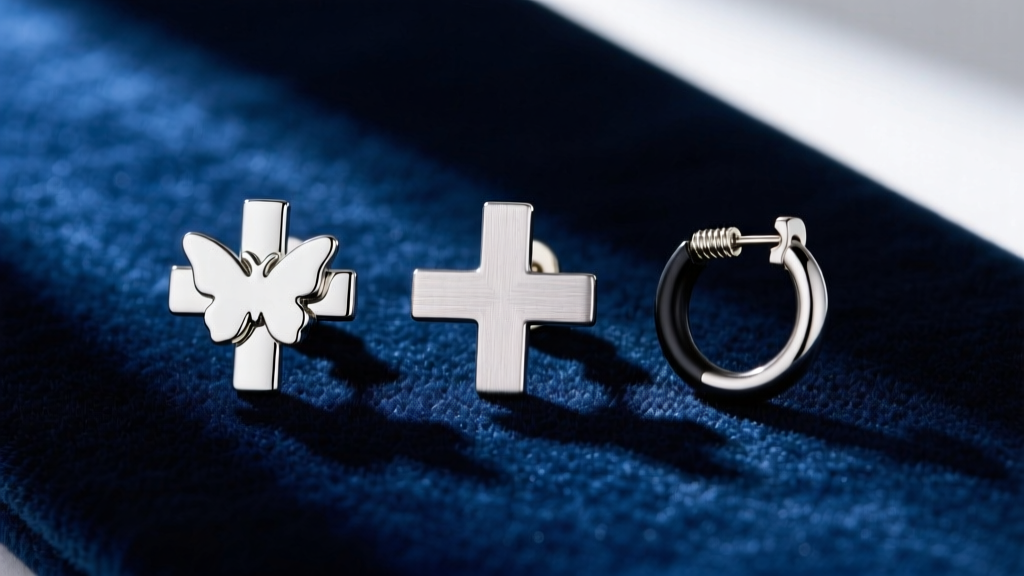
Flash Plating (The Budget Trap): Fast-fashion brands often use flash plating, applying a microscopic layer of gold (usually 0.1 to 0.5 microns) over a base metal like brass or copper. This layer is so thin that the natural oils and friction from your skin will wear it away in a matter of weeks, exposing the base metal. According to the American Academy of Dermatology, exposed base metals frequently contain nickel, a leading cause of allergic contact dermatitis. A $15 flash-plated cross earring that turns your ear green and causes an itchy rash within a month has a terrible cost-per-wear value.
Gold Vermeil (The Smart Middle-Ground): By legal definition in most major markets, vermeil must consist of a 925 sterling silver base coated with a minimum of 2.5 microns of gold (usually 14k or 18k). This thickness provides a durable, water-resistant barrier that can last for years with proper care. When you find a vermeil earring with cross aesthetics in the $60 to $90 range, you are looking at an excellent intersection of budget and quality.
Pro-Tip for 2026 Buyers: Always check the product specifications for the exact micron thickness. Brands that are proud of their vermeil will explicitly state "2.5 microns" or "3 microns." If the description simply says "gold plated over silver," assume it is less than 1 micron and price your expectations accordingly.
2026 Smart Buying Framework: Maximizing Your Budget
To truly assess the value of an earring with cross elements, apply the "Cost-Per-Wear" (CPW) framework. Divide the total cost of the earrings by the estimated number of times you will wear them in a year. A $300 pair of solid 14k gold cross hoops worn 200 times a year yields a CPW of $1.50. A $30 pair of plated brass cross studs worn twice before tarnishing yields a CPW of $15.00. The "expensive" option is mathematically the better budget decision.
When to Buy Budget vs. When to Invest
Not every jewelry purchase requires a lifetime investment. Use this decision matrix to guide your spending:
- Buy Budget (Under $40): When experimenting with a new trend, such as an oversized gothic cross ear cuff that you may only wear for a specific season or event. Opt for stainless steel or titanium to avoid skin irritation.
- Buy Mid-Tier Vermeil ($50 - $120): For statement pieces, like a large pavé diamond-cross drop earring that you plan to wear to dinners and events a few times a month.
- Buy Investment Solid Gold ($200+): For everyday essentials. A minimalist 8mm solid gold cross stud or a seamless 16G gold clicker hoop with a tiny cross charm should be bought in solid 14k or 18k gold so you can shower, swim, and sleep without fear of degradation.
Final Verdict: What Should You Actually Pay?
Ultimately, the value of an earring with cross symbolism is a blend of material integrity, structural design, and personal utility. In 2026, you should expect to pay between $25 and $45 for high-quality implant-grade titanium or sterling silver pieces. For gold vermeil, the sweet spot for genuine value lies between $65 and $110. Anything marketed as "solid gold" below the $150 mark should be heavily scrutinized for hollow construction or misleading karatage.
By prioritizing correct gauge sizes, secure clasp mechanisms, and verified metal thicknesses, you can build a curated collection of cross earrings that offer both profound aesthetic appeal and undeniable financial value. Stop paying for brand names and start paying for metallurgy.


