Brick Stitch Earrings Patterns Free: An Expert Beader's Guide
Discover expert techniques and brick stitch earrings patterns free for beaders. Master tension, thread choices, and 11/0 Delica bead geometry.

The Architecture of Brick Stitch: Beyond Basic Tutorials
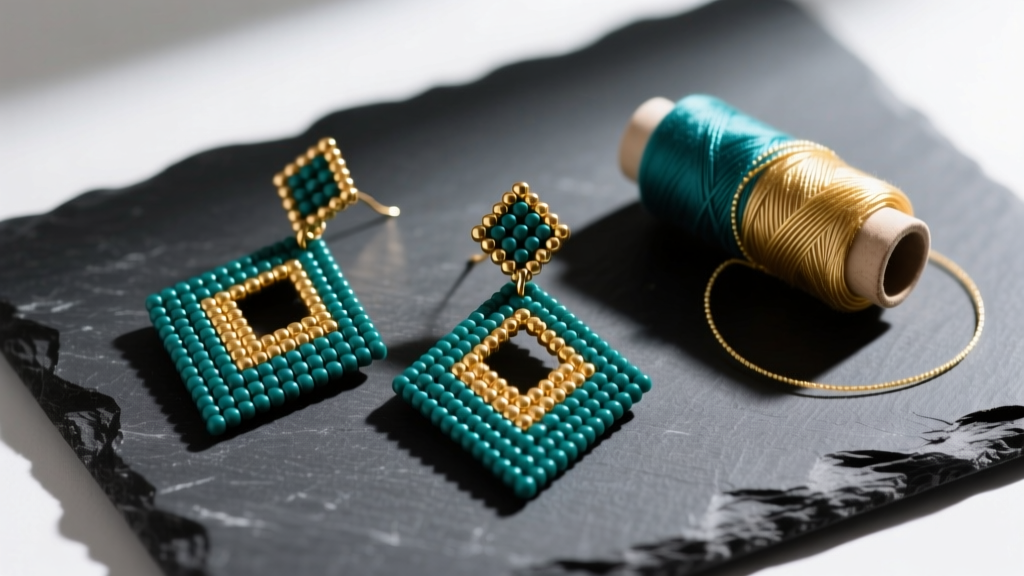
Brick stitch is a cornerstone of off-loom beadweaving, prized for its structural drape and intricate geometric possibilities. Unlike peyote stitch, which builds horizontally, brick stitch stacks beads vertically, anchoring each new bead to the thread bridge of the previous row. This creates a fabric that naturally tapers and flares, making it the premier choice for teardrop, diamond, and fringe earring silhouettes. As we navigate the beading landscape in 2026, the demand for micro-beadwork has surged, requiring beaders to move beyond beginner tutorials and understand the underlying physics of thread tension and bead geometry.
When designing or executing complex pieces, the structural integrity of the beadwork relies entirely on the foundation row and the consistency of the thread path. A poorly executed ladder stitch foundation will inevitably cause the entire earring to warp, regardless of how perfectly the subsequent rows are woven. Mastering this stitch requires a deep understanding of material tolerances and precise hand mechanics.
Essential Materials: Thread, Needles, and Bead Grades
The most frequent point of failure for intermediate beaders is material mismatch. Using the wrong thread weight or needle size can lead to split threads, bead breakage, or a stiff, board-like earring that lacks movement. Below is the definitive specification chart for professional-grade brick stitch earrings.
| Component | Expert Specification | Rationale & Technical Notes |
|---|---|---|
| Beads | Miyuki Delica 11/0 (DB) | Uniform 1.6mm x 1.3mm cylinder. Essential for tight, gap-free geometric patterns. Avoid round seed beads for the core structure. |
| Thread | Berkley Fireline 6lb (0.006") | Gel-spun polyethylene (GSPE). Zero stretch, UV resistant, and prevents the earring from drooping over time unlike nylon threads. |
| Needle | Tulip Beading Needle Size 10 | Optimal eye size for 6lb Fireline. Allows for up to three passes through an 11/0 Delica when reinforcing the top hanging loop. |
| Findings | 22-Gauge Titanium French Hook | Hypoallergenic and lightweight. The 22-gauge wire is thin enough to pass through a 4mm jump ring without stressing the beadwork. |
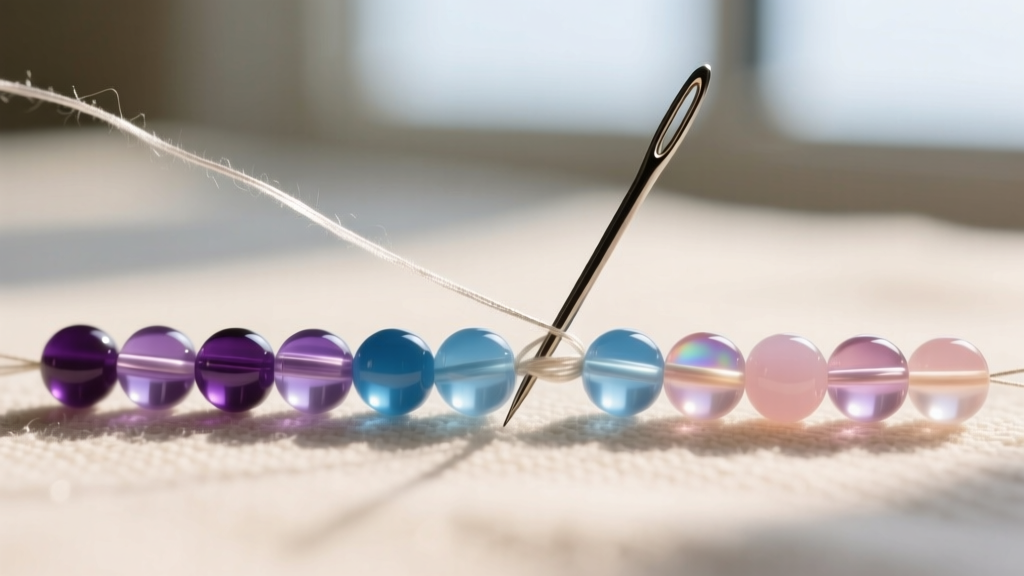
For thread, avoid traditional nylon options like Nymo or Silamide for structural earring components. While excellent for bead embroidery or fringe, nylon possesses a natural memory and stretch. Under the constant gravitational pull of glass or crystal beads, nylon thread will elongate, causing the earring's silhouette to distort within months of wear. GSPE threads, such as Berkley Fireline or Wildfire, maintain absolute dimensional stability.
Sourcing High-Quality Brick Stitch Earrings Patterns Free
While the internet is saturated with generic tutorials, finding structurally sound brick stitch earrings patterns free of charge requires a discerning eye. Many free patterns found on social media lack critical thread-path arrows, leading to structural weak points where the thread is exposed or the tension is uneven.
Decoding the Grid: Japanese vs. American Notations
When evaluating free patterns, you will generally encounter two distinct notation styles. Japanese patterns, often sourced from Miyuki's official pattern database, utilize a highly visual, color-coded grid with explicit thread path arrows. These are the gold standard for complex geometric increases and decreases. American patterns, frequently found in archival beading magazines, often rely on a numbered word-chart or a simplified diagram that assumes the beader already knows the standard brick stitch return-thread path.
Before committing hours to a free pattern, perform a 'dry run' of the first three rows. If the pattern does not clearly indicate how to execute the turnaround at the end of a row (specifically, whether to pass back through the last bead added or the previous bridge), discard it. Ambiguity in the turnaround step is the primary cause of warped edges in off-loom beadweaving.
Technical Execution: Tension Control and Edge Finishing
Tension in brick stitch is not about pulling as tightly as possible; it is about directional consistency. The most common structural failure is edge flaring, where the outermost beads of a row push outward, creating a ruffled effect. This occurs when the working thread is pulled at a downward angle rather than parallel to the previous row.
- The 45-Degree Rule: When pulling the thread snug after adding a new bead, always pull at a 45-degree upward angle, away from the beadwork. This seats the bead firmly against the thread bridge without distorting the row below.
- The Two-Thread Pass: For the top row of the earring (the hanging loop), you must pass the needle through the entire row twice. This creates a double-thickness thread bridge that can support the weight of the earring and the friction of the jump ring.
- Waxing the Thread: If using GSPE, do not use beeswax. Beeswax makes the thread tacky and can cause the beads to stick together, ruining the drape. If you must condition your thread, use a micro-crystalline synthetic wax sparingly.
Hardware Integration: Attaching Ear Wires to Beadwork
Integrating metal hardware with delicate beadwork is where many amateur pieces fail. A common mistake is threading the ear wire directly through the top loop of the brick stitch beadwork. The friction of the metal ear wire rubbing against the thread during wear will act like a microscopic saw, eventually severing the GSPE thread and causing the loss of the earring.
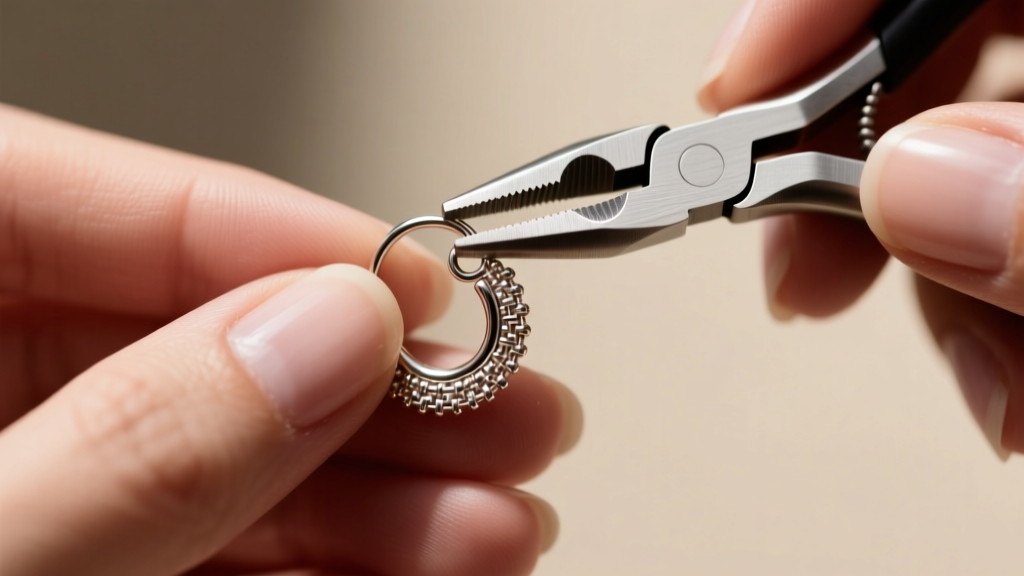
Always use a sacrificial buffer. Attach a 4mm or 5mm 22-gauge jump ring (preferably titanium or niobium to match the ear wire) to the beadwork loop. Then, attach the ear wire to the jump ring. The metal-on-metal friction between the ear wire and the jump ring will preserve your thread indefinitely. When closing the jump ring, use two pairs of flat-nose pliers to twist it open laterally; never pull the ends apart, as this weakens the metal's temper and creates a sharp edge that can slice the beadwork thread.
Troubleshooting Common Structural Failures
Even expert beaders encounter structural anomalies. Here is a technical troubleshooting guide for the most prevalent brick stitch issues:
- Problem: The foundation row is curling.
Diagnosis: The ladder stitch thread tension is too tight, or the thread is twisting inside the beads.
Solution: Use a two-needle ladder stitch technique to maintain uniform tension, or weave the foundation row using a stiff beading mat to keep the beads aligned before beginning the brick stitch rows. - Problem: Thread is fraying at the edge beads.
Diagnosis: The needle is catching the inner edge of the glass bead, or the bead has a sharp, unpolished hole (common in cheap, non-Japanese seed beads).
Solution: Switch to Miyuki Delicas or Toho Treasures, which have smooth, rounded holes. Ensure your needle is passing cleanly through the center axis of the bead. - Problem: The earring lacks drape and feels stiff.
Diagnosis: Over-tensioning the thread or using a thread weight that is too heavy (e.g., 8lb or 10lb Fireline).
Solution: Downgrade to 6lb or even 4lb Fireline for micro-beadwork, and consciously relax your grip on the working thread during the return pass.
By treating beadweaving not just as a craft, but as an exercise in structural engineering and material science, you can elevate your jewelry from fragile hobbies to heirloom-quality accessories. For further technical reading on off-loom weaving mechanics, Interweave Beading remains an invaluable resource for advanced thread-path theories and tension management.


