Master Class: Extra Large Sterling Silver Hoop Earrings
Discover the metallurgy, structural engineering, and clasp mechanics behind extra large sterling silver hoop earrings in our expert technical guide.

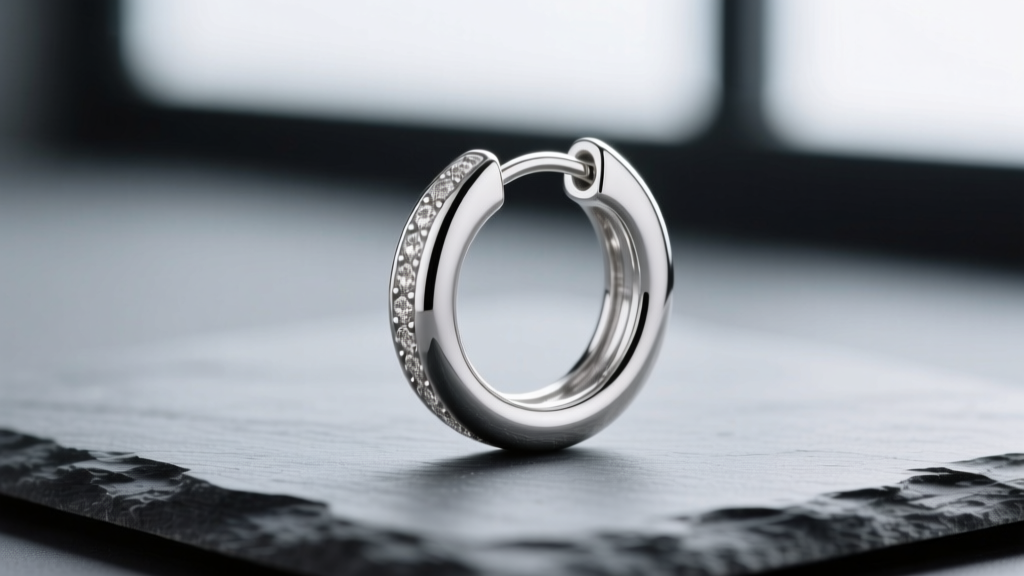
When evaluating extra large sterling silver hoop earrings—typically defined in the jewelry industry as ranging from 70mm to over 120mm in diameter—the design challenges extend far beyond simple aesthetics. At these dimensions, gravity, lateral torque, and material fatigue become critical factors. A poorly engineered oversized hoop will warp, snap at the hinge, or cause irreversible tissue damage to the earlobe. This expert deep dive explores the metallurgy, structural engineering, and biomechanics required to design and wear large-format silver hoops safely and comfortably.
The Metallurgy of 925 Silver in Oversized Hoops
Pure silver (999 fine silver) possesses a Vickers hardness (HV) of roughly 25, making it entirely unsuitable for large-scale structural jewelry. It will bend under its own weight and deform upon the first accidental impact. To achieve the necessary tensile strength, jewelers alloy pure silver, creating what we know as sterling silver.
Traditional 925 vs. Argentium Alloys
Standard 925 sterling silver consists of 92.5% pure silver and 7.5% copper. The copper increases the hardness to approximately 65-70 HV, providing the rigidity needed for hoops up to 80mm. However, copper is highly reactive with sulfur in the atmosphere, leading to rapid oxidation (tarnish)—a problem exacerbated by the massive surface area of extra large hoops.
For premium oversized hoops, metallurgists increasingly turn to Argentium silver, as documented by the Gemological Institute of America. Argentium replaces a portion of the copper with germanium. This not only drastically slows tarnish formation by creating a transparent germanium dioxide layer on the surface, but it also allows the alloy to be heat-hardened to an impressive 130 HV. For a 100mm+ hoop, heat-hardened Argentium ensures the circle retains its perfect geometry even when subjected to daily wear and accidental snags.
Structural Engineering: Wire Gauge and Tensile Strength
The cross-sectional profile of the silver wire dictates both the weight and the structural integrity of the hoop. Designers must choose between solid wire and hollow tube extrusions.
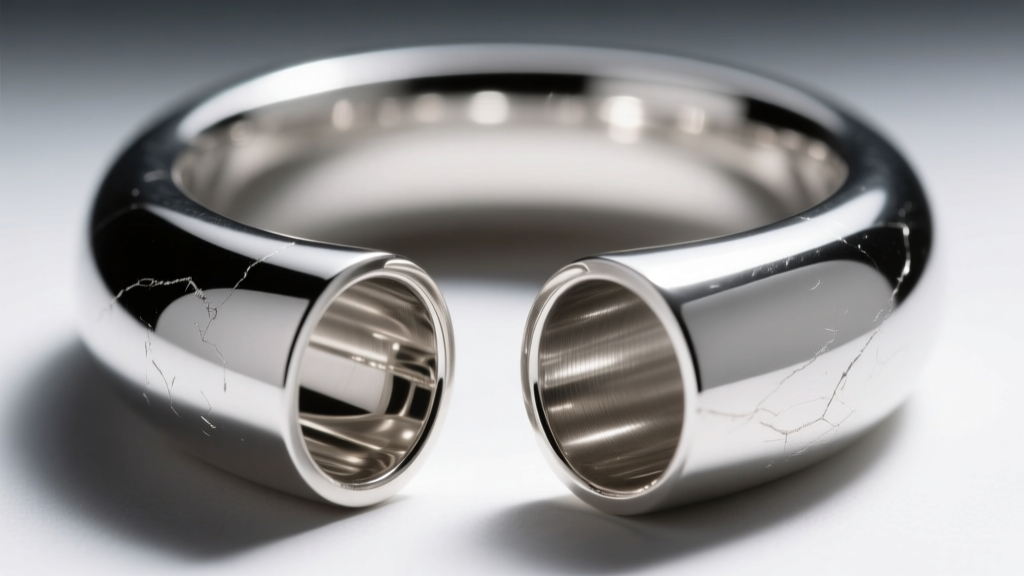
Solid wire provides maximum durability and a luxurious, heavy drape, but it scales poorly in weight as the diameter increases. A 100mm hoop crafted from solid 10-gauge (2.58mm) wire can easily exceed 22 grams per earring. To mitigate this, manufacturers utilize seamless hollow tube extrusions. By drawing silver into a tube with a 1.5mm outer diameter and a 0.4mm wall thickness, engineers can reduce the overall weight by up to 60% without sacrificing the visual impact of a thick, substantial hoop.
Weight and Stress Matrix
| Diameter | Construction | Wire Gauge / Profile | Est. Weight (Per Earring) | Lobe Stress Level |
|---|---|---|---|---|
| 70mm | Solid Wire | 12-Gauge (2.05mm) | 9.5g | Low to Moderate |
| 90mm | Hollow Tube | 10-Gauge OD (2.58mm) | 6.2g | Low |
| 100mm | Solid Wire | 10-Gauge (2.58mm) | 22.4g | Extreme (Requires Support) |
| 120mm | Hollow Tube | 8-Gauge OD (3.26mm) | 11.8g | Moderate |
Clasp Mechanics for Heavy-Gauge Hoops
The clasp is the most common point of catastrophic failure in extra large sterling silver hoop earrings. The lever-arm effect of a 100mm diameter means that a slight tug on the bottom of the hoop translates into massive lateral torque at the clasp joint.
Evaluating Closure Systems
- Standard Latchback (Hinged): Features a hinged post that clicks into a grooved catch. While ubiquitous, the thin catch wall can bend outward if the hoop is pulled parallel to the jawline, resulting in a lost earring.
- Saddleback (Snap-Fit): The post features a contoured saddle that snaps over a precisely machined ridge on the opposing end. This design resists lateral torque significantly better than a standard latchback and is the preferred choice for hoops exceeding 80mm.
- Continuous (Endless): Relies on the tensile spring of the metal itself, with a thin pin sliding into a hollow tube. For extra large hoops, continuous closures are generally discouraged unless the wire gauge is exceptionally thick, as the tension required to keep the pin secure weakens over repeated cycles of opening and closing.
Lobe Biomechanics and Weight Distribution
The human earlobe contains no cartilage; it is composed entirely of fibrofatty areolar tissue. When piercing the lobe, the resulting fistula (the healed tube of skin) is highly susceptible to migration and tearing under sustained gravitational loads.
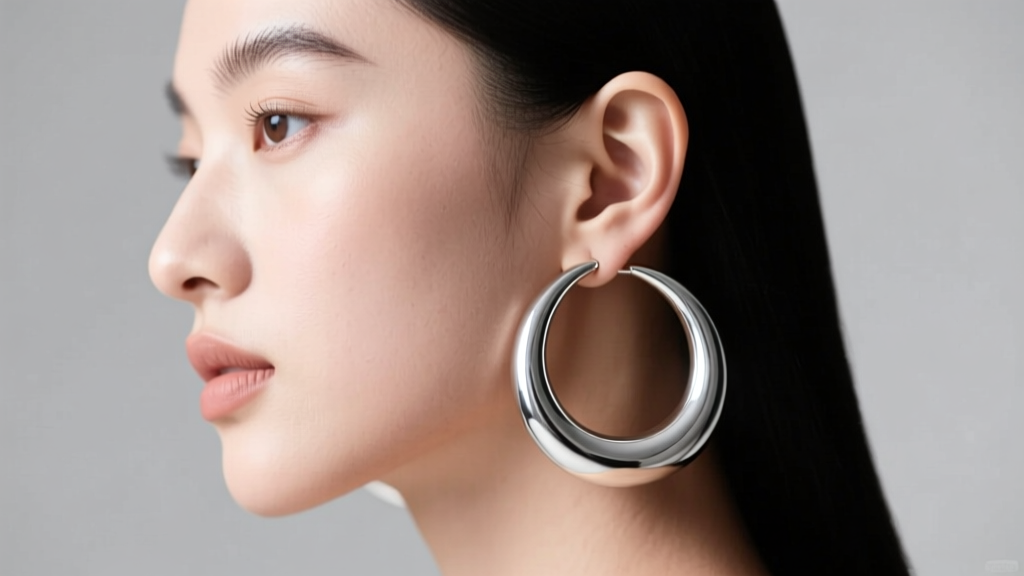
Counterintuitively, a thicker wire gauge is often safer for the earlobe than a thinner one, even if the overall hoop is heavier. This is due to the physics of surface area distribution. An 18-gauge (1.02mm) wire concentrates the downward force vector onto a tiny 1.02mm ridge inside the fistula, creating high pounds-per-square-inch (PSI) pressure that leads to the "cheesecutter effect," slowly slicing through the tissue. Conversely, a 10-gauge (2.58mm) wire distributes that same gravitational force across a surface area 2.5 times larger, drastically reducing the localized PSI. According to guidelines on body jewelry and tissue health from the Association of Professional Piercers, maintaining a wider surface area contact point is crucial for preventing lobe elongation.
Expert Troubleshooting: If you own solid-wire extra large hoops that exceed 15g per earring and are causing lobe fatigue, do not switch to a thinner, lighter wire. Instead, utilize clear silicone O-rings or specialized adhesive earlobe support patches worn behind the ear to distribute the kinetic load across the back of the lobe.
Maintenance and Tarnish Mitigation
Because extra large hoops possess a vast surface area, they are highly visible when tarnish (silver sulfide) begins to form. To combat this, many manufacturers apply a rhodium flash plating. Rhodium, a platinum-group metal, provides a brilliant, untarnishable white-metal finish.
However, rhodium plating on high-friction areas (like the clasp and the wire that passes through the ear) will eventually wear away, revealing the yellowish-grey undertone of the raw 925 alloy beneath. For long-term maintenance of unplated, bare extra large sterling silver hoop earrings, avoid chemical dip cleaners, which can strip the polished surface layer and leave a porous, matte finish that attracts dirt. Instead, use a high-quality micro-abrasive jeweler's cloth impregnated with jeweler's rouge to manually buff the silver, restoring the mirror finish while removing the microscopic layer of oxidized metal.


