Troubleshooting Common Issues With 2 Gram Gold Earrings
Troubleshoot common issues with 2 gram gold earrings. Learn how to fix bent posts, verify authenticity, and prevent lightweight earring damage.

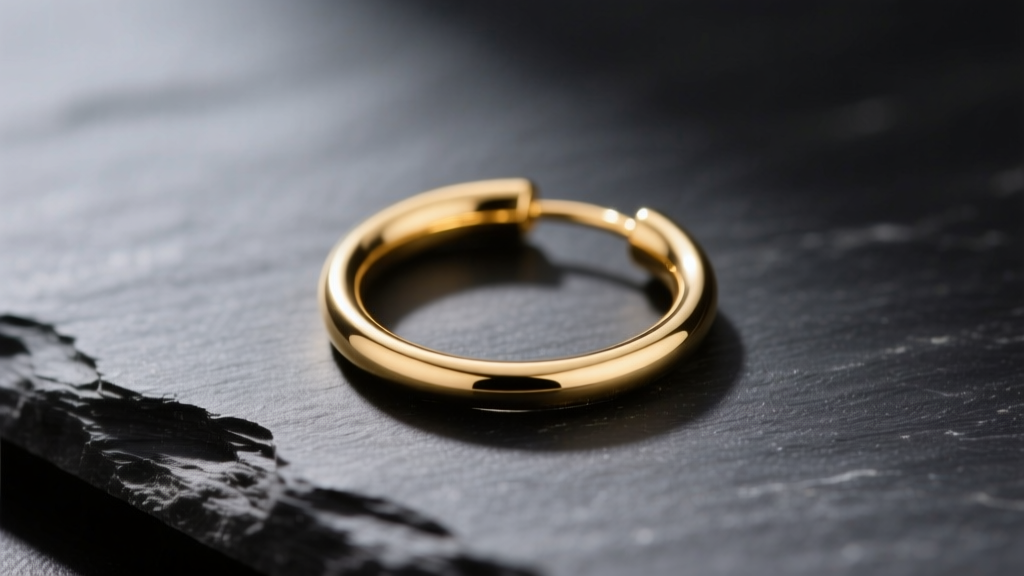
There is an undeniable appeal to lightweight jewelry. 2 gram gold earrings offer a barely-there feel, making them the ultimate choice for 24/7 wear, sleeping, and active lifestyles. However, this extreme reduction in mass introduces a unique set of structural vulnerabilities. When you strip a precious metal down to just two grams, you are no longer just wearing jewelry; you are navigating the strict limits of metallurgy and physics. Whether you are dealing with warped posts, failing clicker hinges, or suspicions about authenticity, troubleshooting lightweight gold requires a highly specific, technical approach. This guide dives deep into the mechanical realities of 2 gram gold earrings and provides actionable, expert-level solutions to keep them in pristine condition.
The Physics of 2 Gram Gold: Why Lightweight Earrings Fail
To troubleshoot effectively, you must first understand the material science at play. Pure 24k gold has a density of 19.32 g/cm³. However, jewelry is rarely pure gold; 14k gold (58.5% gold) has a lower density of approximately 12.9 g/cm³ due to alloying metals like copper, silver, and zinc. Therefore, 2 grams of 14k gold occupies a mere 0.155 cubic centimeters of physical volume.
This tiny volume forces jewelers into two design choices:
- Ultra-thin solid wire: Often drawn down to 22-gauge (0.64mm) or 20-gauge (0.81mm) to create hoops or drops.
- Hollow tubing: Used to create the illusion of a thicker, chunkier hoop while maintaining the 2-gram weight limit.
Hollow tubing is notoriously prone to crushing and denting if squeezed, while ultra-thin solid wire lacks the tensile strength to resist bending when snagged on clothing or hair. Understanding which construction method was used for your specific earring is the first step in diagnosing any structural failure.
Troubleshooting Bent Posts and Warped Hoops
The most frequent complaint with lightweight studs and hoops is deformation. A 20-gauge 14k gold post is highly malleable. If your earring post bends, do not attempt to straighten it with standard steel needle-nose pliers. Steel is significantly harder than 14k or 18k gold and will leave deep, permanent gouges in the metal, creating weak points that will eventually snap.
The Nylon-Jaw Plier Technique
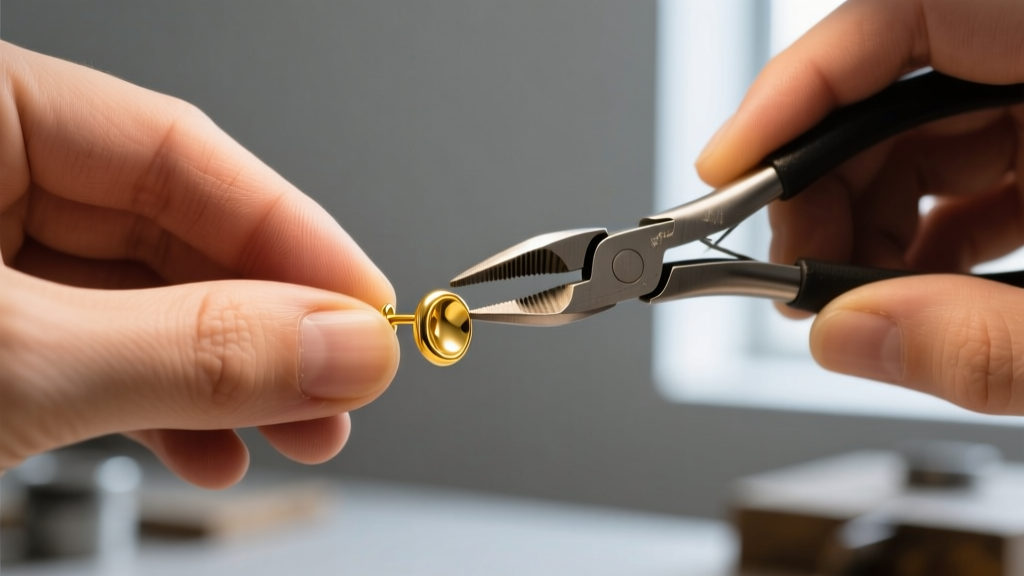
Invest in a pair of nylon-jaw pliers, a staple in any professional jeweler's bench. The soft nylon grips the gold without marring the surface. To straighten a bent post on a 2 gram stud:
- Secure the earring head gently in a soft-jaw vise or hold it firmly with your non-dominant hand using a microfiber cloth for grip.
- Clamp the nylon-jaw pliers at the base of the bend (closest to the earring head).
- Apply slow, steady, and minimal pressure. Gold work-hardens when bent; if you bend it back and forth repeatedly, it will become brittle and snap.
- Use a 10x jeweler's loupe to inspect the post for micro-fractures after straightening.
Clasp Failures on Lightweight Huggies and Hoops
When a huggie or hoop weighs only 2 grams, the clasp mechanism is disproportionately complex relative to the amount of metal available to house it. The hinge and the locking catch require precise tolerances, and thin metal walls often lead to clasp failure.
| Clasp Type | Common Failure Mode | Troubleshooting / Fix |
|---|---|---|
| Hinge & Snap | The thin catch wire bends, preventing a secure 'click'. | Use a burnishing tool to gently push the catch wire back into alignment. Do not pull it. |
| Clicker (Segment) | The internal tension spring loses elasticity or the pin shears. | Unfixable at home. Requires a jeweler to replace the entire clicker segment via laser welding. |
| Endless (Continuous) | The thin wire post deforms and no longer seats tightly in the hollow tube. | Gently twist the wire post to increase its friction fit, or use a tiny drop of clear silicone earring stopper. |
Authenticity Checks: Is Your 2 Gram Earring Solid or Plated?
Because 2 grams is so light, it is a prime target for counterfeiters. Scammers often sell thick gold-plated brass or tungsten cores marketed as 'lightweight solid gold.' Brass has a density of 8.5 g/cm³, meaning a brass earring of the exact same physical dimensions as a 2-gram 14k gold earring will actually weigh closer to 1.3 grams. Conversely, a tungsten core will feel unnaturally heavy.
The Specific Gravity Water Test
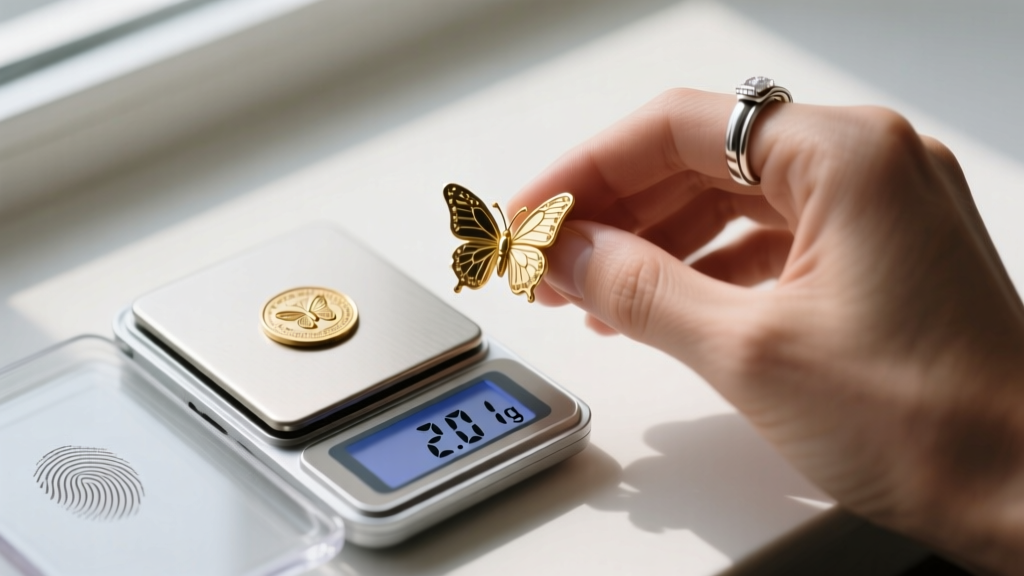
According to the Gemological Institute of America (GIA), verifying gold authenticity without destructive acid testing relies heavily on specific gravity (SG). You can perform a highly accurate SG test at home using a digital milligram scale and a cup of water.
- Weigh the dry earring on the scale (e.g., 2.00 grams).
- Place a small cup of water on the scale and tare it to zero.
- Suspend the earring in the water using a fine silk thread (ensuring it doesn't touch the bottom or sides) and record the submerged weight (e.g., 0.15 grams).
- Divide the dry weight by the submerged weight (2.00 / 0.15 = 13.3).
14k yellow gold has an SG of roughly 12.9 to 13.6 depending on the exact alloy mix. If your result is near 8.5, you have brass. If it is near 19.3, it is 24k gold (or a tungsten fake). This non-destructive test is the gold standard for verifying lightweight pieces.
Preventing Earlobe Sag and Tearing
While 2 grams is objectively light, the distribution of that weight dictates how it interacts with your earlobe. A 2-gram huggie sits flush against the ear, distributing force evenly. A 2-gram drop earring, however, hangs below the lobe, creating a pendulum effect that can slowly stretch the piercing channel over time, especially during sleep or exercise.
The Fix: Ditch standard friction butterfly backs. They offer poor support and allow the earring to droop, shifting the center of gravity forward. Upgrade to La Pousette backs (also known as locking clutch backs). These feature a spring-loaded internal mechanism that grips the post tightly, keeping the 2-gram earring head perfectly flush against the front of the earlobe, neutralizing the lever effect that causes stretching.
When to See a Professional Jeweler
There is a hard limit to what you can troubleshoot at home. If a 20-gauge wire hoop snaps, or a hollow-tube huggie crushes, traditional repair methods will not work. According to jewelry manufacturing experts at Rio Grande, using a traditional butane or oxy-acetylene torch on a 2-gram earring is disastrous. The high thermal conductivity of gold means the heat will instantly travel through the tiny mass, melting the entire piece into a puddle before the solder flows.
Instead, you must seek out a jeweler equipped with a pulsed laser welder. Laser welding concentrates intense heat into a microscopic point (often less than 0.5mm) for a fraction of a millisecond. This allows the jeweler to fuse a broken 22-gauge post back to the earring head without heating the rest of the lightweight metal, preserving the structural integrity and the exact 2-gram weight of your jewelry.
Expert Takeaway: Treat 2 gram gold earrings as precision instruments rather than casual accessories. By utilizing nylon tools, upgrading your earring backs, and relying on laser-welding for repairs, you can ensure your lightweight jewelry survives the rigors of daily wear for decades.


