How to Fix Flip Flop Earrings That Won't Hang Right
Are your summer flip flop earrings hanging backwards or causing irritation? Discover 4 expert troubleshooting fixes for perfect dangle alignment.

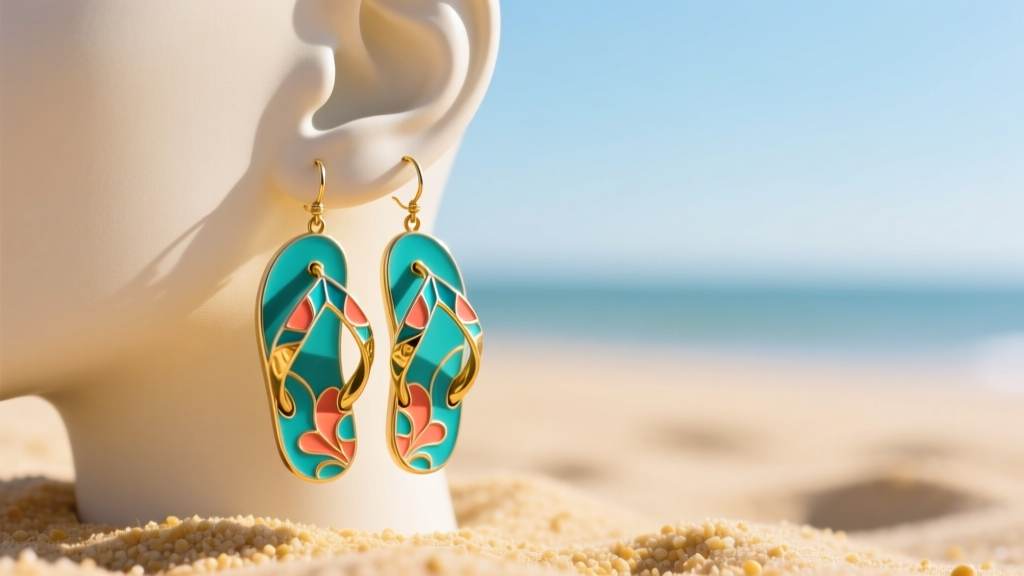
As we navigate the 2026 summer jewelry market, the influx of direct-to-consumer novelty drops has made beach-themed accessories more accessible than ever. However, the charming aesthetic of flip flop earrings often comes with a frustrating reality: they rarely hang the way they do in the product photos. Instead of laying flat and facing forward, these elongated charms frequently flip backward, twist sideways, or drag the earlobe down into an uncomfortable sag.
Troubleshooting novelty drop earrings requires a basic understanding of jewelry physics, material science, and anatomical load distribution. Whether you are dealing with cheap base-metal alloys causing contact dermatitis or top-heavy enamel charms that refuse to articulate properly, this guide provides professional-grade solutions to salvage your favorite summer pair.
The Physics of the Forward Flop
To understand why flip flop earrings fail to hang correctly, we must look at their center of mass. A standard flip flop charm is an elongated oval with a dense 'thong' strap attachment at the top third. If the manufacturer drilled the jump ring hole too low—below the charm's true center of gravity—the bottom-heavy weight will cause the charm to flip upside down or backward against the earlobe.
Furthermore, articulation plays a massive role. If the earring's fishhook wire is 20-gauge but the charm's loop is only 22-gauge, the wire binds inside the loop. This lack of rotational freedom freezes the charm in whatever position it was placed, usually facing the wrong way. Below is a diagnostic matrix to help you identify your specific hardware failure.
Troubleshooting Matrix: Common Flip Flop Earring Failures
| Symptom | Root Cause | Hardware Fix |
|---|---|---|
| Charm hangs backward or upside down | Off-center drill hole; stiff single jump ring | Install a double-jump ring universal joint |
| Green skin or itchy red rash | Copper oxidation or nickel leaching from zinc alloy | Isolate post with polyurethane or swap to titanium |
| Earlobe sagging or piercing stretch | Heavy enamel/resin exceeding 5g on a 22g wire | Use silicone O-ring support patches |
| Hair snagging on the strap | Micro-burrs from cheap rubber mold casting | Seal with UV resin or sand with 600-grit pad |
Fix 1: Correcting the Center of Gravity
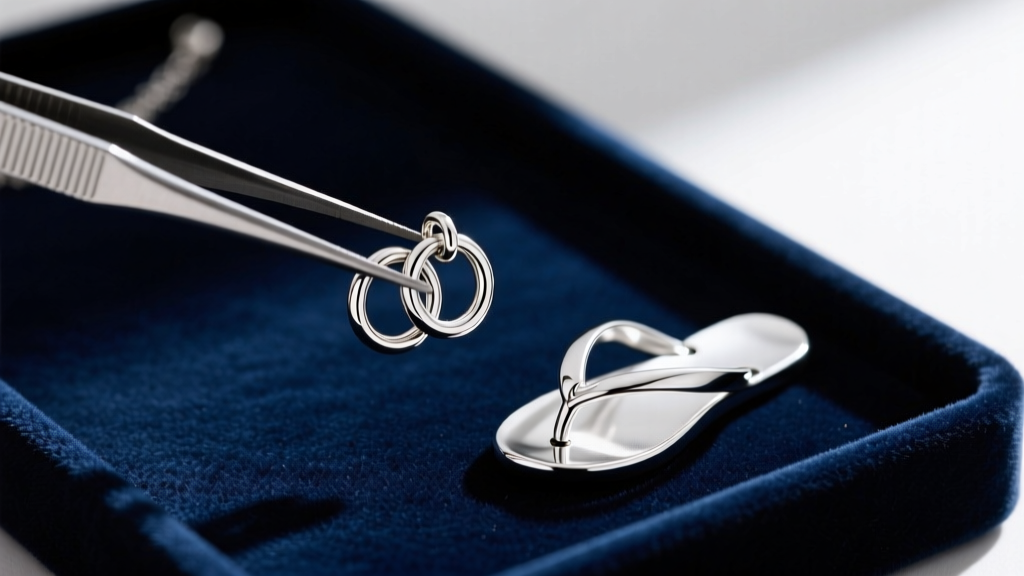
If your flip flop charms are perpetually facing backward, you need to introduce a secondary pivot point. This is known in professional jewelry fabrication as creating a universal joint. By using two interlocking jump rings instead of one, you allow the charm to rotate freely on both the X and Y axes, forcing gravity to pull the heaviest part (the sole of the flip flop) straight down.
Step-by-Step Universal Joint Assembly
- Source the correct findings: Purchase 4mm outer diameter (OD) jump rings made from 22-gauge dead-soft wire. According to Rio Grande, a 4mm ring provides enough interior clearance for a standard 20-gauge fishhook to move without binding.
- Open the rings laterally: Use two pairs of flat-nose pliers to twist the jump rings open side-to-side. Never pull them apart outward, as this warps the circle and ruins the flush closure.
- Link and close: Thread one jump ring through the hole of the flip flop charm. Thread the second jump ring through the first one, and then through the loop of your earring wire. Close both rings flush.
This dual-ring setup eliminates the rigid tension that causes the 'backward flop,' allowing the earring to swing naturally and face forward regardless of how your ear is angled.
Fix 2: Eradicating Base Metal Contact Dermatitis
Novelty summer jewelry is notorious for utilizing 'mystery metals'—typically brass or zinc alloys plated with a microscopically thin flash of silver or gold. When exposed to summer humidity and sweat, these alloys trigger severe reactions. The American Academy of Dermatology notes that nickel is one of the most common causes of allergic contact dermatitis, resulting in weeping, itchy piercings.
If your flip flop earrings are causing the dreaded 'green ear' (a harmless but unsightly copper oxidation reaction) or an itchy rash, you have two troubleshooting paths:
The Temporary Barrier Method
For a quick fix before a beach vacation, coat the entire earring post and the back of the charm with two layers of clear, hard-drying polyurethane nail polish. This creates a physical barrier between the base metal and your skin. Reapply every 4 to 5 wears, as the friction of insertion will eventually wear the coating down.
The Permanent Titanium Swap
For a permanent solution, use a flush cutter to snip off the base metal post entirely. You can then use 20-gauge implant-grade titanium wire (meeting the ASTM F136 standard) to wire-wrap a new, hypoallergenic post directly onto the charm's top loop. Titanium is completely inert and will never react with sweat or bodily fluids, making it the ultimate fix for sensitized summer lobes.
Fix 3: Stabilizing Heavy Enameled Charms
While they look lightweight, solid alloy or heavily enameled resin flip flop charms can weigh anywhere from 4 to 8 grams each. A standard earlobe piercing is designed to support roughly 2 to 3 grams of continuous weight. When a 6-gram charm pulls on a 20-gauge wire, the sheer force concentrates entirely on the 1mm diameter of your piercing hole, leading to micro-tears, inflammation, and eventual lobe sagging.
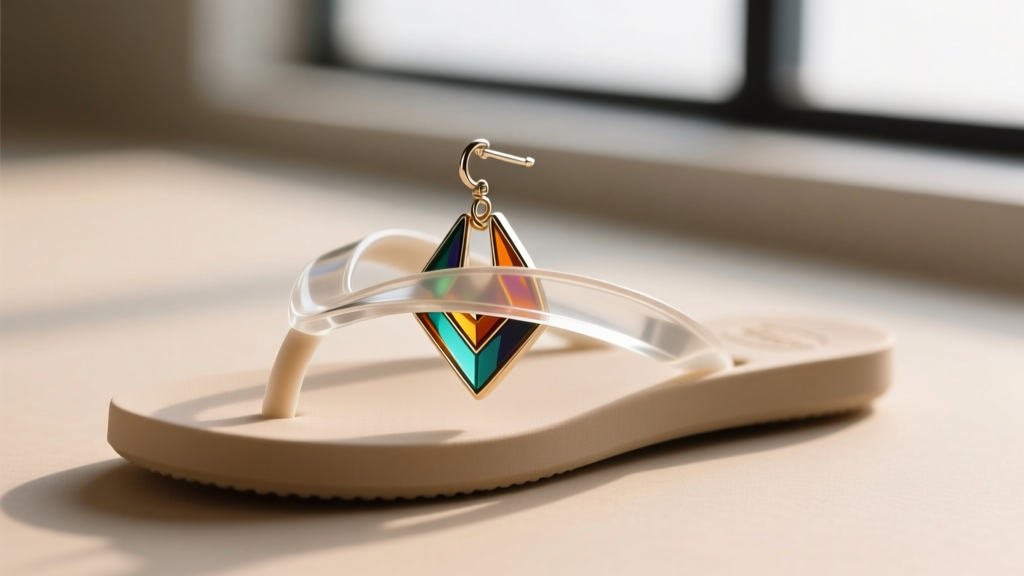
To troubleshoot this without giving up your favorite earrings, you must increase the surface area of the load distribution. Purchase medical-grade silicone earring support patches (often sold under brand names like Lobe Wonder or Blomdahl). These adhesive discs feature a central slit that slides over the earring post behind your earlobe.
By spreading the downward drag of the heavy flip flop charm across a 12mm diameter pad, the pressure on the actual piercing channel is reduced by over 80%. This allows you to wear top-heavy novelty drops all day at the boardwalk without experiencing the sharp, stinging pain of a stretched piercing.
Fix 4: Deburring the Thong Strap
A highly specific annoyance with cast-metal or molded-resin flip flop earrings is the 'thong' strap detail. Because these charms are mass-produced using rubber molds or die-casting, the intersection where the strap meets the sole often retains micro-burrs or sharp flashing. These tiny, jagged edges act like velcro, catching and snapping your hair whenever you turn your head.
To solve this snagging issue, do not attempt to file the metal, as you will strip the plating and expose the reactive base metal underneath. Instead, use a jewelry-grade UV resin. Apply a microscopic drop of clear UV resin over the strap intersections and cure it with a 36W UV lamp for 60 seconds. This encapsulates the sharp burrs in a smooth, glass-like dome of hardened resin, completely eliminating hair snags while preserving the visual detail of the charm.
Summary
Troubleshooting flip flop earrings is entirely about managing physics and material interactions. By upgrading your jump rings for better articulation, isolating reactive base metals, and distributing the weight of heavy enamel charms, you can transform cheap, frustrating novelty jewelry into comfortable, perfectly hanging summer staples. Always prioritize ASTM-certified titanium for sensitized piercings, and never underestimate the power of a silicone support patch for keeping your lobes healthy and pain-free.