Air Force Earring Regs: Technical Guide to DAFMAN 36-2909
Master Air Force earring regs with our technical deep dive into DAFMAN 36-2909. Exact dimensions, gauge limits, and material rules for Airmen.


Navigating Air Force Earring Regs: A Technical Deep Dive
For United States Air Force Airmen and Space Force Guardians, personal appearance is not merely a matter of style—it is a strict adherence to military discipline and uniformity. When it comes to air force earring regs, the governing document is DAFMAN 36-2909 (Dress and Personal Appearance of United States Air Force and United States Space Force Personnel), which replaced the legacy AFI 36-2903. Understanding the exact metallurgical, dimensional, and tactical requirements of this manual is critical for maintaining compliance while ensuring ear health and comfort during active duty.
In this expert guide, we break down the precise tolerances, acceptable gauge sizes, material grades, and tactical considerations for wearing earrings in a military environment in 2026. Whether you are a cadet at USAFA, an active-duty officer, or an enlisted Airman preparing for deployment, this technical synthesis will keep you squarely within regulations.
The Core Framework: DAFMAN 36-2909 Explained
The foundational rule of military jewelry is jurisdiction. Air Force earring regs apply strictly when you are in uniform, on a military installation, or representing the Department of the Air Force in an official capacity. Off-base and out of uniform, standard civilian liberties apply, though extreme modifications that violate the "conservative and faddish" clauses can still draw scrutiny from commanders under the broader personal appearance umbrella.
According to the official DAFMAN 36-2909 e-Publishing index, the regulations are explicitly binary based on gender presentation as defined by military records, with zero tolerance for ambiguity in uniform.
Gender-Specific Technical Specifications
The most common compliance failures occur when Airmen misunderstand the stark contrast between male and female regulations. Below is the technical breakdown of what is authorized in uniform.
| Specification | Male Airmen / Guardians | Female Airmen / Guardians |
|---|---|---|
| Authorization | Strictly Prohibited | Authorized (Conservative) |
| Maximum Dimension | N/A | 6mm (approx. 1/4 inch) diameter |
| Placement | N/A | One per earlobe, centered |
| Allowed Shapes | N/A | Spherical (Studs/Balls) |
| Cartilage/Helix | Prohibited | Prohibited in Uniform |
Note: Male Airmen are not permitted to wear earrings while in PT gear, OCPs, or service dress, even if they are off-duty but physically located on a military installation.
Material, Gauge, and Dimensional Tolerances
For female Airmen, the manual specifies that earrings must be "plain, conservative, and fit tightly against the earlobe." But what does this mean from a jewelry manufacturing perspective?
Acceptable Alloys and Gemstones
DAFMAN 36-2909 explicitly limits visible materials to white diamond, gold, white pearl, or silver. Colored gemstones (sapphires, rubies, emeralds), rose gold, and matte black metals are unauthorized in uniform. However, the regulation dictates the visible aesthetic. Many Airmen suffer from contact dermatitis caused by the nickel content in standard commercial silver or low-karat gold posts.
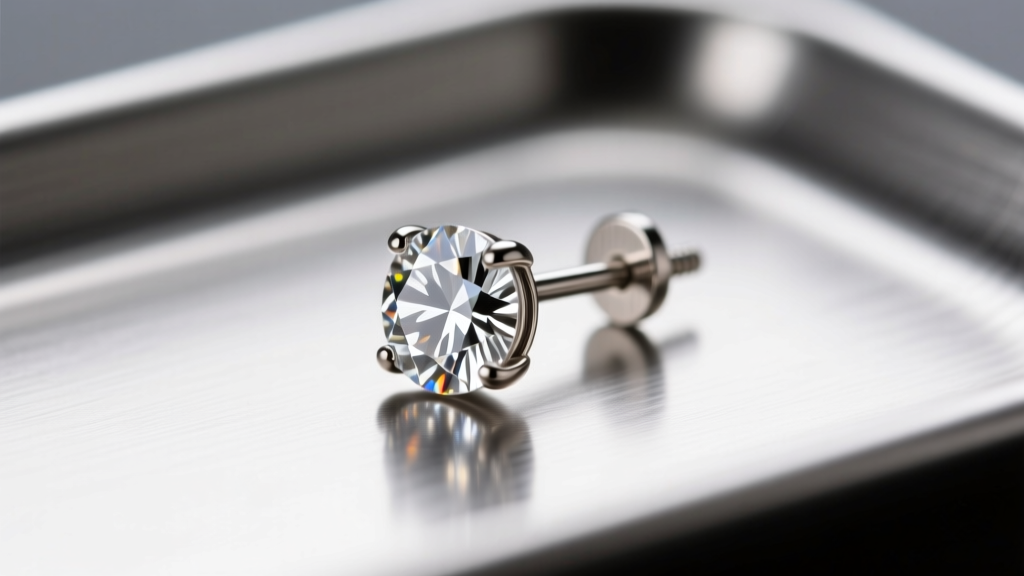
Expert Workaround: You can utilize an implant-grade titanium post (ASTM F136) for the part that passes through the fistula (the piercing hole), provided the visible front-facing end is a compliant 6mm gold, silver, pearl, or diamond sphere. Threadless or internally threaded flat-back labrets are highly recommended over standard butterfly-clutch posts, as they eliminate the sharp post-tips that can dig into the neck when wearing a helmet or resting on a high OCP collar.
Gauge and Stretching Limitations
Standard military-compliant earrings utilize a 20-gauge (0.81mm) or 18-gauge (1.02mm) post. The Air Force strictly prohibits "faddish" styles, which includes stretched earlobes (gauging). If an Airman has previously stretched their lobes to 8-gauge (3.2mm) or 00-gauge (10mm), they must allow the tissue to close. Wearing skin-toned silicone retainers to hide the hole is a gray area; if the retainer is visible or protrudes, it violates the "conservative and tightly fitted" clause. For further guidance on Air Force appearance standards, always consult your local First Sergeant or Inspector General.
Tactical and Deployment Considerations
When deploying or participating in field exercises, jewelry becomes a safety hazard. While DAFMAN 36-2909 allows female Airmen to wear 6mm studs in OCPs, tactical commanders retain the authority to restrict all jewelry for safety reasons (e.g., when wearing advanced combat helmets, CBRN masks, or aviation headsets).
- Snag Hazards: Butterfly clutches can easily snag on the loop-pile fabric of OCP uniform collars or tactical vests.
- CBRN Mask Seals: While earlobe studs do not interfere with the protective mask seal (unlike facial piercings), large or poorly fitted earrings can cause pressure sores when helmet straps are tightened over the ears.
- Flat-Back Superiority: Transitioning to a 6mm push-in or internally threaded flat-back stud ensures the jewelry sits completely flush against the earlobe, eliminating the rear-post protrusion entirely.

Off-Duty, PT Gear, and Cadet Caveats
Air Force earring regs extend to Physical Training (PT) gear and cadet environments with specific nuances:
- PT Gear: Female Airmen may wear their authorized 6mm studs during PT. Hoops, dangles, and huggies are strictly prohibited due to the risk of avulsion injuries (ear tearing) during high-intensity interval training or running.
- ROTC and USAFA Cadets: Cadets are held to even stricter interpretations of DAFMAN 36-2909. Female cadets must ensure their pearls or diamonds do not exceed the 6mm limit, as cadre frequently utilize calipers during uniform inspections to verify dimensional compliance.
- Medical Exemptions: If a piercing becomes infected or rejects, Airmen must seek medical treatment at the MTF (Medical Treatment Facility). You are not authorized to wear "flesh-toned bandaids" or non-compliant plastic spacers over the jewelry to hide it in uniform. The jewelry must be removed until the ear heals.
Compliance Checklist for Airmen and Guardians
Before stepping onto the installation or into formation, run through this rapid technical checklist to ensure your earrings meet all air force earring regs:
- [ ] Diameter: Is the visible surface area 6mm (1/4 inch) or smaller?
- [ ] Material: Is the visible color strictly gold, silver, white pearl, or white diamond?
- [ ] Shape: Is it a spherical stud? (No hoops, no teardrops, no geometric shapes).
- [ ] Placement: Is it centered on the lower earlobe, with only one earring per ear?
- [ ] Profile: Does it sit flush against the skin without protruding excessively on the back?
"Compliance with DAFMAN 36-2909 is not just about avoiding a reprimand; it is about maintaining the standardized, professional lethality expected of the world's most advanced aerospace force. When in doubt, opt for a 4mm to 5mm flush-fit stud to guarantee you remain well within the 6mm absolute maximum."
By understanding the exact material grades, gauge tolerances, and tactical limitations outlined in the DAFMAN, Airmen and Guardians can navigate military jewelry regulations with absolute confidence and technical precision.


