Troubleshooting Multiple Hoop Earrings: Spacing, Snags & Healing
Solve common issues with multiple hoop earrings. Learn expert troubleshooting for spacing, snagging, healing, and gauge sizing for a flawless ear.

The Geometry of Spacing: Why Your Piercings Clash
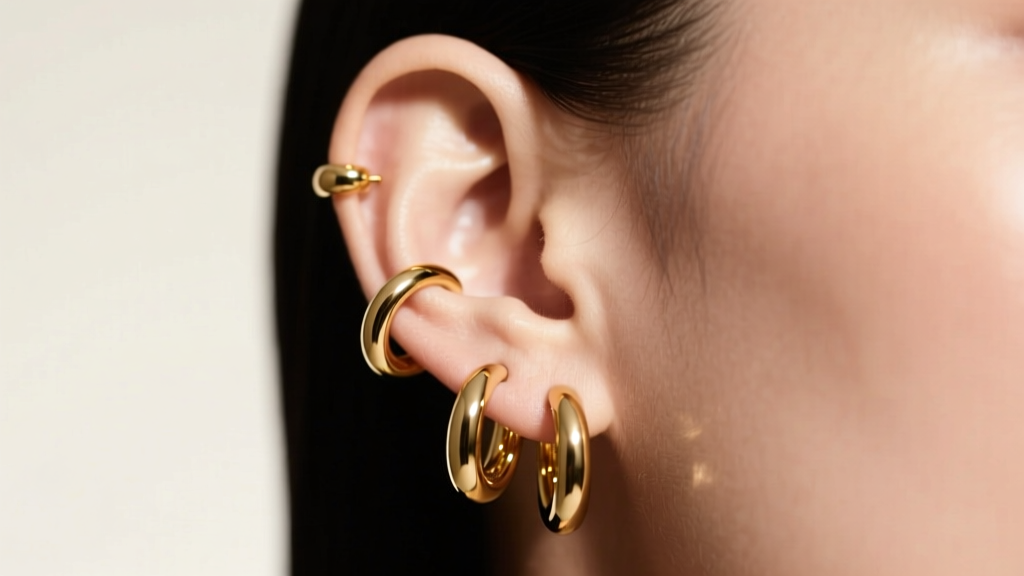
Curating a constellation of piercings is an art form, but when you introduce multiple hoop earrings into the mix, poor spacing quickly transforms a sleek aesthetic into a cluttered, tangled mess. The most frequent troubleshooting issue we see at Jewel Style Radar is physical interference between adjacent hoops. When piercings are placed too closely together, the outer diameter (OD) of the hoops overlap, causing friction, metal-on-metal scratching, and chronic irritation.
To solve this, you must understand the difference between wire thickness (gauge) and inner diameter (ID). A standard 8mm ID hoop made from 16-gauge wire actually has an outer footprint of nearly 11mm. Therefore, the absolute minimum distance between the center of two adjacent piercings must be at least 8mm for standard lobes and 6mm to 7mm for dense cartilage clusters like the helix or conch. If your piercer placed your holes only 4mm apart, you cannot comfortably wear multiple hoop earrings in those specific holes simultaneously. The troubleshooting fix here is strategic swapping: wear a hoop in the primary lobe piercing, and opt for low-profile threadless studs or flat-back labrets in the secondary and tertiary holes to maintain visual flow without the physical clash.
Troubleshooting Snags, Catches, and Tangled Hair
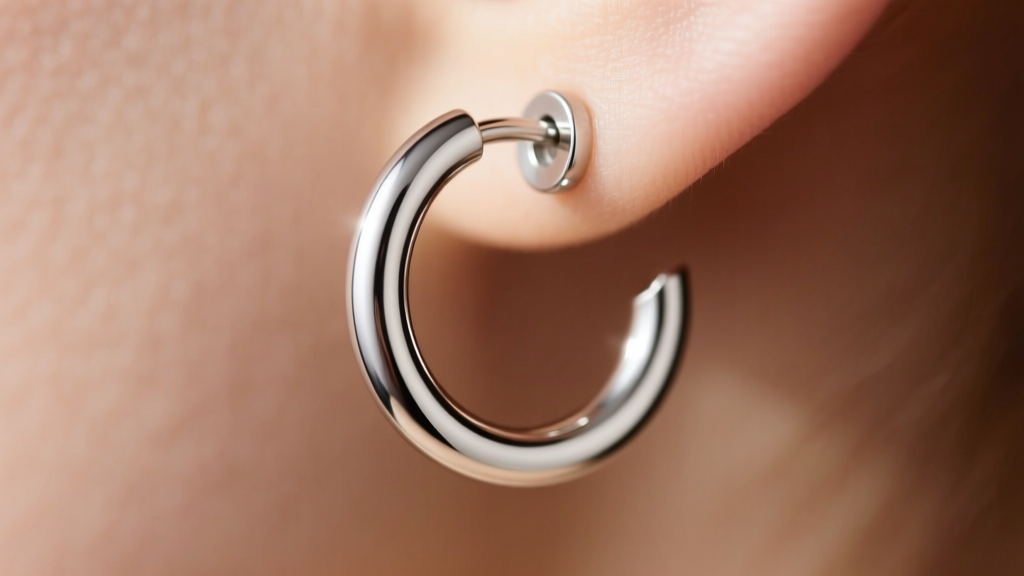
Nothing ruins the experience of wearing multiple hoop earrings faster than waking up with three of them hopelessly tangled in your hair or catching on a knit sweater. The root cause of this issue almost always traces back to the closure mechanism of the jewelry. If you are wearing hinged snap-clickers or segment rings with visible seams, you are practically inviting snags.
The Closure Hierarchy for Snag Prevention
- Continuous (Seamless) Rings: The ultimate solution for snagging. These hoops have no hinge or clasp; the wire slides seamlessly into a hollow tube. They are virtually undetectable to hair and clothing. The trade-off? They require ring-opening pliers to insert and remove, making them a poor choice if you frequently swap your jewelry.
- Segment Rings: Featuring a removable O-ring or segment that clicks into place. While smoother than hinged clickers, the microscopic gap where the segment meets the ring can still catch fine, freshly washed hair. Applying a tiny dab of clear, skin-safe nail polish over the seam (only on fully healed piercings) can temporarily seal the snag point.
- Hinged Clickers: Excellent for ease of use, but the hinge barrel creates a raised bump. If you must use clickers for your multiple hoop earrings, reserve them for the lower lobe where hair naturally falls behind the ear, and avoid them in the upper helix or tragus where hair sweeps directly over the jewelry.
For sleep-related tangles, the only true troubleshooting method is switching to sleep-safe flat-back studs at night, or investing in a specialized silk piercing pillow with a central ear hole to eliminate friction entirely.
Solving Heavy Earlobe Syndrome and Migration Risks
When you stack multiple hoop earrings, particularly in the lower lobe, the cumulative weight can lead to a condition colloquially known as "heavy ear syndrome." Over time, the constant downward drag stretches the fistula (the piercing channel), causing the holes to migrate downward, thin the tissue, and eventually tear. This is especially prevalent when wearers use thick 14-gauge or 12-gauge hoops with large 15mm+ diameters in standard lobe piercings.
| Piercing Location | Ideal Gauge | Max Inner Diameter (ID) | Weight Limit per Earring |
|---|---|---|---|
| Standard Lobe (Hole 1) | 18g or 16g | 12mm - 15mm | Under 4 grams |
| Upper Lobe (Hole 2 & 3) | 18g or 16g | 6mm - 8mm (Huggies) | Under 2 grams |
| Helix / Flat | 16g | 6mm - 8mm | Under 2.5 grams |
| Conch | 16g or 14g | 10mm - 14mm | Under 5 grams |
To troubleshoot an already stretched lower lobe, remove heavy hoops immediately and switch to ultra-lightweight 18-gauge titanium huggies or threadless studs for a minimum of 3 to 6 months to allow the tissue to contract and firm up. If the migration is severe, you may require a minor surgical repair by a dermatologist before re-piercing.
Eradicating Irritation Bumps and Contact Dermatitis
Managing multiple healing piercings simultaneously is a biological tightrope. The introduction of multiple hoop earrings often triggers a cascade of irritation bumps (hypertrophic scarring) or contact dermatitis. Unlike flat-back studs, hoops rotate constantly within the fistula. This rotation introduces dried lymph, bacteria, and external debris directly into the healing wound, delaying the maturation of the fistula and causing localized swelling.
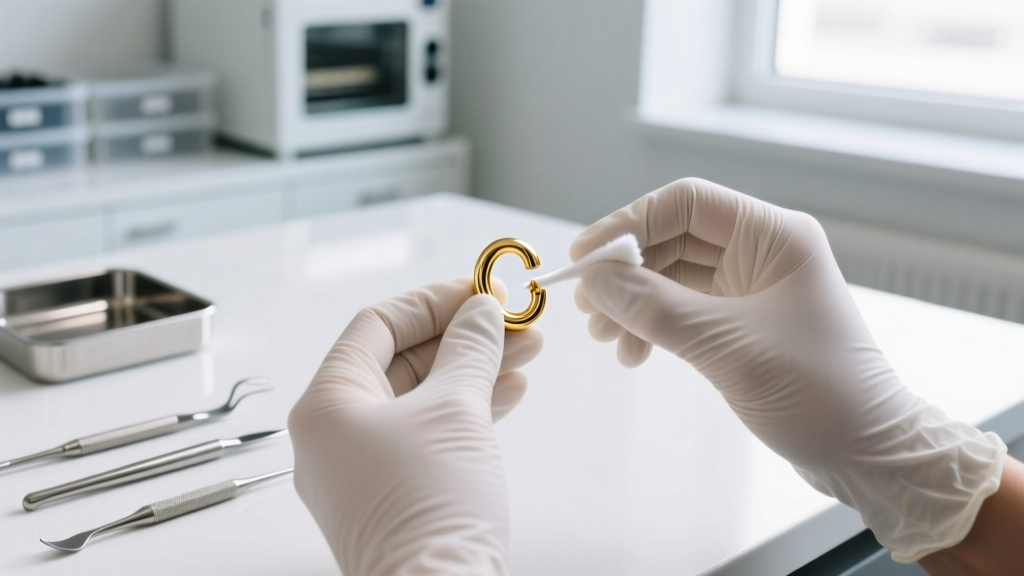
Furthermore, metal allergies are a massive culprit. According to the Mayo Clinic, nickel is the most common cause of contact dermatitis, and many commercial "surgical steel" hoops contain up to 10% nickel. When you multiply the surface area of metal touching your skin by wearing four or five hoops, you exponentially increase your allergic load.
The Material Troubleshooting Protocol
If you are experiencing redness, weeping, or persistent bumps across multiple piercings, execute the following protocol:
- Audit Your Metals: Remove all mystery metals, plated brass, and standard surgical steel. The Association of Professional Piercers (APP) strictly recommends only ASTM F136 implant-grade titanium, niobium, or 14k/18k solid, nickel-free gold for healing and sensitive ears.
- Downsize and Stabilize: Swap the rotating hoops for internally threaded or threadless flat-back labrets. Stabilizing the jewelry stops the mechanical irritation caused by the hoop spinning.
- Sterile Saline Only: Cease all use of tea tree oil, alcohol, or harsh soaps. Spray a sterile 0.9% sodium chloride wound wash twice daily and let it air dry.
Expert Insight: If you are committed to the hoop look during the healing phase of a cartilage piercing, consider a "captive bead ring" (CBR) sized perfectly to the swelling by a professional piercer. CBRs rotate less freely than seamless rings and hold their shape better under the pressure of cartilage swelling.
Visual Weight: Troubleshooting Aesthetic Clutter
Beyond the physical mechanics, styling multiple hoop earrings presents a visual troubleshooting challenge. An ear adorned entirely in identical, medium-sized gold hoops often looks monotonous and heavy, lacking a focal point. The human eye is drawn to contrast and asymmetry.
To fix a cluttered aesthetic, apply the "Rule of Odds" and vary your textures. If you have three lobe piercings, anchor the bottom with a slightly larger, textured or beaded hoop (such as a twisted rope design or a diamond-pave huggie). Follow it with a medium, smooth, polished hoop in the second hole, and finish with a tiny, delicate seamless ring or a stud in the third hole. This creates a cascading gradient that guides the eye upward toward the cartilage. Brands like BVLA and Maria Tash excel at offering varied hoop profiles—from diamond-set clickers to matte-finished titanium rings—allowing you to mix metallic finishes and gemstone accents without overwhelming the natural geometry of your ear. By balancing visual weight with mechanical precision, your curated ear will remain as comfortable as it is captivating.


