Triple Earrings Troubleshooting: Fix Snags and Tangles
Struggling with tangled chains, hair snags, or heavy triple earrings? Discover expert troubleshooting tips for triple drops, cuffs, and connectors.


The Mechanical Failures of Triple Earrings
Triple earrings—whether they are chain-linked lobe sets, triple-drop dangles, or single-piece illusion cuffs designed to mimic three distinct piercings—offer a high-impact, curated aesthetic. However, from a bench jeweler’s perspective, they are notorious for mechanical failures. The very geometry that makes triple earrings visually striking also creates structural vulnerabilities. When you connect multiple points of articulation or span across uneven cartilage angles, you introduce friction, leverage imbalances, and snag points.
If your triple earrings are constantly tangling in your hair, pulling uncomfortably on your lobes, or irritating your cartilage, the issue is rarely your anatomy. It is almost always a flaw in the jewelry’s engineering. Below, we break down the exact physics behind these failures and provide actionable, professional-grade troubleshooting solutions to salvage your favorite pieces.
Diagnosing the Tangle: Chain Link Geometry
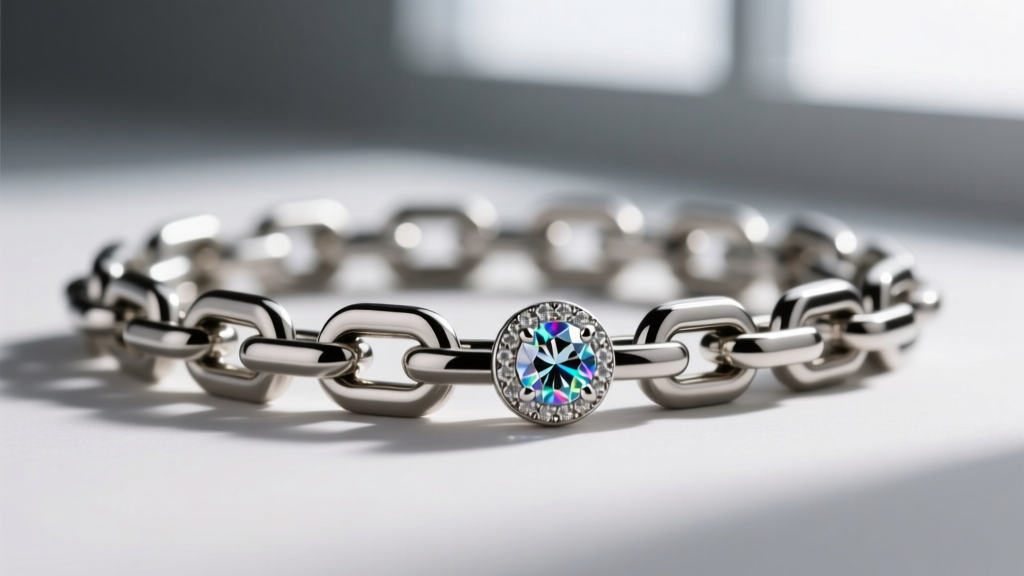
The most common complaint with chain-linked triple earring sets is relentless tangling. This occurs when the chain’s link geometry allows adjacent links to fold in on themselves or catch on the jump rings connecting the three earring components.
The Snake Chain Problem
Many mass-market triple sets use snake chains because they are inexpensive to produce and offer a sleek, liquid-metal look. However, snake chains are essentially smooth, tightly wound coils. They act like microscopic hooks that catch on individual hair strands and easily fold into tight, nearly impossible-to-untangle knots.
The Solution: Upgrade to Box or Curb Chains
To eliminate tangling, you must change the link profile. Box chains feature flat, 90-degree interlocking links that physically cannot fold back on themselves past a certain radius. Curb chains lay flat and possess a wider surface area that resists twisting. If you are having a bench jeweler repair or rebuild your triple set, request an 18-gauge or 16-gauge box chain. The thicker wire gauge adds just enough rigidity to prevent the chain from collapsing into a knot.
Jump Ring Aspect Ratios
Tangles often originate at the connection points. If the inner diameter (ID) of the jump ring connecting your triple drops is too large relative to the wire thickness, the chain will slip through and knot. The golden rule in chainmaille and jewelry engineering is the Aspect Ratio (AR). For triple earring connectors, the jump ring ID should be no more than 3.5 times the wire thickness. If your jeweler uses 20-gauge wire (0.81mm), the jump ring ID should not exceed 2.8mm.
Solving Hair Snags in Triple Drop Earrings
Triple drop earrings rely on vertical articulation, meaning they swing freely with head movement. This pendulum effect turns poorly finished settings into hair-catching magnets.
- Claw Prongs: Standard claw prongs, especially on lower-tier commercial jewelry, often have microscopic burrs or sharp tips that act like Velcro for hair.
- The Bezel Alternative: Whenever possible, opt for triple drops featuring bezel settings or flush mounts. A bezel setting encircles the gemstone with a smooth, continuous rim of metal, eliminating all protruding edges.
- Tiffany vs. V-Prongs: If you prefer the light-optimizing properties of prongs, ensure your jeweler uses polished Tiffany-style round prongs rather than V-prongs, which feature sharp corners that easily snag knitwear and hair.
Weight Distribution and Lobe Fatigue
Triple earrings concentrate mass. Whether it is a heavy triple-hoop illusion piece or a three-stone diamond drop, the cumulative weight pulls downward. Over time, this leverage causes lobe fatigue, stretching the piercing channel and leading to the dreaded "cheese-cutter" effect, where the earring slowly migrates downward through the tissue.
Material Density Comparison
Not all metals weigh the same. Swapping the base material of your triple earrings can reduce the gravitational pull on your lobes by up to 45% without changing the visual size of the jewelry.
| Metal / Alloy | Density (g/cm³) | Weight Impact on Lobe | Best Application for Triple Sets |
|---|---|---|---|
| 316L Surgical Steel | 8.00 | High (Causes fatigue in large hoops) | Small, tight triple huggies |
| 14k Yellow Gold | 13.90 | Very High (Requires lobe support) | Petite triple bezel drops |
| ASTM F136 Titanium | 4.43 | Low (Ideal for oversized triples) | Large illusion cuffs, long chains |
| Niobium | 8.57 | Medium | Anodized triple cartilage hoops |
Troubleshooting Fix: If your gold or steel triple earrings are stretching your lobes, apply medical-grade silicone earring support patches (like Lobe Wonder) to the back of the ear. These patches distribute the downward shear force across a wider surface area of the lobe, neutralizing the leverage.
Cartilage Tension in Triple Illusion Cuffs
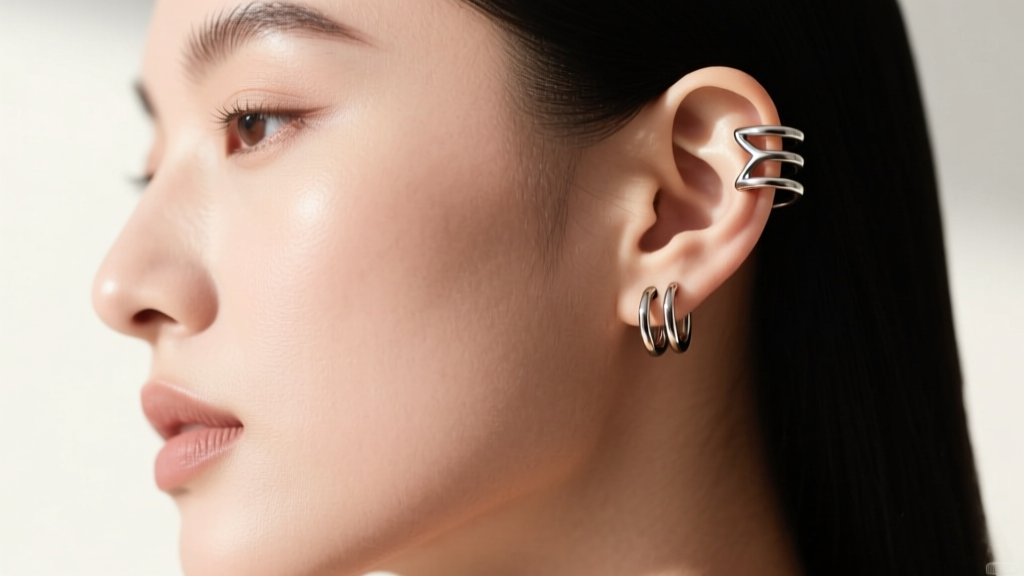
Single-piece triple illusion cuffs that span across the helix or conch are incredibly popular, but they frequently cause cartilage irritation bumps. This is rarely an allergy; it is an angle mismatch.
Human cartilage is asymmetrical. A rigid, straight triple-bar cuff forces the metal to sit at an angle that contradicts the natural slope of your ear. This creates constant, low-grade pressure on the piercing channels, leading to inflammation. According to the Association of Professional Piercers (APP), jewelry must follow the exact angle of the piercing channel to heal and rest properly.
The Fix: Custom Bending and Tension Wire
If you are buying off-the-shelf triple cuffs, look for brands that use flexible tension wire (often a specialized titanium alloy that can be gently molded to the ear's contour). For rigid metals like 14k gold or platinum, take the piece to a master bench jeweler. They can use a mandrel and nylon-jaw pliers to custom-bend the connector bar to match your specific ear topology, eliminating the pressure points that cause cartilage bumps.
Metal Allergies and Surface Area Exposure
Because triple earrings cover more physical real estate on the ear, they increase the total surface area of metal touching your skin. If you have a mild, sub-clinical nickel sensitivity, a single 20-gauge stud might not trigger a reaction, but a triple-hoop set spanning three inches of cartilage will.
The American Academy of Dermatology notes that prolonged contact with nickel-releasing alloys is the primary driver of contact dermatitis in jewelry wearers. Furthermore, the Gemological Institute of America (GIA) warns that even some lower-karat gold alloys and white golds (which are often rhodium-plated over nickel-heavy bases) can leach allergens as the plating wears off.
The Protocol: For any triple earring setup, strictly limit your materials to ASTM F136 Implant-Grade Titanium, Niobium, or nickel-free 14k/18k gold. Avoid "surgical steel" for triple sets, as the 8-10% nickel content in 316L steel is highly problematic when spread across multiple piercings.
Quick-Reference Troubleshooting Matrix
Use this diagnostic matrix to quickly identify and resolve the most common triple earring failures:
- Problem: Chain links knotting tightly at the jump rings.
Root Cause: Jump ring Inner Diameter (ID) is too wide.
Fix: Have a jeweler solder the jump rings shut or replace them with a lower Aspect Ratio (AR < 3.5). - Problem: Hair catching on the gemstone settings.
Root Cause: Unpolished claw prongs or V-prongs.
Fix: Upgrade to bezel settings, or have a jeweler file and polish the prong tips to a smooth Tiffany profile. - Problem: Redness and bumps on the middle cartilage piercing.
Root Cause: Rigid bar angle mismatch causing shear stress.
Fix: Custom-bend the connector bar on a mandrel, or switch to a flexible titanium tension-wire design. - Problem: Bottom lobe piercing stretching or migrating.
Root Cause: Cumulative weight and downward leverage.
Fix: Switch to hollow-core tubing or ASTM F136 Titanium, and use silicone lobe support patches.
By treating your triple earrings not just as accessories, but as mechanical systems that interact with human anatomy, you can eliminate the daily frustrations of tangling, snagging, and irritation. Invest in proper link geometry, respect the weight-to-density ratios of your metals, and ensure your jewelry follows the natural architecture of your ear.


