How to Fix Triangle Stud Earrings That Won't Sit Flat
Struggling with drooping or spinning triangle stud earrings? Learn expert troubleshooting tips for post alignment, backings, and lobe support.

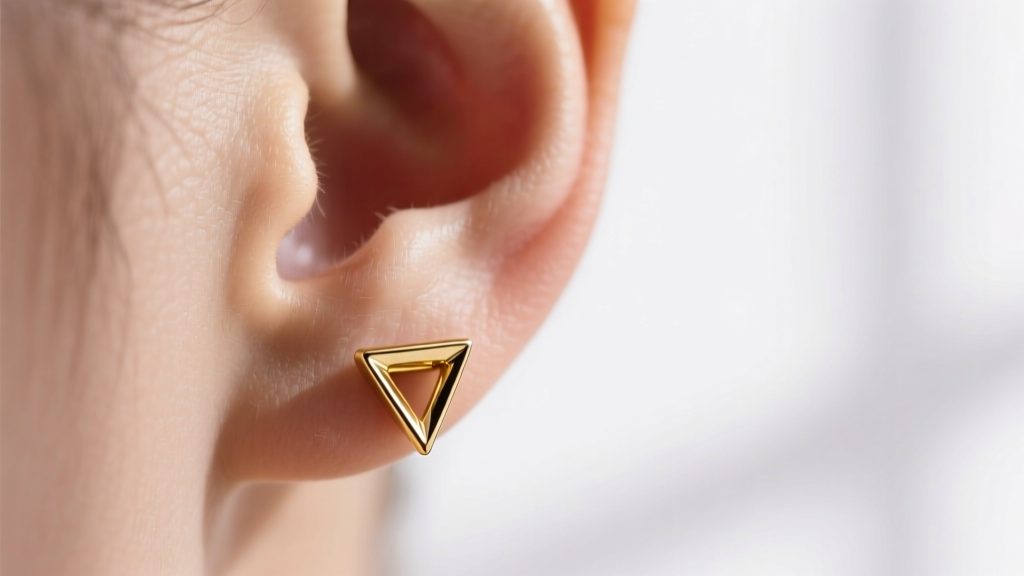
Geometric jewelry has dominated trend forecasts through 2026, but few shapes present as many structural headaches as the triangle. Whether you prefer a minimalist equilateral design or an elongated isosceles drop, triangle stud earrings are notoriously prone to spinning, drooping forward, or sitting awkwardly against the lobe. This isn't a flaw in your ear anatomy; it is a pure physics and manufacturing challenge. When a geometric shape with an uneven center of mass is suspended from a single pivot point (your piercing fistula), gravity will always force the heaviest side downward. Below, we break down the exact mechanical failures behind drooping triangle studs and provide actionable, bench-jeweler-approved solutions to fix them.
The Geometry Problem: Center of Mass and Solder Joints
The primary reason triangle studs fail to sit flush against the earlobe comes down to the solder joint. In jewelry manufacturing, the earring post must be soldered exactly at the centroid (the geometric center of mass) of the triangle. For a perfect equilateral triangle, this is roughly one-third of the way up from the base. However, mass production often leads to tolerances of 1 to 2 millimeters. If the post is soldered just 1mm too high on a downward-pointing triangle, the bottom becomes top-heavy relative to the pivot point, causing the earring to perpetually swing forward. Conversely, upward-pointing triangles often suffer from the apex drooping backward into the ear if the post is placed too low.
Furthermore, the surface area of a flat triangle resting against a curved earlobe creates a fulcrum effect. Unlike a round stud that distributes pressure evenly in a 360-degree radius, the sharp corners of a triangle act as levers. When you sleep on your side or brush your hair, lateral pressure on a corner multiplies the torque on the post, leading to bending and spinning.
Troubleshooting Matrix: Diagnosing Your Triangle Studs
Before attempting a fix, you must accurately diagnose the mechanical failure. Use this troubleshooting matrix to identify the root cause of your triangle stud issues.
| Issue | Primary Cause | Quick At-Home Fix | Permanent Jeweler Fix |
|---|---|---|---|
| Forward Droop (Bottom Heavy) | Post soldered above the centroid | Add a 2mm silicone O-ring behind the lobe to push the post up | Laser-weld a micro-bead of gold to the top back to counterbalance |
| Constant Spinning | Post gauge too thin for the fistula | Use a La Pousette lock back with a wider 5mm base | Swap the post for an 18-gauge (1.02mm) threaded post |
| Apex Digging into Ear | Top-heavy inverted triangle design | Apply an invisible earlobe support patch to stiffen the tissue | Hollow out the back of the triangle to reduce overall mass |
| Post Bending | Sterling silver used in 22G thickness | Gently straighten with nylon-jaw pliers | Replace with ASTM F136 titanium or 14k white gold |
Upgrading the Hardware: Post Gauges and Metallurgy
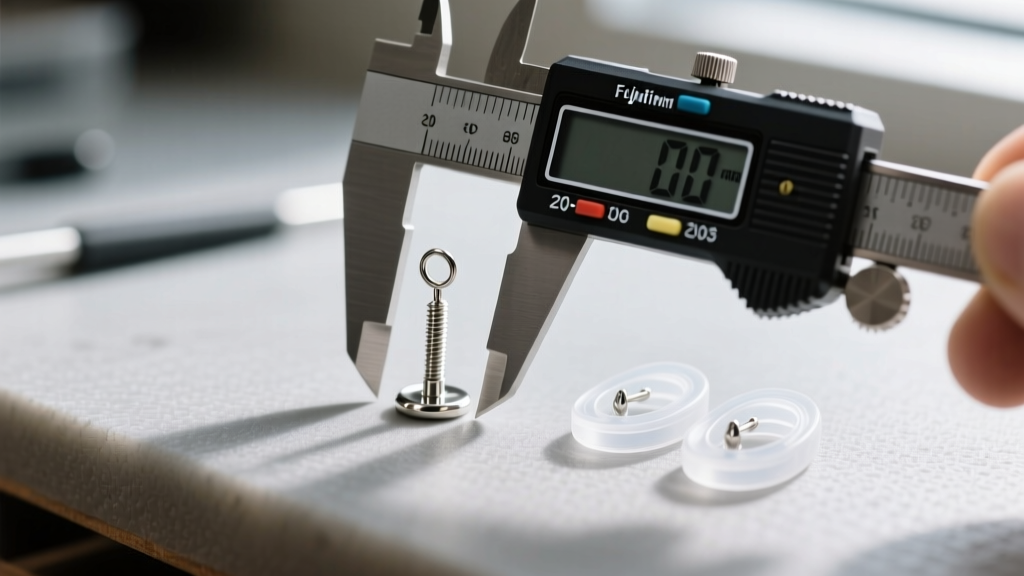
The structural integrity of your triangle stud earrings is entirely dependent on the post gauge and the metal alloy. Many fast-fashion and mid-tier jewelers cut costs by using ultra-thin posts and soft metals, which is catastrophic for geometric shapes.
Why 22-Gauge Posts Fail Geometric Shapes
A standard 22-gauge post measures just 0.64mm in diameter. While perfectly fine for a lightweight 3mm round diamond stud, a 22G post will easily bend under the 1.5 to 3 grams of weight typical of solid metal triangle studs. Once a post bends even slightly, it alters the angle of the earring face, causing it to tilt. According to manufacturing standards outlined by Rio Grande's earring findings guide, geometric and angular studs should never be mounted on anything thinner than a 20-gauge (0.81mm) post. For solid gold triangles larger than 10mm, an 18-gauge (1.02mm) post is mandatory to prevent torque-induced bending.
Friction Backs vs. Mechanical Locks
The traditional "butterfly" friction back relies on the tension of rolled metal scrolls gripping the post's notch. Over time, these scrolls stretch out. When paired with a triangle stud, the asymmetrical weight distribution easily pulls the friction back down the post, allowing the earring to droop. To solve this, upgrade to mechanical lock backs. La Pousette backs feature an internal spring-loaded mechanism that clicks securely into place and boasts a wider 5mm base plate. This wider base distributes the leverage of the triangle across a larger area of the back of your earlobe, drastically reducing forward tilt.
Lobe Anatomy and Support Hacks
Sometimes the jewelry is engineered perfectly, but the earlobe anatomy cannot support the geometry. If you have thin, stretched, or highly flexible earlobes, the piercing fistula itself acts as a loose hinge. When a heavy, elongated isosceles triangle is inserted, the tissue simply folds forward under the weight.
The most effective, non-invasive solution is the use of adhesive earlobe support patches (such as Lobe Wonder). These are discreet, medical-grade silicone shields with a micro-puncture in the center. You apply the patch to the back of the earlobe and push the earring post through it. The patch stiffens the tissue, creating a rigid backboard that prevents the triangle from pulling the lobe downward. The Association of Professional Piercers frequently recommends similar supportive backing methods to prevent migration and tearing in piercings subjected to heavy or awkwardly balanced jewelry.

Advanced Styling: Using Tension to Your Advantage
If you cannot alter the jewelry or your lobe, you can use secondary styling elements to anchor the triangle. Ear cuffs and huggies can be strategically used to create a tension network.
- The Chain Anchor: Attach a delicate, 20-gauge gold chain from the bottom corner of your triangle stud to a secondary helix or lobe piercing. This physically prevents the triangle from spinning or drooping.
- Silicone Stoppers: Slide a 1mm thick, 4mm outer-diameter silicone O-ring onto the post before securing the backing. The O-ring acts as a spacer, forcing the earring face to sit slightly away from the lobe, which can bypass the natural curvature of the ear that causes friction and tilting.
- Threaded Ends: If your triangles are internally threaded, apply a microscopic drop of jeweler's cyanoacrylate to the threads before screwing the backing on. This prevents the constant micro-vibrations of daily movement from loosening the back.
When to Consult a Bench Jeweler
If you have invested in fine jewelry—such as solid 14k gold or platinum triangle studs—and they still refuse to sit flat, it is time to visit a professional bench jeweler. As noted in GIA's jewelry manufacturing insights, laser welding technology allows jewelers to make micro-adjustments to solder joints without exposing the surrounding metal or gemstones to the extreme heat of a traditional torch. A jeweler can desolder the post, fill the original divot, and re-solder the post precisely on the centroid. They can also "hollow out" or "pierced" the back of a solid triangle to reduce its overall gram weight without altering the front-facing aesthetic, fundamentally changing the center of gravity and allowing the earring to sit perfectly flush against your ear.


