Flat Diamond Earrings: The Beginner's Guide to Flush Studs
Discover everything about flat diamond earrings. Learn about bezel vs. prong settings, ideal carat sizes, and how to choose flush studs for sensitive ears.

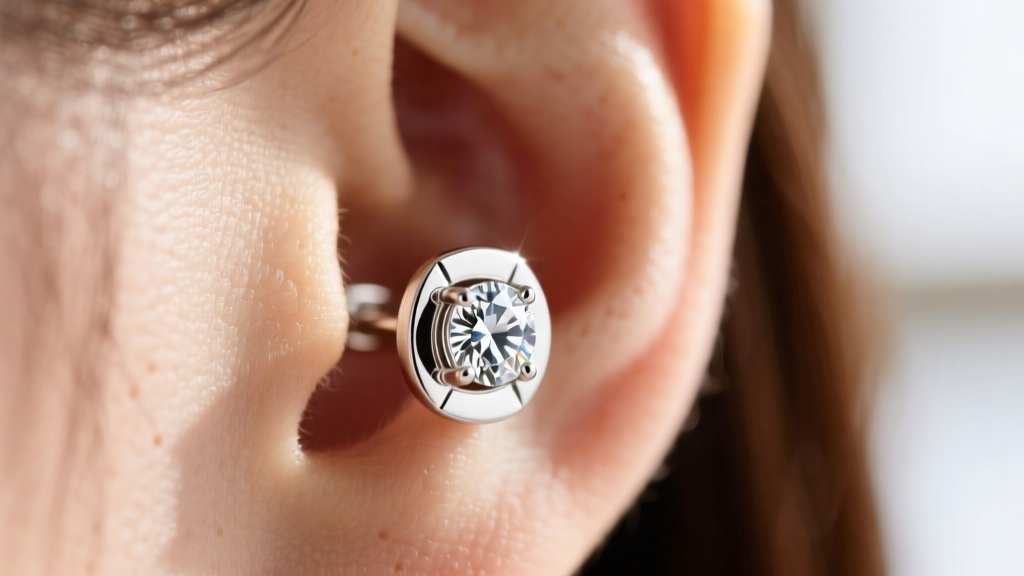
If you have ever been poked in the neck by a sharp earring post while trying to sleep, or caught a prong on your favorite cashmere sweater, you already understand the frustration of traditional jewelry. Enter flat diamond earrings—the ultimate solution for minimalists, active individuals, and anyone with sensitive piercings. Unlike traditional studs that sit proudly off the earlobe, flat diamond earrings are engineered to sit completely flush against the skin.
As we navigate the jewelry trends of 2026, the demand for 'sleep-friendly' and 'snag-proof' fine jewelry has skyrocketed. But buying a truly flat earring requires understanding setting architecture, post mechanics, and precise millimeter sizing. This beginner-friendly guide will break down exactly what to look for when investing in your first pair of flush-fit diamond studs.
What Defines a 'Flat' Diamond Earring?
The term 'flat' refers to the Z-axis profile of the earring—specifically, how far the gemstone and setting protrude from the earlobe. A standard diamond stud might sit 4mm to 6mm away from the skin to allow light to enter the pavilion (the bottom of the diamond). A true flat diamond earring, however, sits just 1.5mm to 2.5mm off the skin.
To achieve this ultra-low profile, jewelers must utilize specialized settings and specific backing mechanisms. The goal is to eliminate any sharp edges, exposed culets (the bottom point of the diamond), or protruding prongs. According to the American Gem Society, a well-crafted low-profile setting should protect the diamond's girdle while maintaining as much light return as possible, a balancing act that requires master-level craftsmanship.
Bezel vs. Low-Profile Prong: Which Setting is Best?
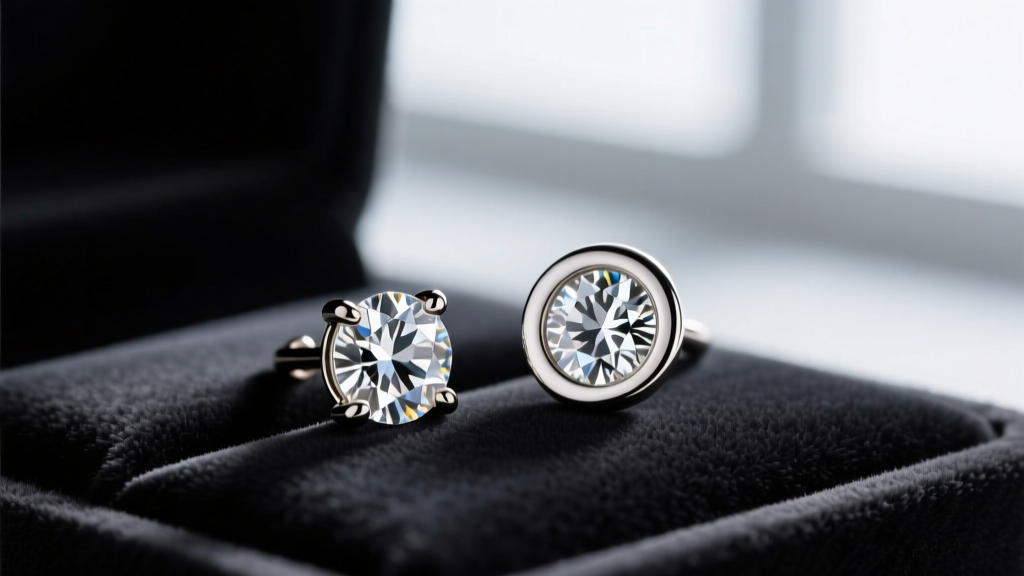
When shopping for flat diamond earrings, you will primarily encounter two setting styles. Each has distinct advantages depending on your lifestyle and aesthetic preferences.
1. The Bezel Setting
A bezel setting wraps a thin rim of metal entirely around the diamond's girdle. For flat earrings, a 'half-bezel' or 'low-wall bezel' is often used so the metal doesn't completely swallow the small stone. Bezel settings are the undisputed champions of snag-proof jewelry.
2. The Low-Profile Prong Setting
Instead of standard tall prongs, jewelers use micro-prongs that are filed down and polished flat against the crown of the diamond. This allows more light to enter the stone than a bezel, resulting in superior sparkle, though it carries a marginally higher snag risk.
| Feature | Low-Wall Bezel | Low-Profile Prong |
|---|---|---|
| Snag Risk | Extremely Low (Zero sharp edges) | Low (Rounded micro-prongs) |
| Light Return (Sparkle) | Moderate (Metal blocks side light) | High (Open pavilion design) |
| Diamond Protection | Maximum (Girdle fully encased) | Moderate (Girdle partially exposed) |
| Best For | Active lifestyles, sleeping, helix piercings | Everyday lobe wear, maximizing brilliance |
| Average Price Premium | +15% (Requires more metal & labor) | Base Price |
The Secret to True Flatness: The Post and Backing
A common beginner mistake is buying a flat-front diamond earring, only to realize the back is a traditional 'butterfly' friction clutch. Butterfly backs feature sharp metal loops that dig into the neck during sleep. To achieve a truly flat, comfortable experience, you must look at the post mechanics.
Threadless Flat-Back Labrets
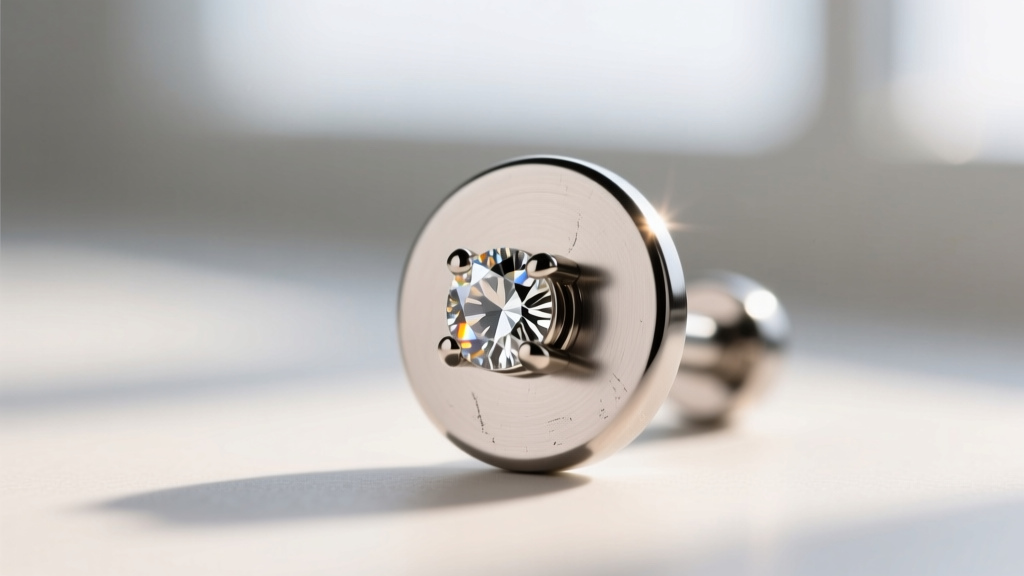
The gold standard for flat earrings in 2026 is the threadless flat-back labret post. Originally popularized by professional body piercers, these posts feature a smooth, flat disc at the back that rests flush against the skin. The Association of Professional Piercers (APP) strongly recommends internally threaded or threadless flat-back jewelry for healing and sensitive piercings because the smooth disc eliminates tissue irritation.
- 18-Gauge (1.0mm): The standard thickness for most earlobe piercings and delicate cartilage placements.
- 16-Gauge (1.2mm): Slightly thicker, offering more durability for helix or tragus piercings where the earring might be bumped.
- Post Lengths: Flat-back posts come in specific lengths (e.g., 6mm, 8mm, 10mm). A 6mm or 8mm post is usually ideal for standard earlobes to ensure the flat disc sits snugly without pinching.
Sizing Matrix: Carat Weight vs. Millimeter Dimensions
When buying flat diamond earrings, thinking in millimeters (mm) is far more useful than thinking in carat weight. Because the setting is low-profile, a diamond that is too large will look disproportionate and may catch on hair. Here is the definitive sizing matrix for flush-fit studs:
- 2.5mm (approx. 0.06ct): The 'micro' size. Perfect for secondary lobe piercings, tragus, or helix placements. Sits completely unobtrusive.
- 3.0mm (approx. 0.10ct): The most versatile size. Ideal for a subtle, everyday primary lobe stud or a prominent cartilage stud. This is the sweet spot for sleep-friendly jewelry.
- 4.0mm (approx. 0.25ct): The classic solitaire size. Excellent for primary lobe piercings, but may feel slightly bulky for side-sleepers if set in a bezel.
- 5.0mm+ (0.50ct+): Generally not recommended for flat/sleep-friendly earrings. The surface area becomes too wide, increasing the risk of catching on pillows and hair.
2026 Buying Guide: Diamond Quality and Metals
Because flat diamond earrings utilize smaller stones (melee or near-melee sizes), you do not need to pay for flawless clarity. The Gemological Institute of America (GIA) notes that inclusions in diamonds under 0.30 carats are rarely visible to the naked eye, especially when partially obscured by a bezel wall.
'For flush-fit bezel earrings, prioritize an Excellent or Ideal cut grade over color and clarity. The cut is the sole engine of brilliance in a small, low-profile stone. A G-color, SI1-clarity diamond with an Ideal cut will outsparkle a D-color, VS1 diamond with a Poor cut every single time.'
— Master Jeweler & Setting Specialist
Metal Selection for Sensitive Ears
If you are buying flat-back labret styles, the metal of the post is critical. Look for ASTM F-136 Implant-Grade Titanium. Unlike standard 'surgical steel,' which can contain trace amounts of nickel, implant-grade titanium is entirely nickel-free and biocompatible. If you prefer gold, ensure it is 14k or 18k nickel-free alloy, as yellow and rose golds are sometimes mixed with nickel for durability.
The Lab-Grown Advantage
In 2026, lab-grown diamonds dominate the small-stud market. Because flat earrings require high-clarity rough to be cut into small, precise proportions, lab-grown stones offer a massive price advantage. You can expect to pay between $120 and $250 for a high-quality, 3mm lab-grown bezel stud in 14k gold, compared to $400 to $700 for its natural equivalent.
Care and Maintenance for Flush Settings
While flat diamond earrings are low-maintenance, they are not no-maintenance. The tight tolerances of a bezel setting can trap skin oils, lotions, and dead skin cells, which will quickly dull the diamond's sparkle.
- Weekly Cleaning: Use a few drops of mild dish soap in warm water. Soak the earrings for 10 minutes, then gently brush the diamond and the underside of the setting with a baby-soft toothbrush.
- Avoid Ultrasonic Cleaners on Fracture-Filled Stones: If you bought budget-friendly natural diamonds that have been fracture-filled, ultrasonic vibrations can knock the fillings out. Stick to manual cleaning unless you are certain your stones are untreated.
- Check the Post Tension: If using threadless flat-back posts, the front pin relies on a slight bend to create tension inside the hollow post. Every six months, ensure the pin still has a slight bend so the diamond top doesn't fall out during wear.
By prioritizing a low-profile setting, a smooth flat-back post, and an Ideal cut grade, you can build a collection of flat diamond earrings that offer uncompromising brilliance and 24/7 comfort.


