Material Guide: Choosing the Best Flat Gold Hoop Earrings
Discover how gold karats, alloys, and construction methods impact the durability, weight, and shine of flat gold hoop earrings in this expert guide.

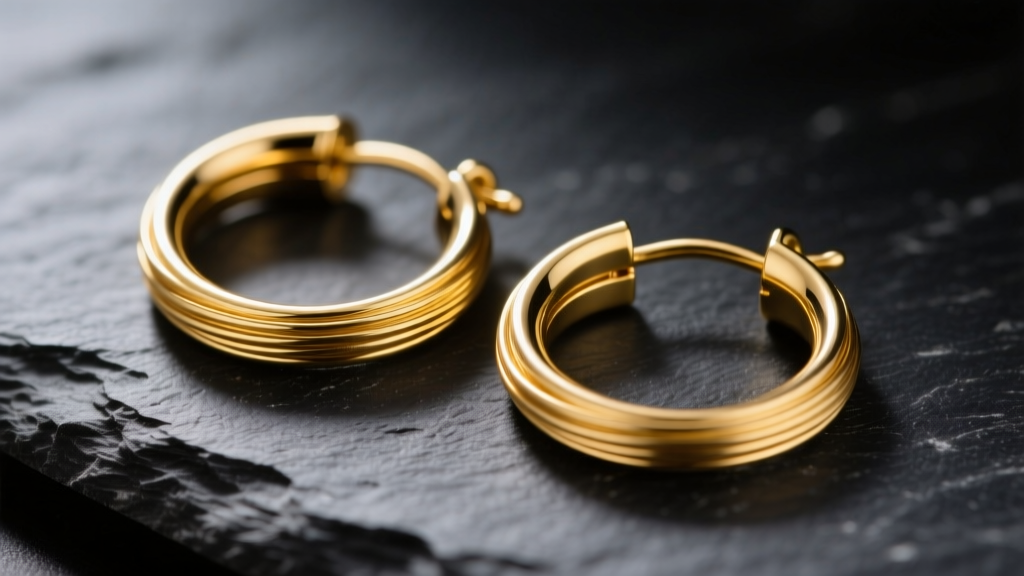
The Structural Challenge of Flat Gold Hoops
When evaluating flat gold hoop earrings—often referred to as ribbon hoops, squircle hoops, or paddle hoops—the material science is fundamentally different from traditional round-wire hoops. A round wire distributes mechanical stress radially, meaning it bends uniformly regardless of the direction of force. Flat wire, however, possesses a high moment of inertia on its broad axis but is remarkably weak on its lateral axis.
This physical property means that while a flat gold hoop resists bending forward and backward, it is highly susceptible to lateral twisting and warping. If you sleep on a flat hoop made of soft, high-karat gold, it will easily twist into a figure-eight shape. Therefore, selecting the correct alloy and construction method is not just about color or prestige; it is a structural necessity to ensure the earring retains its geometric integrity over years of daily wear.
Solid vs. Hollow: Why Flat Profiles Demand Solid Cores
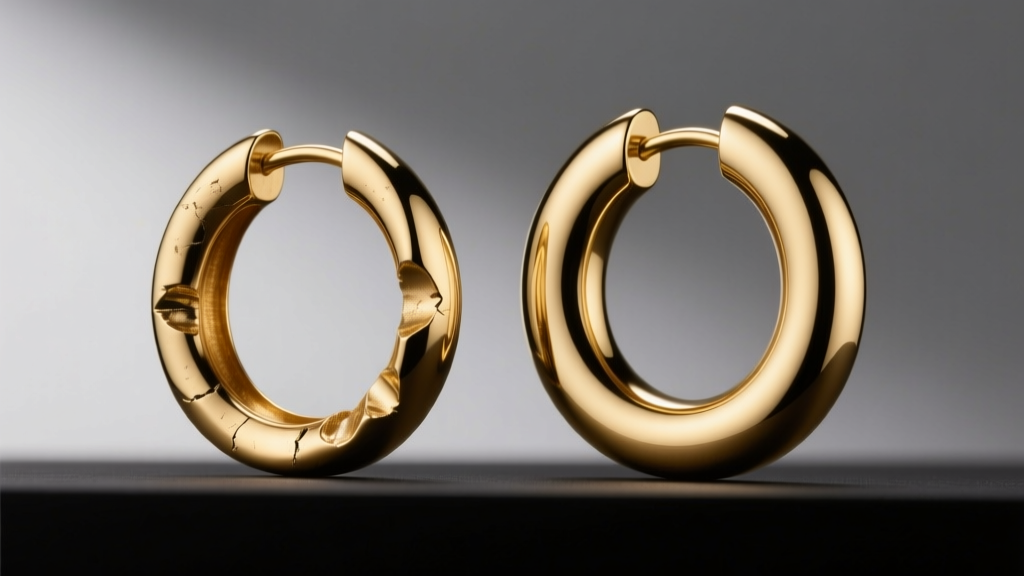
The market is flooded with lightweight, hollow flat hoops designed to maximize visual impact while minimizing gold weight. However, from a metallurgical standpoint, hollow flat profiles are a liability. Hollow hoops are typically created through electroforming or by stamping and soldering thin sheets of gold (often under 0.8mm thick).
Expert Insight: A hollow flat gold hoop dropped onto a ceramic tile floor from just three feet high will likely dent or crush. Because the flat surface area is broad, the force of impact is distributed across a thin, unsupported cavity, causing irreversible structural failure.
Solid flat hoops, crafted via lost-wax casting or extrusion, are significantly more durable. A standard 20mm diameter solid 14k flat hoop (4mm wide, 1.5mm thick) weighs approximately 3.8 grams per earring. While this adds noticeable weight and increases the retail price—especially with 2026 gold spot prices hovering near historic highs—the trade-off is a piece of jewelry that can withstand daily impacts without collapsing.
Karat Comparison: 14k vs. 18k vs. 22k for Flat Hoops
Pure gold (24k) is far too malleable for jewelry, measuring a mere 25 on the Vickers Hardness (HV) scale. To create durable flat gold hoop earrings, gold must be alloyed with other metals. The karat system dictates the ratio of pure gold to alloy metals, directly impacting the tensile strength and scratch resistance of the flat surface.
| Karat | Gold Content | Vickers Hardness (HV) | Yield Strength | Best Application for Flat Hoops |
|---|---|---|---|---|
| 10k | 41.7% | 160-180 HV | Very High | Budget-friendly, high-stress active wear |
| 14k | 58.3% | 140-160 HV | High | Everyday flat hoops, optimal balance of color and durability |
| 18k | 75.0% | 120-140 HV | Medium | Luxury flat hoops, requires careful wear and storage |
| 22k | 91.6% | 60-80 HV | Low | Avoid for flat profiles; will warp and scratch easily |
According to the Gemological Institute of America (GIA), 14k and 18k gold offer the most reliable balance for structural jewelry. For flat hoops specifically, 14k is the superior choice for daily wear because its higher alloy content provides the lateral rigidity required to prevent the hoop from twisting out of shape.
Alloy Metallurgy: What Makes Your Hoops Bend or Snap?
The specific metals mixed with pure gold dictate not only the color but the mechanical failure modes of the earring. Jewelers manipulate these alloys to achieve specific working properties:
- Copper: Increases hardness and tensile strength significantly. High copper content results in rose gold, which is naturally more rigid and scratch-resistant than yellow or white gold variants of the same karat.
- Silver: Adds malleability and a greenish-yellow hue. Too much silver in a flat hoop alloy can make the metal slightly softer, increasing the risk of lateral warping.
- Zinc: Acts as a deoxidizer during the melting process, preventing porosity in cast flat hoops. It also lightens the color of copper-heavy alloys.
- Nickel: Historically used to create white gold and increase hardness. However, nickel is a known sensitizer. The American Academy of Dermatology strongly warns against nickel in body jewelry due to the high prevalence of allergic contact dermatitis. Always verify that white gold flat hoops are nickel-free or rhodium-plated to create a barrier.
Clasp and Hinge Mechanics in Flat Wire Designs
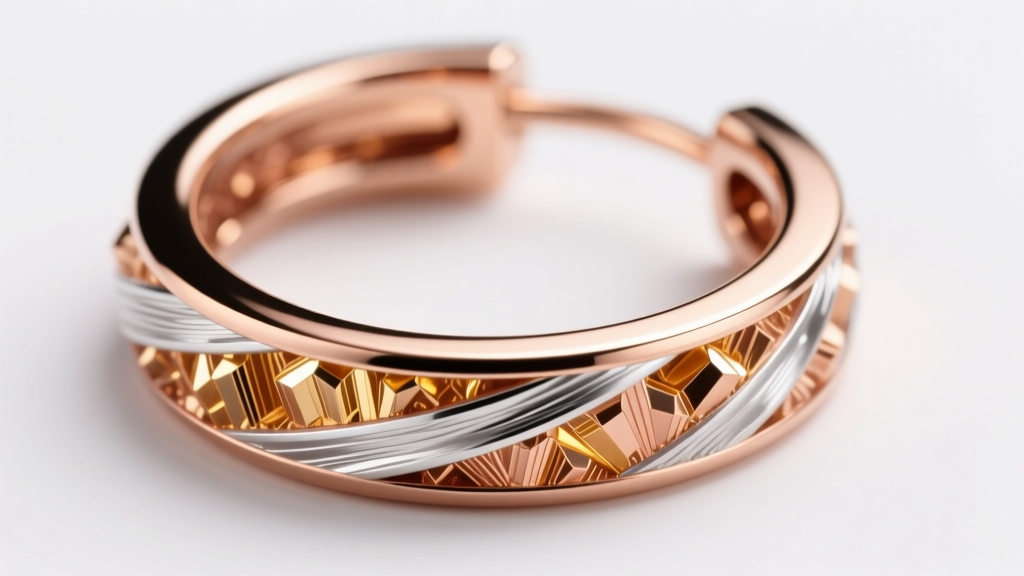
The weakest point of any hoop earring is the hinge and clasp mechanism. In round wire hoops, a simple cylindrical pin and barrel hinge work perfectly. In flat gold hoop earrings, using a standard round hinge creates a severe stress concentrator where the flat body transitions into the round pin. Over time, the repeated opening and closing will cause micro-fractures at this junction, eventually leading to a clean snap.
High-quality flat hoops utilize specialized hardware:
- Flat Clicker Hinges: The pin and the receiving tube are milled flat to match the exact width and thickness of the hoop body. This distributes the mechanical load evenly across the entire cross-section.
- Saddleback Clasps: Often used in wider ribbon hoops, the clasp features a hinged saddle that wraps over the post, secured by a friction fit or a tiny set screw, eliminating the need for a hollow hinge tube altogether.
Maintenance and Scratch Mitigation
Flat surfaces act like mirrors; they reflect light uniformly, which means micro-scratches, scuffs, and fingerprints are vastly more visible on a flat gold hoop than on a textured or round wire hoop. The broad, continuous plane of the metal highlights every point of contact with hard surfaces.
To mitigate this, consider the finish of the gold. While high-polish flat hoops offer a striking, modern gleam, they require frequent buffing with a jeweler's cloth. Opting for a brushed, satin, or hammered finish diffuses light reflection, effectively camouflaging daily wear and tear. If you prefer high polish, store your flat hoops individually in soft microfiber pouches to prevent them from rubbing against other jewelry, which is the primary cause of surface abrasion.
Expert Verdict: Which Material Should You Buy?
When investing in flat gold hoop earrings, prioritize structural integrity over pure gold content. The ideal specification for a lifelong, everyday flat hoop is solid 14k yellow or rose gold, featuring a flat-milled clicker hinge and a brushed or satin finish. This combination provides the necessary Vickers hardness to resist lateral twisting, the solid core to prevent impact denting, and a surface texture that gracefully ages without requiring constant polishing. Avoid 22k gold and hollow constructions entirely, as the physics of the flat profile will inevitably lead to warping and crushing.


