Budget Guide: Assessing the Value of a Flower Earring Gold Piece
Learn how to evaluate the true value of a flower earring gold piece. We break down karat weights, manufacturing costs, and fair retail premiums.

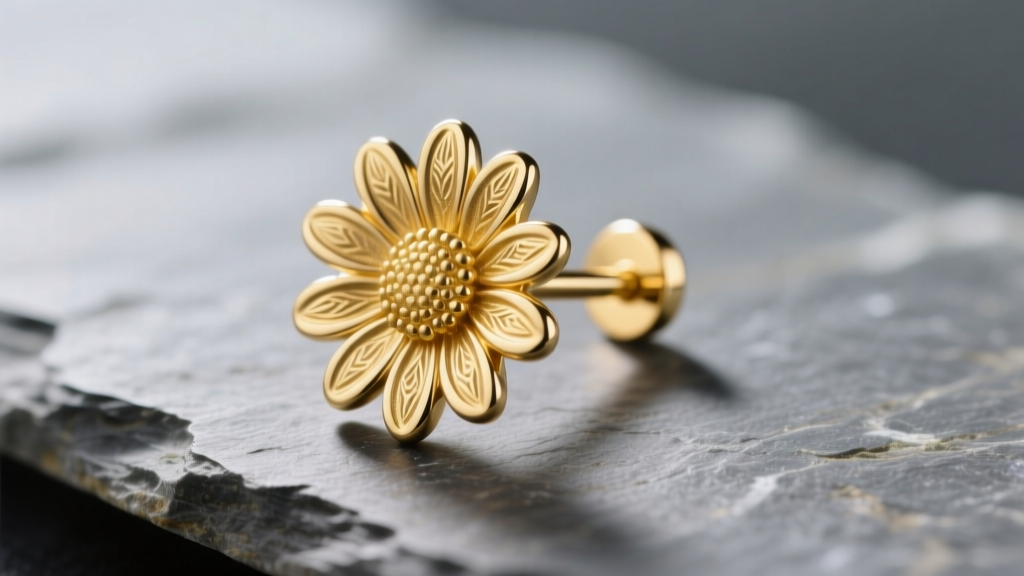
The Botanical Premium: Why Floral Gold Jewelry Holds Value
The enduring appeal of botanical jewelry has made the classic flower earring gold silhouette a staple in both fashion and fine jewelry collections. However, when assessing the true market value of a flower earring gold design, consumers must look past the aesthetic and scrutinize the metallurgy, manufacturing techniques, and structural integrity. In 2026, with precious metal markets experiencing significant volatility, understanding the difference between intrinsic melt value and retail craftsmanship premiums is critical for making a sound investment. Whether you are evaluating a vintage estate piece or a modern boutique casting, this budget and value assessment framework will ensure you never overpay for your floral gold jewelry.
Material Tiers and the 'Gold' Misconception
The term 'gold' is frequently abused in the jewelry industry. When shopping for a flower earring gold piece, the first step in value assessment is identifying the exact material tier. The Federal Trade Commission Jewelry Guides strictly regulate how gold content can be advertised, yet misleading terminology still plagues the market. Below is a comparative breakdown of the most common material tiers you will encounter, along with their expected price ranges for a standard 6mm to 8mm floral stud.
| Material Tier | Base Metal | Gold Layer / Purity | Avg. Retail Price (Pair) | Expected Lifespan |
|---|---|---|---|---|
| Gold Plated | Brass or Copper | < 0.5 microns | $25 - $60 | 6 - 12 months |
| Gold Vermeil | Sterling Silver | 2.5+ microns (min 10k) | $80 - $160 | 2 - 5 years |
| Solid 10k Gold | Gold Alloy (41.7%) | Solid throughout | $120 - $220 | Lifetime |
| Solid 14k Gold | Gold Alloy (58.3%) | Solid throughout | $180 - $380 | Lifetime |
| Solid 18k Gold | Gold Alloy (75.0%) | Solid throughout | $300 - $650+ | Lifetime |
If your goal is to find a flower earring gold piece that holds intrinsic value and can be passed down as an heirloom, you must restrict your search to solid 10k, 14k, or 18k gold. Plated and vermeil options, while budget-friendly, possess zero melt value and will eventually wear down to the base metal, especially on high-friction areas like the earring post and clutch.
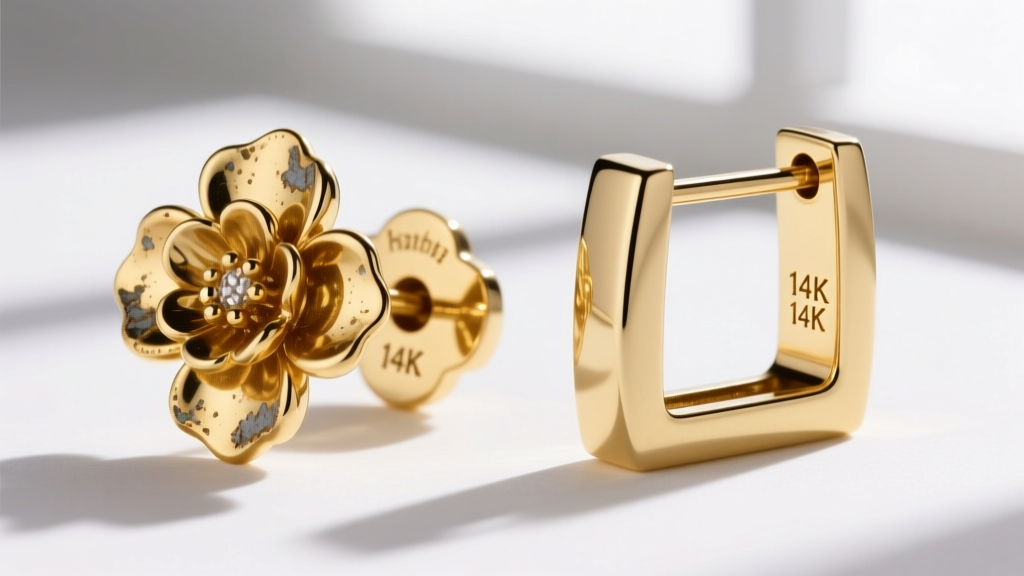
Manufacturing Techniques: Stamping vs. Casting
The manufacturing method used to create the floral motif drastically impacts both the retail price and the long-term durability of the earrings. Mass-market jewelry brands typically rely on die-striking or stamping to produce floral designs. In this process, a sheet of gold alloy is pressed between two hardened steel dies under immense pressure. Die-struck flower earrings are generally less expensive, highly dense, and resistant to denting. However, they are limited to flat or low-relief 2D designs, lacking the organic, three-dimensional curvature of natural flower petals.
The Lost-Wax Casting Premium
For intricate, 3D floral designs—such as blooming roses, orchids, or deeply textured daisies—jewelers utilize the lost-wax casting method. A wax model of the flower is encased in a plaster investment, burned out in a kiln, and replaced with molten gold. This technique allows for stunning, lifelike details but introduces porosity risks and requires extensive hand-finishing and polishing. Consequently, a cast flower earring gold piece will command a 30% to 50% higher labor premium than a stamped equivalent. When assessing value, examine the petal edges: if they are perfectly uniform and flat, it is likely stamped; if they feature organic, asymmetrical curves and deep undercuts, you are paying for casting and hand-finishing labor.
Structural Integrity: Post Gauges and Petal Thickness
A common failure point in budget gold jewelry is the earring post. The Gemological Institute of America (GIA) notes that alloying gold with metals like copper and zinc increases hardness, but pure gold and high-karat alloys (like 18k or 22k) remain relatively soft. A standard lightweight stud uses a 20-gauge (0.81mm) post. However, a solid gold floral head with a diameter exceeding 10mm carries significant weight. If a heavy 14k or 18k gold flower is mounted on a flimsy 20-gauge or 22-gauge post, the post will inevitably bend when the wearer pushes the friction clutch (butterfly back) into place.
When evaluating a high-quality flower earring gold piece, inspect the post thickness. It should be a minimum of 18-gauge (1.02mm) or even 16-gauge (1.29mm) for oversized floral statement pieces. Additionally, check the petal thickness. Petals thinner than 0.6mm are highly susceptible to crushing and denting from everyday wear. A well-crafted solid gold floral earring will feature a slightly domed or reinforced backplate to provide structural rigidity without adding excessive, costly gold weight.
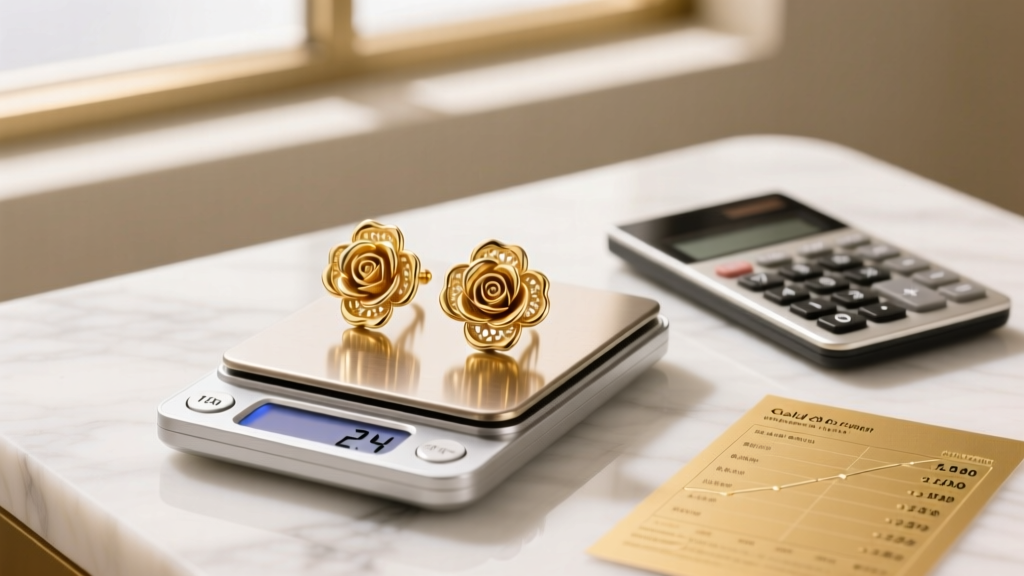
The Math: Calculating Melt Value vs. Retail Premium
To determine if you are being overcharged, you must calculate the intrinsic melt value of the earrings and compare it to the retail asking price. According to data from the World Gold Council, gold prices fluctuate daily, but we can use a baseline 2026 spot price of $2,350 per troy ounce for this assessment.
- Step 1: Find the exact gram weight of the earrings. (e.g., A pair of solid 14k gold daisy studs weighs 2.2 grams).
- Step 2: Calculate the pure gold value per gram. ($2,350 / 31.103 grams = $75.55 per gram of 24k pure gold).
- Step 3: Adjust for karat purity. 14k gold is 58.3% pure. ($75.55 x 0.583 = $44.04 per gram of 14k gold).
- Step 4: Multiply by the item's weight. (2.2 grams x $44.04 = $96.88 intrinsic melt value).
If the retail price for these 2.2-gram 14k flower earrings is $160, the retail premium is roughly 1.65x the melt value. This is an excellent, fair-market price for mass-produced cast or stamped jewelry. If the retail price is $600, the premium is over 6x the melt value. While high premiums are justified for renowned designer brands or artisan hand-fabricated pieces with complex milgrain and hand-engraving, a 6x markup on a basic, mass-cast floral stud is a poor allocation of your budget.
Hallmarks and Legal Stamping Requirements
Under the US National Stamping Act, any item stamped with a karat mark (e.g., '14k' or '585') must also bear a registered maker's mark or trademark. This ensures accountability for the gold purity. When inspecting a vintage or modern flower earring gold piece, use a jeweler's loupe to examine the back of the floral head or the base of the post. If you see a '14k' stamp but no accompanying maker's mark, the piece may be imported from a region with lax assay laws, or it may be mislabeled entirely. Always demand a hallmark that includes both the purity and the manufacturer's trademark to guarantee the metallurgical integrity of your purchase.
Expert Verdict: Where to Allocate Your Budget
When investing in botanical jewelry, prioritize solid 14k gold for the optimal balance of durability, rich color, and budget efficiency. 18k gold offers a warmer, more luxurious hue but is softer and commands a steep premium that rarely translates to proportional resale value. Avoid gold-plated floral designs entirely, as the intricate crevices of flower petals trap moisture and accelerate the tarnishing and flaking of the microscopic gold layer. By focusing on 18-gauge posts, reinforced backplates, and a retail-to-melt premium of under 3x, you can acquire a stunning flower earring gold piece that serves as both a beautiful daily accessory and a resilient store of intrinsic value.


