Matching Gauges with Hoop Earrings: A Material Properties Guide
Discover how to match wire gauges with hoop earrings based on metal properties. Compare titanium, gold, and steel for lobe and cartilage piercings.

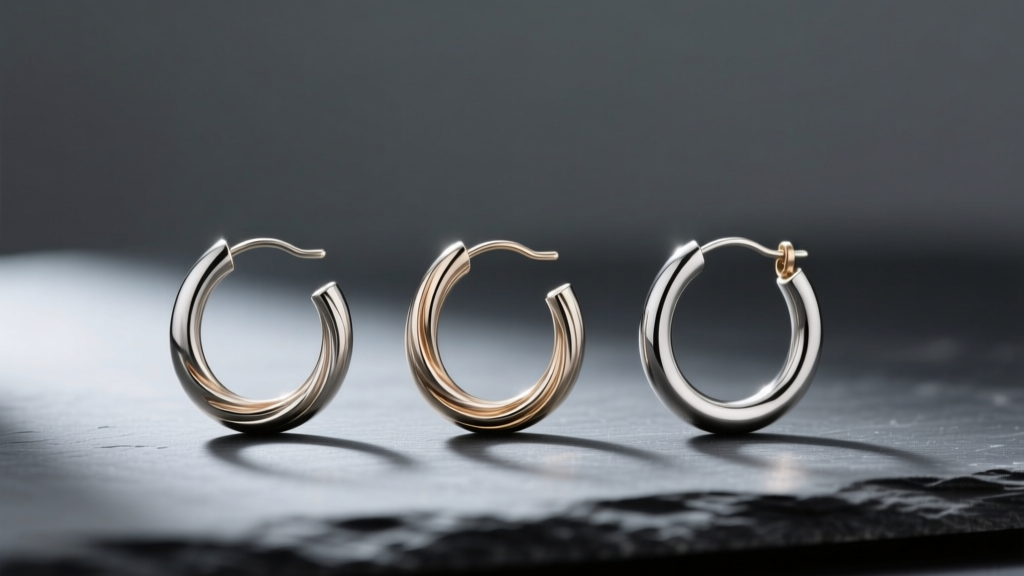
The Biomechanics of Body Jewelry in 2026
As we navigate the jewelry landscape of 2026, the conversation around body modification has shifted significantly from purely aesthetic choices to a deeper understanding of biomechanical compatibility. When selecting gauges with hoop earrings, consumers and professional piercers alike are no longer just looking at the diameter or the sparkle of the gemstone. Instead, the focus is on how the physical thickness of the wire (the gauge) interacts with the metallurgical properties of the chosen material. A hoop earring is a dynamic piece of jewelry; it moves, catches, and bears weight. Understanding the intersection of wire gauge and metal alloy is critical for preventing tissue damage, avoiding jewelry failure, and ensuring long-term piercing health.
The Inverse Rule of Wire Gauges Explained
Before diving into material properties, it is essential to clarify the American Wire Gauge (AWG) system, which dictates the thickness of body jewelry. The AWG system is inverse: the higher the gauge number, the thinner the wire. For hoop earrings, the industry standards generally fall into four categories:
- 20-Gauge (0.81mm): Exceptionally thin, primarily used for standard lobe piercings or delicate, lightweight fashion hoops.
- 18-Gauge (1.02mm): The standard for most healed lobe piercings and some delicate cartilage placements like the upper helix.
- 16-Gauge (1.29mm): The gold standard for cartilage piercings (helix, tragus, conch) due to its balance of structural integrity and tissue comfort.
- 14-Gauge (1.63mm): A thick, robust wire used for daith, rook, and industrial hoops, or for heavy-gauge lobe stretching.
The structural viability of these gauges changes drastically depending on the metal being used. A 20-gauge wire in implant-grade titanium behaves entirely differently than a 20-gauge wire in 18-karat gold.
Material Behavior Across Different Gauges
Implant-Grade Titanium (ASTM F136)
Titanium is the undisputed champion of cartilage jewelry. With a high strength-to-weight ratio and complete biocompatibility, ASTM F136 titanium allows for thinner gauges without sacrificing structural integrity. A 16-gauge titanium hoop is remarkably lightweight, reducing the gravitational pull on a healing helix or daith piercing. Furthermore, titanium possesses a high yield strength (approximately 830 MPa), meaning a 14-gauge or 16-gauge titanium hoop will resist permanent deformation if snagged on clothing or hair. According to the Association of Professional Piercers (APP), titanium's lack of nickel and superior surface finish makes it the optimal choice for fresh piercings across all gauges.
Solid Gold (14k vs. 18k Alloys)
Gold is a dense, malleable precious metal, but its behavior in hoop form depends heavily on the alloy mix. Pure 24k gold is far too soft for body jewelry. Therefore, we rely on 14k (58.5% gold) and 18k (75% gold) alloys. 14k gold, alloyed with copper, silver, and zinc, offers a higher Vickers hardness than 18k gold. Consequently, an 18-gauge 14k gold hoop is structurally sound for lobe piercings. However, an 18-gauge 18k gold hoop is highly susceptible to warping in active cartilage placements. If you are opting for high-karat gold in a 16-gauge daith or rook hoop, the wire must be carefully annealed and work-hardened by the jeweler to prevent the hoop from pulling open under minor tension.
Surgical Steel (ASTM F138)
Surgical steel is a staple in the jewelry industry, but its high density (roughly 8.0 g/cm³ compared to titanium's 4.43 g/cm³) presents unique challenges in hoop form. A large-diameter, 14-gauge steel hoop can be surprisingly heavy. In a fresh cartilage piercing, this weight can cause the jewelry to tilt, leading to angular migration and uneven healing. Steel is best reserved for 16-gauge or 14-gauge hoops in fully healed, structurally robust piercings where the added weight will not cause tissue stress.
Comparative Data: Gauge, Material, and Tensile Strength
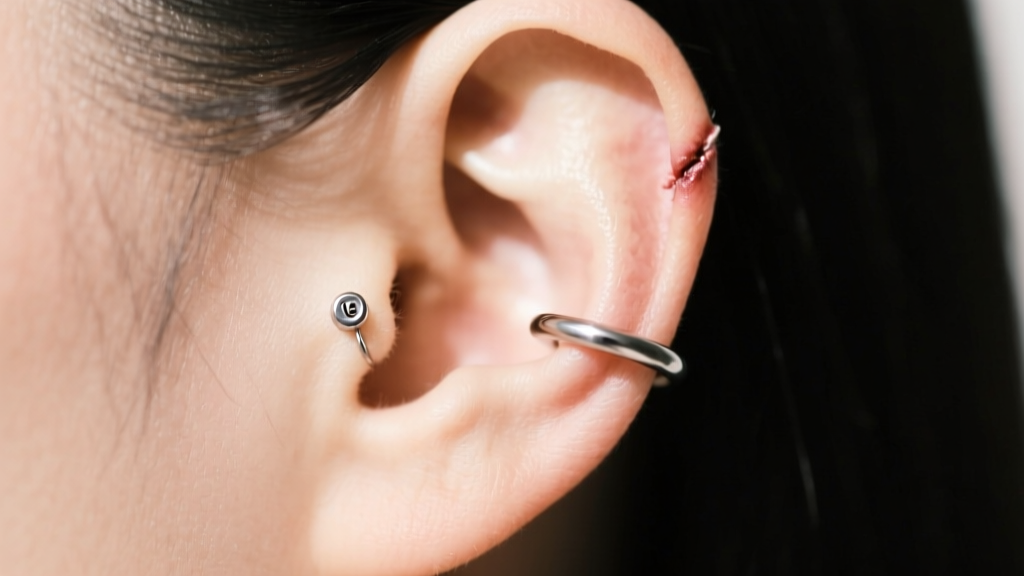
To visualize how these variables interact, refer to the comparative matrix below. This data highlights why certain gauge-material pairings are recommended over others for specific piercing placements.
| Wire Gauge | Thickness (mm) | Optimal Material | Structural Risk Profile | Recommended Placement |
|---|---|---|---|---|
| 20g | 0.81mm | 14k Gold / Titanium | High risk of 'cheese-cutter' effect in lobes if heavy. | Standard Lobes (Healed) |
| 18g | 1.02mm | 14k Gold / Steel | Moderate bending risk in cartilage if snagged. | Lobes, Upper Helix (Healed) |
| 16g | 1.29mm | ASTM F136 Titanium | Low risk; excellent balance of weight and strength. | Helix, Tragus, Conch, Nostril |
| 14g | 1.63mm | Titanium / Niobium | Negligible bending risk; heavy if steel is used. | Daith, Rook, Septum, Stretched Lobes |
Cartilage vs. Lobe: Selecting the Optimal Pairing
Standard Lobe Piercings
The earlobe is composed of soft, vascular tissue without the rigid support of cartilage. Because of this, lobes are highly susceptible to the 'cheese-cutter effect'—a phenomenon where a thin, heavy wire slowly slices downward through the tissue. When matching gauges with hoop earrings for lobes, avoid pairing large-diameter hoops with 20-gauge or 22-gauge wires, especially in dense metals like steel or solid gold. An 18-gauge 14k gold hoop with a diameter of 15mm or less is generally the safest aesthetic choice. If you prefer larger, statement-sized hoops, you must scale up to a 16-gauge or 14-gauge wire to distribute the weight across a wider surface area of the fistula.
Helix, Tragus, and Daith Piercings
Cartilage piercings require rigid stability to heal properly and maintain their angle. The APP's guidelines on fresh piercings emphasize that movement and pressure can cause hypertrophic scarring. For hoops in cartilage (often worn after the initial healing phase on a flat-back labret), a 16-gauge titanium hoop is the industry benchmark. The 1.29mm thickness provides enough rigidity to resist bending if you sleep on the ear or catch the hoop on a towel, while remaining thin enough to pass comfortably through the dense cartilage tissue without causing excessive trauma during insertion.
Common Failure Modes: When the Wrong Gauge Meets the Wrong Metal
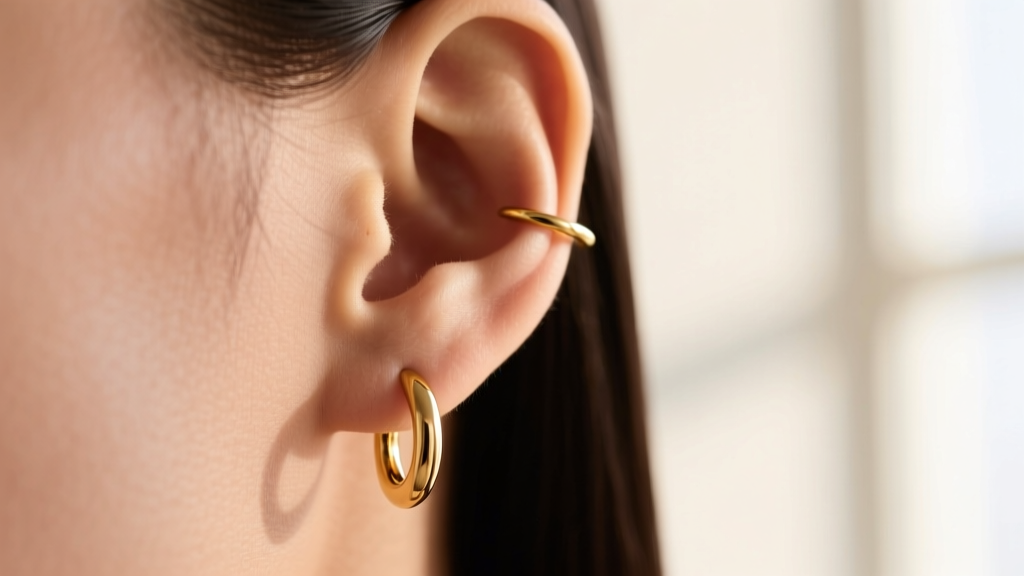
Understanding material properties also means anticipating how jewelry fails. Here are three common failure modes when gauges and materials are mismatched in hoop earrings:
- Hinge Blowout on Thick Gold: Creating a 14-gauge huggie hoop out of 18k gold requires a robust hinge mechanism. Because 18k gold is softer, the stress of opening and closing a thick wire can warp the hinge pin over time, leading to a 'blowout' where the clasp no longer seats securely.
- Thread Stripping in Steel: For threaded hoop closures (like ball-captive rings), using a 20-gauge surgical steel wire means the internal threads are microscopic. Steel's hardness makes tapping these tiny threads difficult, and cross-threading is a frequent failure mode that ruins the jewelry.
- Spring-Back Deformation in Titanium: Titanium has a high degree of elasticity. If a 16-gauge titanium seamless hoop is forced open too wide to insert into a daith piercing, it may not 'spring back' to its original perfect circle, resulting in a warped hoop that puts uneven pressure on the piercing channel.
Final Recommendations
The modern approach to curating an ear project requires a synthesis of art and engineering. When evaluating gauges with hoop earrings, always prioritize the structural limitations of the metal alloy. Opt for ASTM-certified titanium in 16-gauge for cartilage stability, reserve 18-gauge 14k gold for healed lobes, and avoid thin-gauge heavy metals entirely to protect your tissue. By respecting the metallurgical realities of body jewelry, you ensure your piercings remain healthy, comfortable, and beautifully adorned for years to come.


