Gold Door Knocker Earrings: Material Guide & Properties
Discover the best metals for gold door knocker earrings. Compare 14k, 18k, and hollow gold properties to prevent lobe damage and ensure lasting shine.

The Physics of the Drop: Why Alloy Composition Matters
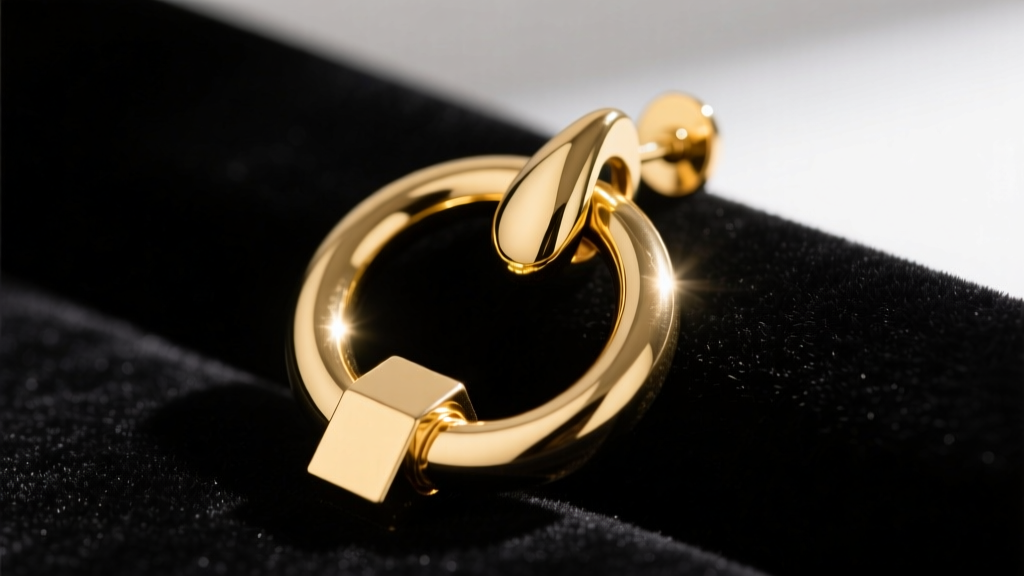
Gold door knocker earrings are a masterclass in bold geometry and kinetic movement. Characterized by a rigid, often geometric top—such as a circle, square, or triangle—with a hinged or fixed drop that mimics a traditional door knocker, these statement pieces are inherently front-heavy. Because of their substantial surface area and pendulum-like motion, a standard solid gold door knocker can weigh between 12 to 25 grams per earring. For context, a standard earlobe piercing can comfortably support 7 to 10 grams before experiencing tissue fatigue, migration, or stretching. Therefore, the metallurgical properties of the gold alloy are not merely aesthetic choices; they are structural necessities that dictate the earring's longevity and your earlobe's health.
When evaluating materials, we must look beyond color and examine tensile strength, yield point, and specific gravity. The Gemological Institute of America (GIA) notes that pure gold is exceptionally malleable, which is why alloying metals like copper, silver, zinc, and palladium are introduced. In heavy, hinged styles like door knockers, these alloying metals determine whether the earring will survive daily wear or warp under its own kinetic momentum.
Solid Gold Karats: Hardness vs. Purity
Choosing the right karat for a heavy statement earring requires balancing the rich, warm luster of high-karat gold with the structural rigidity of lower-karat alloys. Here is how the most common karats perform under the mechanical stress of a door knocker design:
10k Gold (41.7% Pure Gold): The most durable and scratch-resistant option. With a high proportion of alloy metals, 10k gold offers excellent tensile strength, making it ideal for the thin hinge pins and posts of heavy earrings. However, it has a paler yellow hue and a higher risk of causing contact dermatitis if alloyed with nickel.
14k Gold (58.3% Pure Gold): The industry standard for fine jewelry. 14k gold provides the optimal compromise between structural integrity, tarnish resistance, and rich color. It is rigid enough to support an 18-gauge post without bending, making it the premier choice for solid gold door knockers.
18k Gold (75% Pure Gold): Prized for its deep, saturated yellow color and hypoallergenic properties. However, 18k gold is significantly softer. A solid 18k gold door knocker is highly susceptible to post bending and hinge deformation if dropped or snagged.
22k and 24k Gold: Entirely unsuitable for the structural components of heavy hinged earrings. Pure gold and 22k alloys lack the yield strength required to support their own weight over time, leading to inevitable warping and clasp failure.
| Karat | Gold Content | Vickers Hardness (HV) | Tensile Strength | Verdict for Door Knockers |
|---|---|---|---|---|
| 10k | 41.7% | ~130-150 HV | High | Excellent for structural parts; paler color. |
| 14k | 58.3% | ~120-140 HV | Medium-High | Best overall balance of strength and color. |
| 18k | 75.0% | ~110-125 HV | Medium | Risky for solid heavy drops; requires thicker posts. |
| 22k | 91.6% | ~70-90 HV | Low | Too soft; hinges and posts will warp. |
The Weight Dilemma: Solid vs. Hollow Construction
To bypass the extreme weight of solid gold, many jewelers utilize hollow construction techniques. This reduces the weight of a 20-gram door knocker down to a highly wearable 5 to 8 grams, preserving the earlobe while maintaining the visual impact of a massive silhouette.
Electroformed Hollow Gold
Electroforming involves depositing gold ions onto a wax or resin mold, which is subsequently melted or dissolved away, leaving a seamless, hollow gold shell. This technique allows for intricate, organic, or massive geometric door knocker shapes that would be impossibly heavy if cast solid. The primary failure mode of electroformed gold is denting; because the gold shell is often less than 0.5mm thick, a hard impact against a tabletop can permanently crush the surface.
Stamped Tubing and Sheet Gold
For more angular, geometric door knockers (like the classic 80s box or circle styles), jewelers often use stamped gold tubing or folded sheet gold. This provides slightly more crush resistance than electroforming and allows for sharper, more defined edges. However, the seams where the gold is soldered can become stress fractures if the earring is repeatedly twisted.
Hinge Mechanics and Stress Points
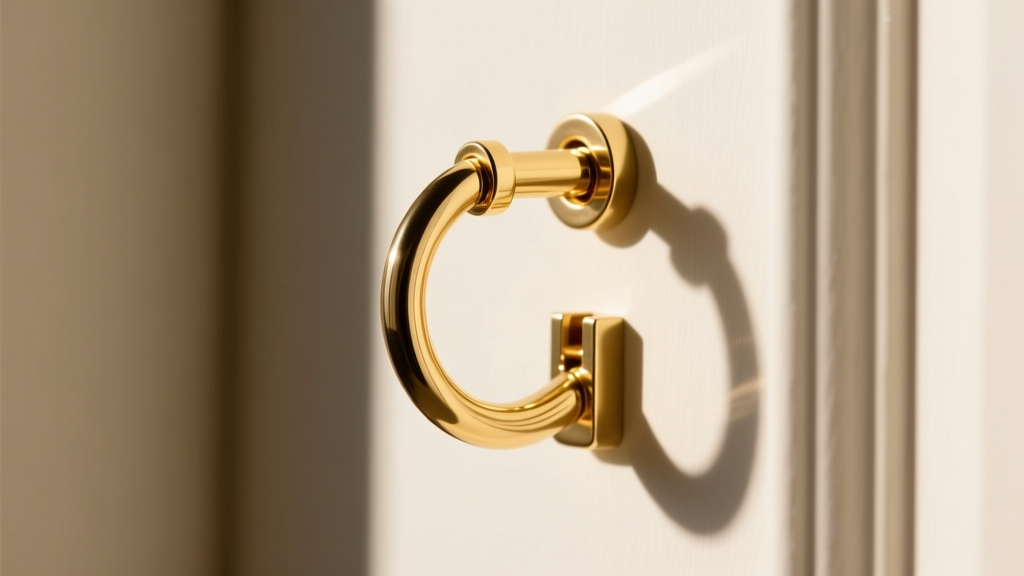
The defining feature of a door knocker earring is the hinge connecting the stationary lobe stud to the swinging drop. This joint bears the brunt of the kinetic energy every time you turn your head. In inferior designs, the hinge pin is soldered poorly or made of a low-melting-point alloy, leading to the drop snapping off entirely. High-quality gold door knockers utilize a friction-fit or laser-welded steel or 14k gold pin within the hinge barrel. When inspecting a pair, gently swing the drop; it should move freely without lateral wobble or grinding resistance, indicating precise CNC machining or expert hand-fabrication.
Gold Vermeil, Filled, and Plated: FTC Standards
For those seeking the look of heavy gold without the fine jewelry price tag, alternative gold finishes are available. However, heavy earrings experience high friction against the neck, hair, and clothing, which accelerates the wear of surface-level gold. According to the Federal Trade Commission (FTC) Jewelry Guides, the terminology for these finishes is strictly regulated:
- Gold Vermeil: Must consist of a sterling silver base coated with at least 2.5 microns of 10k+ gold. Because sterling silver is heavy, vermeil door knockers remain quite heavy, though the silver base prevents the green skin reaction associated with brass or copper bases.
- Gold Filled: Requires a brass or copper base mechanically bonded with a gold layer that constitutes at least 1/20th (5%) of the total metal weight. Gold-filled hollow tubing is an excellent, durable, and lightweight alternative to solid gold door knockers.
- Gold Plated: A microscopic layer (less than 0.5 microns) over a base metal. Avoid gold-plated heavy earrings, as the friction from the pendulum motion will wear through the plating at the hinge and post within months.
Structural Integrity: Posts, Clasps, and Lobe Health
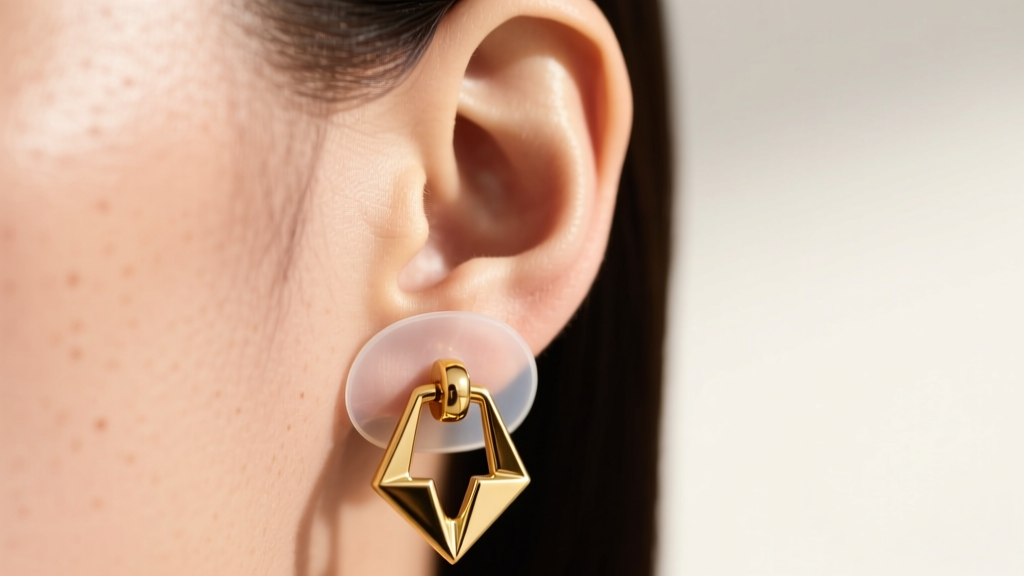
The material of the earring is only half the equation; the hardware that secures it to your body is equally critical. A heavy gold door knocker requires specific engineering to prevent the dreaded "cheese wire effect," where a thin post slowly slices through the earlobe tissue due to constant downward drag.
Post Gauge: Standard earrings use a 20-gauge (0.81mm) post. For a door knocker weighing over 12 grams, an 18-gauge (1.02mm) or even 16-gauge (1.29mm) post is mandatory to distribute the shear force across a wider area of the piercing channel.
Clasp Mechanics: Standard butterfly friction backs are entirely inadequate for heavy drops; the narrow surface area will dig into the neck, and the weight will easily pull the earring off the post. Instead, look for:
- Omega Backs: These feature a wide, curved paddle that snaps securely over the post, distributing the earring's weight across the entire back of the earlobe.
- Leverbacks with a Lock: If the door knocker utilizes a wire hook, it must have a locking latch to prevent the heavy drop from pulling the wire forward and out of the piercing.
- Silicone Stabilizers: Products like BlingWraps or generic silicone support discs adhere to the back of the earlobe, providing a rigid, wide surface area that completely eliminates lobe drooping and tissue migration, regardless of the earring's weight.
Care and Maintenance for Heavy Gold Alloys
Maintaining gold door knockers requires an understanding of their construction. Solid 14k and 18k gold pieces can be safely cleaned in an ultrasonic jewelry cleaner using a mild degreasing solution to remove sebum and hairspray from the hinge barrels. However, never place hollow electroformed gold or gold-plated brass pieces in an ultrasonic cleaner. The high-frequency cavitation bubbles can easily breach the microscopic pores of hollow gold, trapping liquid inside and causing permanent discoloration or structural blistering. For hollow or plated door knockers, use a soft microfiber cloth and a gentle, non-abrasive gold polishing foam, taking care to avoid rubbing the hinge joints where the finish is thinnest.


