Gold Flower Statement Earrings: Technical Craft Guide
Explore the metallurgy, casting techniques, and ergonomic hardware behind gold flower statement earrings in this expert technical guide.

The Physics and Engineering of Botanical Silhouettes
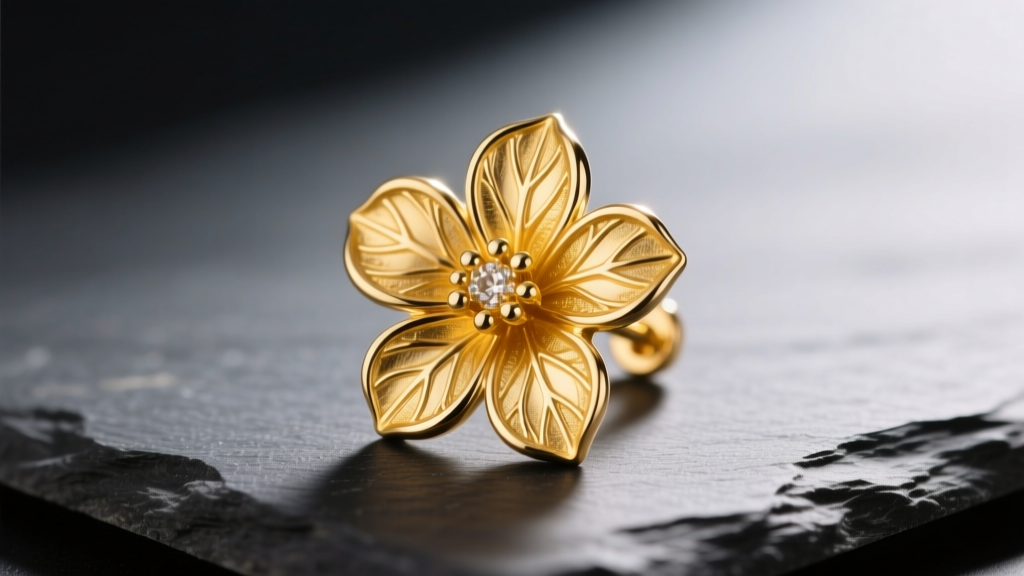
When evaluating gold flower statement earrings, the untrained eye focuses solely on the botanical silhouette and surface polish. However, from a master jeweler’s perspective, a large-scale floral earring is a complex exercise in structural engineering and physics. The primary challenge lies in the paradox of the design: gold is an exceptionally dense metal (19.3 g/cm³ in its pure form), while statement florals—such as sculpted peonies, orchids, or lotus blossoms—require significant volume to achieve their visual impact. If a solid casting method is used for a 40-millimeter wide peony earring, the resulting piece can easily exceed 35 grams per ear, which is well beyond the anatomical threshold of the human earlobe.
To counteract this, expert bench jewelers must manipulate the center of mass. In a poorly engineered floral drop, the weight is concentrated at the distal tips of the petals, creating a high moment of inertia. This lever effect pulls the earring forward, causing the post to tilt and the decorative face to point toward the floor rather than resting flush against the face. By strategically thickening the calyx (the base where the petals meet the post) and tapering the petal edges to sub-millimeter thicknesses, designers shift the center of gravity closer to the earlobe, ensuring the gold flower statement earrings remain upright and visually balanced without requiring constant manual adjustment.
Metallurgy and Karat Selection for Floral Motifs
The choice of gold karat is not merely a matter of color preference or intrinsic value; it fundamentally dictates the structural viability of the floral details. Botanical designs rely on the crispness of petal edges, the depth of stamen textures, and the delicate curvature of leaves. Pure 24-karat gold is far too malleable for these applications, possessing a Vickers Hardness (HV) of roughly 25 to 30. An intricate 24k floral earring would bend, warp, and lose its detail upon the first accidental impact.
Consequently, alloying is mandatory. By introducing copper, silver, zinc, and sometimes palladium, metallurgists alter the crystalline lattice of the gold, increasing its tensile strength and hardness. As of 2026, advanced CAD-driven topology optimization allows jewelers to map stress points in a digital floral model before casting, recommending specific alloy mixes based on the petal thickness. Below is a technical breakdown of how different karats perform in statement floral applications.
| Karat | Gold Purity | Vickers Hardness (HV) | Structural Viability for Florals |
|---|---|---|---|
| 14k | 58.3% | 130 - 160 | Optimal for sharp, paper-thin petal edges and high-impact durability. |
| 18k | 75.0% | 110 - 135 | Excellent balance of rich color and structural integrity for medium-weight blooms. |
| 22k | 91.6% | 60 - 80 | Poor for delicate edges; requires heavy, rounded, sculptural petal forms. |
For collectors seeking the rich, buttery hue of high-karat gold without sacrificing the delicate nature of a rose or daisy motif, some master artisans employ a bi-metal or layered approach, utilizing an 18k or 14k structural core with a 22k gold outer electroplated layer, though this is rare in solid cast pieces. According to the Gemological Institute of America (GIA), understanding the specific alloy composition is critical, as copper-heavy 18k rose gold will naturally exhibit higher hardness than silver-heavy 18k yellow gold, allowing for slightly finer detail retention in the casting process.
Advanced Manufacturing: Lost-Wax vs. Electroforming
To achieve the dramatic scale of gold flower statement earrings without the punishing weight, manufacturers rely on two primary techniques: hollow-form lost-wax casting and electroforming.
Hollow-Form Lost-Wax Casting
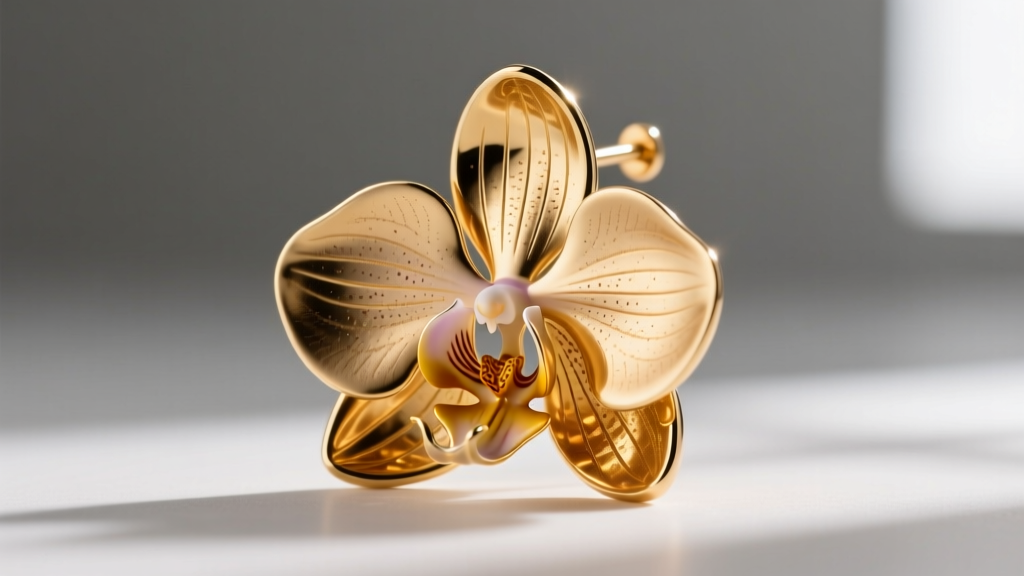
Traditional lost-wax casting yields a solid metal object. To create a hollow floral earring, a specialized silicone core or a dissolvable resin is used inside the wax model. During the burnout phase in the kiln, the core must completely vaporize or melt away without leaving ash residue, which could cause porosity in the final gold pour. In 2026, the integration of AI-assisted CAD resin printing allows for internal lattice structures that maintain the outer volume of a magnolia blossom while reducing the final gold weight by up to 45%. The challenge here is ensuring the outer gold shell is at least 0.8mm thick; anything thinner risks collapsing under the vacuum pressure of the casting machine.
The Electroforming Advantage
For ultra-large, gravity-defying statement pieces, electroforming is the superior technical choice. As detailed by the Ganoksin Jewelry Making Community, electroforming involves depositing gold ions onto a conductive wax or 3D-printed resin mandrel in an electrolyte bath over several days. This builds up a pure gold or high-karat shell that is incredibly thin—often between 0.2mm and 0.4mm. The result is a massive, highly detailed gold flower statement earring that weighs a fraction of its cast counterpart. The internal resin is sometimes left in place to provide structural rigidity, or dissolved via chemical solvents through a microscopic laser-drilled exit hole, which is later sealed with a microscopic gold solder bead.
Ergonomics and Hardware: Preventing Lobe Fatigue
A masterpiece of floral jewelry is rendered useless if it causes physical discomfort or tissue damage. The human earlobe is composed of fibro-fatty tissue with no cartilage, making it highly susceptible to stretching and tearing under sustained kinetic load. Standard earring posts are typically 20-gauge (0.81mm). When a 15-gram floral earring is suspended on a 20-gauge post, the narrow wire acts like a cheese cutter, slowly migrating downward through the piercing channel and causing irreversible lobe elongation.
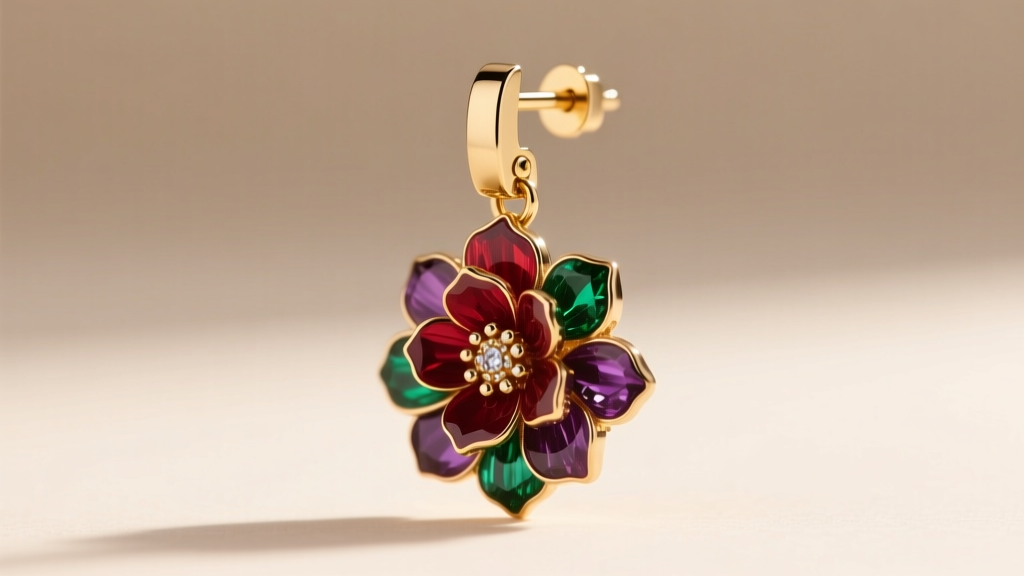
To mitigate this, expert bench jewelers upgrade the hardware on statement florals. The minimum acceptable standard for heavy botanical drops is an 18-gauge (1.02mm) or 16-gauge (1.29mm) post. This wider surface area distributes the downward shear force across a broader section of the piercing tissue. Furthermore, standard friction-back butterflies are entirely inadequate for statement pieces, as the repetitive motion of walking or turning the head will gradually work the clutch loose, leading to catastrophic loss.
- La Pousette Clutches: Utilizing a spring-loaded internal mechanism that locks onto a grooved post, providing a secure, ratcheted fit that cannot be pulled off accidentally.
- Screw-Back Assemblies: The post is threaded, and the backing screws on, requiring intentional rotational force to remove. Ideal for highly valuable, heavy 18k gold florals.
- Omega Clips & French Wires: For non-pierced ears or additional support, an omega clip distributes the weight across the back of the earlobe rather than concentrating it entirely on the piercing hole.
Maintenance, Cleaning, and Structural Failure Points
Owning large-scale botanical jewelry requires an understanding of its specific mechanical vulnerabilities. The most common point of structural failure in gold flower statement earrings is the solder joint connecting the post or drop-loop to the floral body. Because jewelers must use a lower-temperature "easy" or "medium" solder to attach the hardware without melting the intricate petal details (which were cast using a higher-temperature alloy), this joint remains the weakest link. If the earring is dropped face-up on a hard surface, the kinetic energy transfers directly to this solder joint, potentially causing a clean fracture.
The Ultrasonic Hazard
Perhaps the most critical maintenance warning concerns cleaning. While ultrasonic cleaners are standard for solid diamond and gold jewelry, they are exceptionally dangerous for hollow-form or electroformed gold flower statement earrings. The high-frequency cavitation bubbles created in the ultrasonic bath can exert immense localized pressure. If a hollow floral earring has a micro-fissure or an imperfectly sealed resin core, the fluid can become trapped inside. Subsequent temperature changes or further ultrasonic agitation can cause the trapped fluid to expand or vaporize, leading to the literal implosion or bulging of the delicate gold petals. For these pieces, manual cleaning with a soft-bristled brush, mild surfactant, and lukewarm water is the only safe protocol.
"True luxury in statement jewelry is not defined merely by the gram weight of the gold, but by the invisible engineering that allows a heavy metal to mimic the weightless grace of a living flower."
By understanding the metallurgy, casting methodologies, and ergonomic hardware requirements detailed above, collectors and designers can critically evaluate gold flower statement earrings not just as aesthetic accessories, but as triumphs of micro-sculptural engineering.


