Gold Jade Earrings: 2026 Pricing & Value Assessment
Discover the true value of gold jade earrings in 2026. We break down jadeite grades, gold purity, pricing tiers, and how to avoid treated fakes.

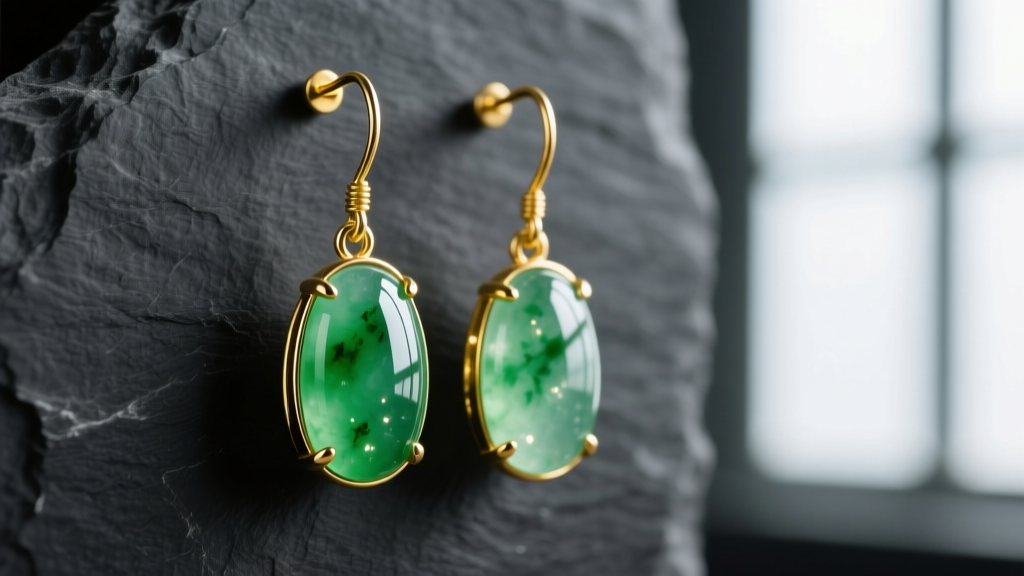
When evaluating gold jade earrings, the disparity between a $50 tourist-trap trinket and a $50,000 investment-grade heirloom is entirely dictated by gemological origin, treatment history, and metallurgical choices. In 2026, the global market for jade has become increasingly complex. Supply chain restrictions from primary mining regions in Myanmar and shifting consumer demands have drastically altered pricing structures. For the discerning buyer, understanding the intersection of gold purity and jade grading is no longer optional—it is a financial necessity. This comprehensive value assessment will equip you with the exact metrics, material grades, and pricing frameworks required to navigate the market without overpaying for structurally compromised or chemically treated stones.
The 2026 Market Landscape for Gold and Jade
The valuation of gold jade earrings hinges on two entirely separate commodities: the precious metal and the silicate mineral. Over the past five years, the price of raw gold has seen steady appreciation, but the true volatility lies in the jade sector. High-quality, untreated Burmese jadeite (specifically 'Imperial' grade) has outperformed many traditional asset classes, driven by extreme scarcity following the tightening of export regulations from the Hpakant mining districts. Conversely, the market has been flooded with mass-produced nephrite and heavily treated jadeite, creating a bifurcated market where visual inspection alone is entirely insufficient for value assessment.
From a budget perspective, buyers must first define their objective. Are you purchasing an everyday ornamental accessory, or are you seeking a store of value? Ornamental pieces prioritize aesthetic symmetry and secure gold settings, while investment pieces demand uncompromising gemological purity, verified by top-tier laboratory certification. According to the Gemological Institute of America (GIA), the sheer volume of treated jade entering the secondary market makes independent verification the single most critical step in the purchasing process.
Gemological Breakdown: Jadeite vs. Nephrite Value
The term 'jade' is a commercial umbrella covering two distinct minerals: jadeite and nephrite. Confusing the two is the most common financial mistake buyers make when shopping for gold jade earrings.
Jadeite (The Premium Standard)
Jadeite is the harder, denser, and more vitreous of the two. It boasts a specific gravity of 3.30 to 3.36 and a refractive index of approximately 1.66. The most prized variety, Imperial Jadeite, features a vivid, semi-transparent emerald-green hue caused by trace amounts of chromium. In 2026, a matched pair of high-domed, 12mm Imperial Jadeite cabochons set in 18k gold will easily command prices between $15,000 and $45,000, depending on the translucency (often referred to as 'water' or 'zhong' in Chinese gemology).
Nephrite (The Budget Alternative)
Nephrite, which includes the famous Hetian jade from China, is a calcium and magnesium-rich amphibole. It is slightly softer (Mohs 6.0-6.5) and less dense (specific gravity 2.90-3.03) than jadeite. Nephrite typically presents in creamy whites, deep spinach greens, and muted yellows. While top-tier 'mutton fat' white nephrite holds significant cultural and historical value, commercial-grade green nephrite set in gold vermeil or 10k gold is widely available in the $75 to $300 range. Nephrite is an excellent choice for budget-conscious buyers seeking durability, as its interlocking fibrous crystal structure makes it incredibly resistant to chipping and shattering.
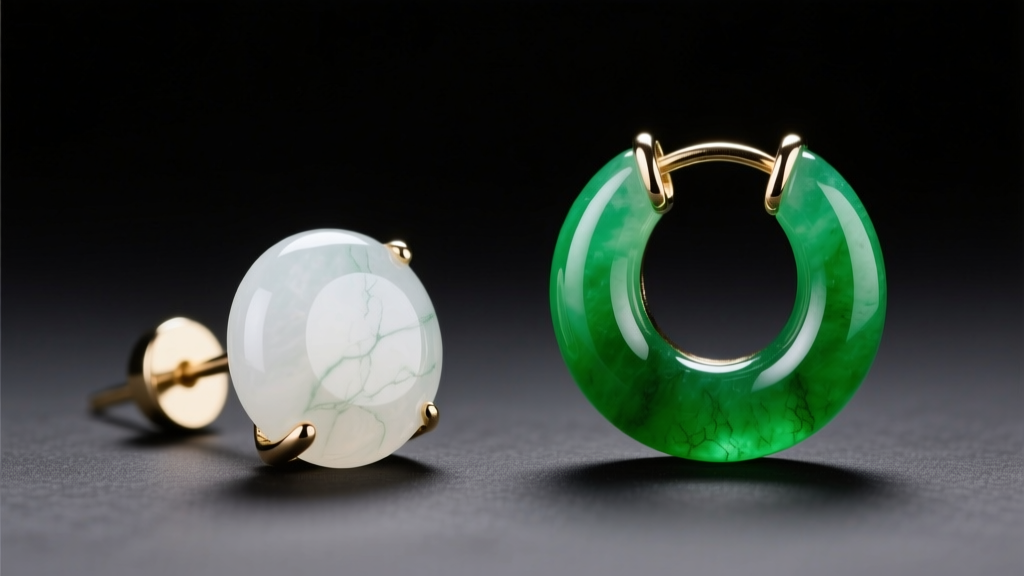
The ABCs of Jade Treatment and Value Destruction
If you take away only one concept from this assessment, let it be the treatment grading scale. The financial value of jadeite is entirely contingent on its structural integrity. The industry classifies jadeite into three distinct categories, and understanding these will save you from catastrophic purchases.
- Type A (Untreated): This is natural jadeite that has been cut, shaped, and polished using only traditional plum-wax surface polishing. Type A jade is the only category that retains or appreciates in value. It is structurally stable and safe for multi-generational wear.
- Type B (Bleached and Polymer-Impregnated): Lower-quality, stained jadeite is soaked in harsh hydrochloric acid to dissolve brown and yellow impurities. This process destroys the stone's internal crystalline matrix, leaving it porous and brittle. It is then injected with epoxy resins to restore translucency. Value Assessment: Type B jade has virtually zero resale value. Furthermore, the polymer resins degrade under UV light and heat, causing the earrings to yellow, cloud, and eventually crack within 5 to 10 years.
- Type C (Dyed): The stone is artificially colored using chemical dyes, often combined with polymer injection (B+C). The color will fade rapidly when exposed to sunlight and cosmetics. These are purely costume jewelry and should be priced accordingly (under $50).
Gold Purity: Matching Karats to Jade Weight
The gold setting is not merely decorative; it is the structural suspension system for a surprisingly heavy stone. Jadeite's high specific gravity means that a pair of 15mm drop earrings can exert significant dynamic stress on the ear wire and prongs as the wearer moves.
24k Gold (99.9% Pure): While culturally significant in many Asian markets, pure gold is far too soft (Mohs 2.5) for secure prong settings. If you are buying heavy jade drops or dangles, 24k gold settings pose a severe failure risk. The prongs will bend, and the ear wires will warp, leading to stone loss.
18k Gold (75% Pure): The industry standard for fine jewelry. Alloyed with copper, silver, or zinc, 18k gold offers the ideal balance of rich color, hypoallergenic properties, and tensile strength. It is the mandatory choice for securing high-value Type A jadeite cabochons.
14k Gold (58.5% Pure): Highly durable and more affordable. 14k gold is excellent for everyday hoop or huggie earrings featuring smaller, carved nephrite or commercial jadeite elements. It resists scratching and deformation far better than higher karats.
2026 Price Matrix: What You Should Actually Pay
To provide actionable budget guidance, we have synthesized current market data into a comprehensive pricing matrix. This table reflects retail expectations for a standard pair of earrings (e.g., 10mm cabochon studs or moderate drop designs) from reputable jewelers in 2026.
| Jade Type & Grade | Gold Setting | Estimated Price Range (USD) | Value Retention & Investment Potential |
|---|---|---|---|
| Type C (Dyed) or Serpentine | Gold Vermeil / Plated | $25 - $80 | Zero. Costume jewelry only. |
| Commercial Nephrite (Spinach Green) | 10k or 14k Solid Gold | $120 - $350 | Low. Retains intrinsic gold melt value. |
| Type B (Polymer Treated) Jadeite | 14k or 18k Solid Gold | $150 - $600 | Negative. Degrades over time; unsellable. |
| Fine Nephrite (Mutton Fat White) | 18k Solid Gold | $800 - $2,500 | Moderate. Culturally prized, stable market. |
| Type A Commercial Jadeite (Icy/Apple) | 18k Solid Gold | $1,500 - $6,000 | High. Excellent wearable store of value. |
| Type A Imperial Jadeite (Vivid Green) | 18k or 22k Artisan Gold | $15,000 - $60,000+ | Exceptional. Museum-grade investment asset. |
Red Flags: Avoiding Treated and Fake Jade
When assessing gold jade earrings in person or online, rely on empirical data rather than seller guarantees. The American Gem Society consistently warns consumers about the proliferation of sophisticated simulants like dyed quartzite, aventurine, and chrysoprase being passed off as jadeite.
The Temperature Test: Real jade (both nephrite and jadeite) has high thermal inertia. It should feel distinctly cold to the touch and take several seconds to warm up against your skin. Glass and plastic simulants warm up almost instantly.
The Acoustic Test: For bangles, the 'ping' test is famous, but it applies loosely to loose cabochons before setting. Type A jadeite produces a crisp, resonant, high-pitched chime when gently tapped. Type B jade, due to its polymer-filled internal fractures, produces a dull, muted thud.
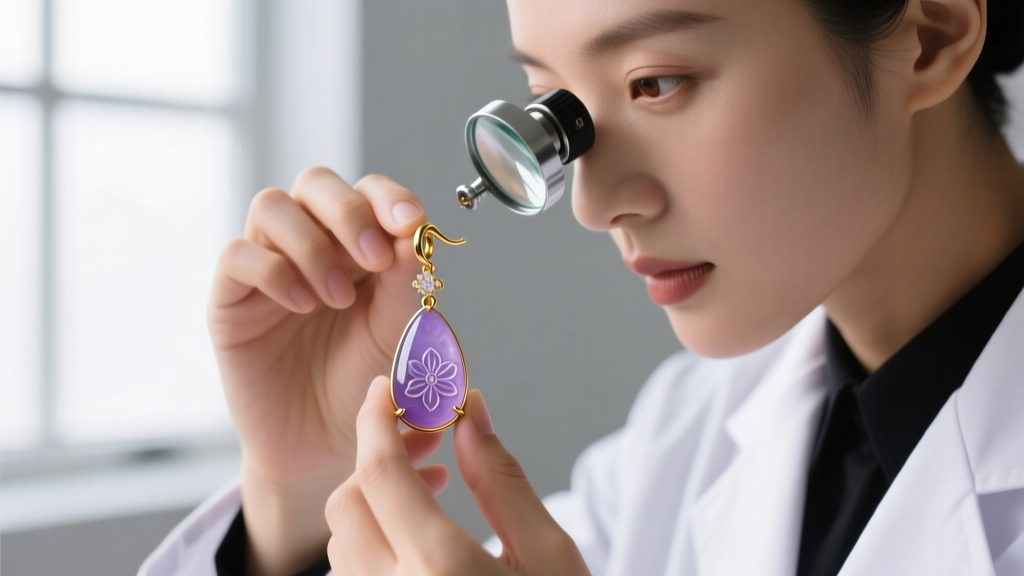
Magnification Inspection: Using a 10x jeweler's loupe, examine the surface of the jade. Type A jade will show natural, irregular interlocking grain structures and minor mineral inclusions. Type B jade often exhibits a 'spiderweb' or 'acid-etched' surface texture where the polymer resin has shrunk slightly below the polished surface of the harder jade crystals.
Authentication and Certification Protocols
In 2026, purchasing high-value gold jade earrings without a laboratory report is financial negligence. Do not accept generic 'Certificates of Authenticity' printed by the retail store. You must demand reports from internationally recognized, independent gemological laboratories.
For jadeite, the gold standard is a report from the GIA or the National Gemstone Testing Center (NGTC) in China, which utilizes advanced Fourier Transform Infrared (FTIR) Spectroscopy. FTIR spectroscopy is the only definitive method to detect the specific polymer resins used in Type B treatments by measuring the absorption of infrared light by organic compounds within the stone. If a seller cannot or will not provide an FTIR-backed certificate for a piece priced over $1,000, walk away immediately.
Investment vs. Ornament: Final Value Verdict
The true value of gold jade earrings is not a single number, but a ratio of gemological integrity to structural security. For budget buyers spending under $300, prioritize solid 14k gold settings and natural, untreated nephrite over suspiciously vibrant, cheap 'jadeite' that is almost certainly dyed or polymer-impregnated. For mid-tier budgets ($1,000 - $5,000), focus on Type A jadeite with high translucency ('icy' varieties) set in secure 18k gold bezels or heavy prongs. Finally, for investment-grade buyers, the capital must be allocated almost entirely to the stone itself—specifically, untreated, chromium-rich Imperial Jadeite verified by FTIR spectroscopy, serving as a wearable, tangible asset that continues to defy broader market inflation.


