Gold Oval Hoop Earrings: Metallurgy, Mechanics, and Fit Guide
An expert technical deep dive into gold oval hoop earrings, covering alloy grades, clasp mechanics, gauge tolerances, and structural ergonomics.

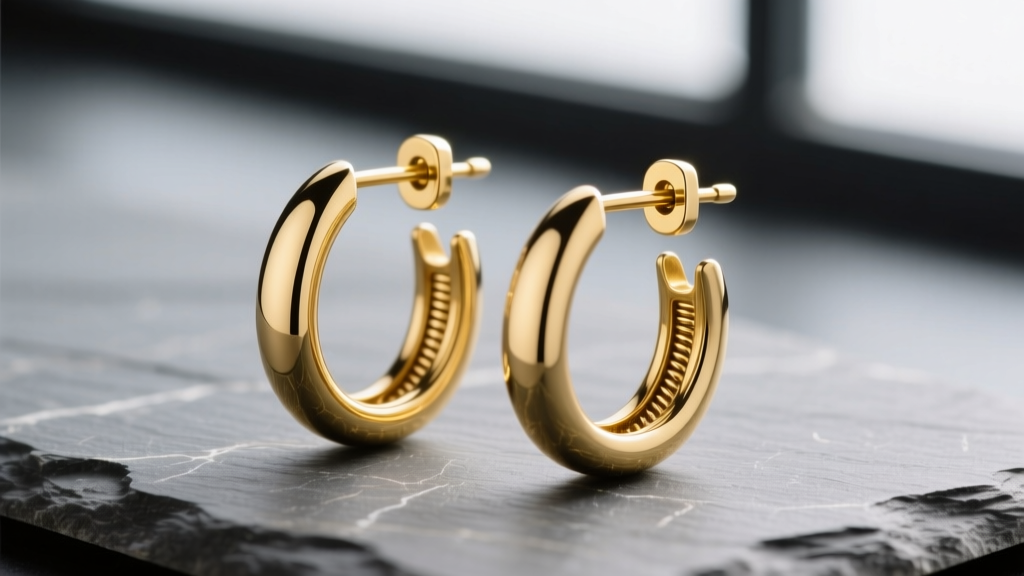
The Geometry of the Oval: Axis Ratios and Visual Mechanics
When analyzing gold oval hoop earrings from an engineering perspective, the first point of divergence from traditional circular hoops is the major-to-minor axis ratio. A standard circular hoop maintains a 1:1 ratio, distributing gravitational pull evenly across the earlobe's piercing axis. Oval hoops, however, typically operate on a 1.3:1 to 1.5:1 ratio (e.g., 25mm wide by 35mm tall). This elongation fundamentally shifts the center of gravity downward, creating a pendulum effect that alters how the earring interacts with the earlobe during kinetic movement.
From a stylistic and anatomical standpoint, this elongated geometry is highly deliberate. The vertical axis draws the eye downward, effectively elongating the jawline and neck. However, this same geometry introduces lateral shear stress on the piercing hole when the wearer turns their head quickly. To mitigate this, master jewelers must carefully calibrate the overall weight of the oval hoop, ensuring it remains under the 4.5-gram threshold for standard 20-gauge or 18-gauge lobe piercings to prevent gradual tissue stretching over time.
Metallurgical Breakdown: 14k vs. 18k Gold Alloys
Pure 24k gold is entirely unsuitable for hoop earrings due to its extreme malleability and low yield strength. To create durable gold oval hoop earrings, metallurgists alloy pure gold with copper, silver, zinc, and occasionally palladium. The choice between 14k and 18k gold is not merely a matter of color or prestige; it dictates the structural integrity of the hoop.
| Alloy Grade | Pure Gold Content | Primary Alloying Metals | Vickers Hardness (HV) | Tensile Strength (MPa) | Best Application |
|---|---|---|---|---|---|
| 14k Yellow Gold | 58.5% | Copper (31%), Silver (10.5%) | 135 - 150 HV | 450 - 550 MPa | Large diameter hoops, thin-wall tubing, high-stress clasps |
| 18k Yellow Gold | 75.0% | Copper (12.5%), Silver (12.5%) | 115 - 125 HV | 300 - 380 MPa | Small to medium huggies, solid wire hoops, luxury segments |
| 18k White Gold | 75.0% | Palladium (15%), Silver (10%) | 120 - 135 HV | 350 - 420 MPa | Diamond-set oval hoops, rhodium-plated finishes |
The Vickers Hardness Factor
As documented by the World Gold Council, the Vickers hardness (HV) of the alloy directly correlates to its resistance against scratching and deformation. 14k gold, with its higher copper content, achieves a higher HV, making it the superior technical choice for large-diameter oval hoops that are prone to being crushed or bent when taken off or stored improperly. Conversely, 18k gold offers a richer hue and better hypoallergenic properties but requires thicker gauge wire to maintain the same structural rigidity.
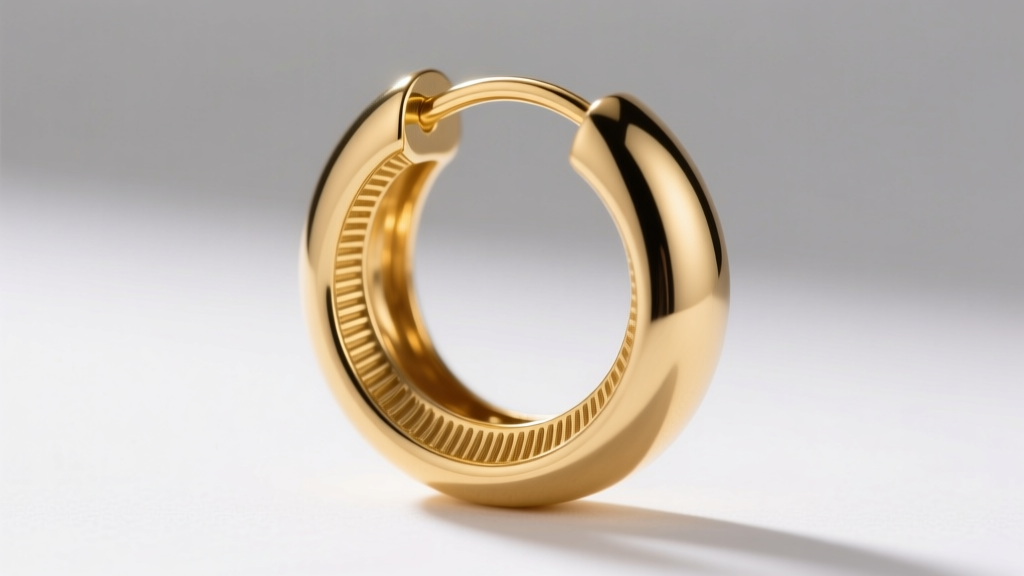
Tubing vs. Solid Wire: Structural Integrity and Kink Fatigue
The manufacturing method of the hoop's body drastically affects its longevity. Gold oval hoop earrings are primarily constructed using either solid wire or drawn hollow tubing. Solid wire hoops are incredibly durable but become prohibitively heavy and expensive at larger dimensions. Therefore, 80% of the market relies on hollow tubing.
Hollow tubing is created through a process called mandrel drawing, where a gold alloy tube is pulled through a series of progressively smaller dies over a steel core. The critical metric here is the wall thickness. For 18k gold oval hoops, a wall thickness of less than 0.35mm will inevitably lead to 'kink fatigue'—a failure mode where the metal folds in on itself like a crushed straw when subjected to lateral pressure. Premium manufacturers maintain a strict 0.45mm to 0.60mm wall thickness, often incorporating internal structural ribbing or leaving a polymer core inside the tubing to resist crushing without adding significant metallic weight.
Clasp Mechanics and Asymmetric Torque Failure Modes
The clasp is the most common point of failure in any hoop earring, but oval designs introduce unique mechanical challenges. Because the mass of an oval hoop is distributed further from the pivot point (the earlobe), it generates higher rotational torque when snagged. According to jewelry manufacturing standards outlined by the Gemological Institute of America (GIA), clasp tolerances must be exact to prevent accidental opening.
- Hinged Saddle (Click-Top) Clasp: The industry standard for modern oval hoops. It features a hidden hinge pin (typically 0.8mm in diameter) and a snap-fit catch. Failure occurs if the catch lip wears down below 0.2mm, causing the clasp to pop open under the oval's pendulum torque.
- Latchback Clasp: Utilizes a hinged post that clicks into a hollow saddle. While secure, the exposed post is vulnerable to bending if the earring is dropped on a hard surface.
- Continuous (Endless) Hoop: A thin wire that feeds into a hollow tube. Highly discouraged for oval shapes, as the asymmetric weight distribution frequently causes the wire to slip out of the tube during wear.
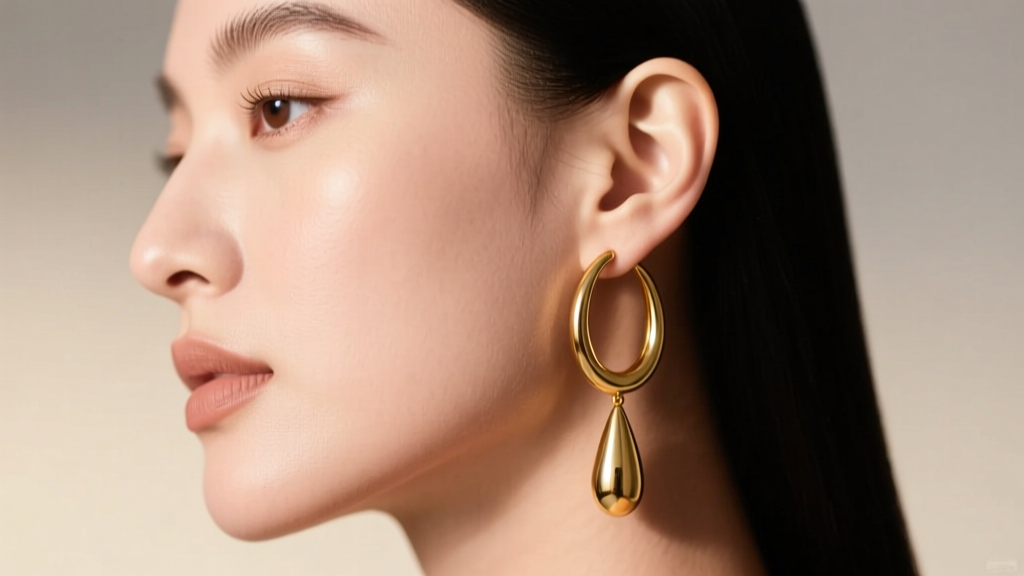
Gauge Thickness and Ergonomic Weight Distribution
The gauge (thickness) of the wire or tubing that passes through the earlobe must be carefully matched to the hoop's overall dimensions. Standard ear piercings are done at 20G (0.81mm) or 18G (1.02mm). However, manufacturing a large 40mm oval hoop with a 20G post creates a severe structural bottleneck. The thin post will act as a fulcrum, bending under the weight of the elongated oval body.
Expert jewelers employ a technique called 'stepping' or 'tapering.' The main body of the oval hoop might be a robust 14G (1.6mm) or 12G (2.0mm) to maintain the geometric plane and prevent the 'taco effect' (where the hoop twists out of its oval shape). The post that actually passes through the ear is then tapered down to a standard 18G (1.02mm) or 16G (1.29mm) to ensure comfort and compatibility with healed piercings. This ergonomic weight distribution ensures the earring sits flush against the lobe without dragging the tissue downward.
CAD/CAM Precision in 2026 Manufacturing
The landscape of jewelry manufacturing has evolved significantly. In 2026, the integration of advanced CAD/CAM (Computer-Aided Design and Computer-Aided Manufacturing) and micro-laser welding has revolutionized the production of gold oval hoop earrings. Historically, hinge pins were soldered using traditional torches, which often resulted in heat-induced warping of the delicate hinge knuckles. Today, micro-laser welding allows for pinpoint heat application, fusing the hinge components without altering the temper or hardness of the surrounding gold alloy.
Furthermore, 5-axis CNC milling of the master resin molds ensures that the major and minor axes of the oval are mathematically perfect, eliminating the slight asymmetries that were common in hand-carved wax models. This precision translates to a perfectly balanced earring that hangs exactly plumb, optimizing the visual elongation effect on the wearer's face.
Ultrasonic Cleaning and Maintenance Protocols
Maintaining the high-polish finish and structural integrity of gold oval hoops requires specific cleaning protocols. Because many oval hoops utilize hollow tubing, submerging them in liquid cleaners can trap moisture inside the cavity, leading to internal oxidation of the alloying metals (particularly the copper in 14k gold), which can cause a greenish discharge from the hinge seams.
For routine maintenance, utilize an ultrasonic cleaner operating at a 40kHz frequency with a mild, non-ammoniated surfactant. Limit the cleaning cycle to exactly 90 seconds. Prolonged ultrasonic cavitation can loosen the microscopic tension fit of the click-top clasp catch. After cleaning, immediately blow out the hinge mechanism and hollow cavities with compressed air to ensure no residual moisture remains. Avoid harsh cyanide-based polishing compounds, which can strip the microscopic surface layer of the gold alloy and accelerate wear on the clasp's catch lip.


